Thank you for visiting SNEWPapers!
Sign up free
The Virginia Gazette
Richmond, Williamsburg, Richmond County, Virginia
What is this article about?
A letter to the Pennsylvania Gazette critiquing a pamphlet that attacks the English constitution, monarchy, and urges colonial independence. The author defends the British government using biblical, historical, and philosophical arguments, highlighting flaws in republics and advocating for reconciliation over premature separation.
Merged-components note: Continuation of the letter critiquing the republican pamphlet across pages; retained letter_to_editor label as it matches the originating content, correcting the editorial label on the second part.
Clippings
1 of 2
OCR Quality
Full Text
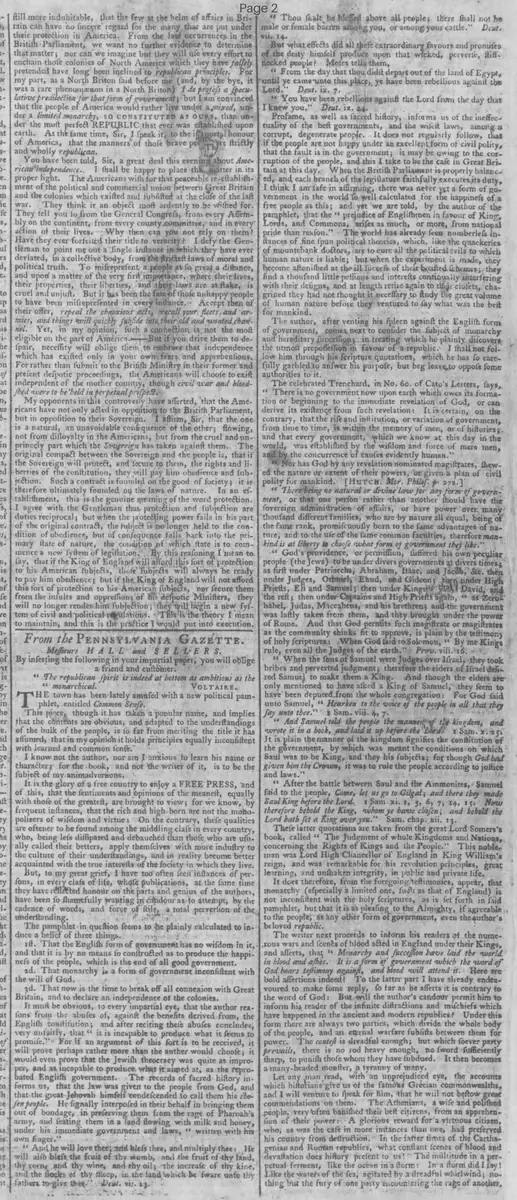
Messieurs HALL and SELLERS.
By inserting the following in your impartial paper, you will oblige a friend and customer.
"The republican spirit is indeed at bottom as ambitious as the monarchical.
This piece, though it has taken a popular name, and implies that the contents are obvious, and adapted to the understandings of the bulk of the people, is so far from meriting the title it has assumed, that in my opinion it holds principles equally inconsistent with learned and common sense.
I know not the author, nor am I anxious to learn his name or character; for the book, and not the writer of it, is to be the subject of my animadversions.
It is the glory of a free country to enjoy a FREE PRESS, and of this, that the sentiments and opinions of the meanest, equally with those of the greatest, are brought to view; for we know, by frequent instances, that the rich and high-born are not the monopolizers of wisdom and virtue: On the contrary, these qualities are oftener to be found among the middling class in every country, who, being less dissipated and debauched than those who are usually called their betters, apply themselves with more industry to the culture of their understandings, and in reality become better acquainted with the true interests of the society in which they live.
But, to my great grief, I have too often seen instances of persons, in every class of life, whose publications, at the same time they have reflected honour on the parts and genius of the authors, have been so shamefully wanting in candour as to attempt, by the cadence of words, and force of style, a total perversion of the understanding.
The pamphlet in question seems to be plainly calculated to induce a belief of three things.
1st. That the English form of government has no wisdom in it, and that it is by no means so constructed as to produce the happiness of the people, which is the end of all good government.
2d. That monarchy is a form of government inconsistent with the will of God.
3d. That now is the time to break off all connexion with Great Britain, and to declare an independence of the colonies.
It must be obvious, to every impartial eye, that the author reasons from the abuses of, against the benefits derived from, the English constitution; and after reciting these abuses concludes, very unfairly, that "it is incapable to produce what it seems to promise." For if an argument of this sort is to be received, it will prove perhaps rather more than the author would choose; it would even prove that the Jewish theocracy was quite as improper, and as incapable to produce what it aimed at, as the reprobated English government. The records of sacred history informs us, that the law was given to the people from God, and that the great Jehovah himself condescended to call them his chosen people. He signally interposed in their behalf in bringing them out of bondage, in preserving them from the rage of Pharaoh's army, and seating them in a land flowing with milk and honey, under his immediate government and laws, "written with his own finger."
"And he will love thee, and bless thee, and multiply thee: He will also bless the fruit of thy womb, and the fruit of thy land, thy corn, and thy wine, and thy oil; the increase of thy kine, and the flocks of thy sheep, in the land which he sware unto thy fathers to give thee." Deut. vii. 13.
"Thou shalt be blessed above all people; there shall not be male or female barren among you, or among your cattle." Deut. vii. 14.
But what effects did all these extraordinary favours and promises of the deity himself produce upon that wicked, perverse, stiff-necked people? Moses tells them,
"From the day that thou didst depart out of the land of Egypt, until ye came unto this place, ye have been rebellious against the Lord." Deut. ix. 7.
"Ye have been rebellious against the Lord from the day that I knew you." Deut. ix. 24.
Profane, as well as sacred history, informs us of the ineffectuality of the best governments, and the wisest laws, among a corrupt, degenerate people. It does not regularly follow, that if the people are not happy under an excellent form of civil polity, that the fault is in the government; it may be owing to the corruption of the people, and this I take to be the case in Great Britain at this day. When the British Parliament is properly balanced, and each branch of the legislature faithfully executes its duty, I think I am safe in affirming, there was never yet a form of government in the world so well calculated for the happiness of a free people as this; and yet we are told, by the author of the pamphlet, that the "prejudice of Englishmen in favour of King, Lords, and Commons, arises as much, or more, from national pride than reason." The world has already seen numberless instances of fine spun political theories, which, like the quackeries of mountebank doctors, are to cure all the political evils to which human nature is liable; but when the experiment is made, they become astonished at the ill success of their boasted schemes; they find a thousand little passions and interests continually interfering with their designs, and at length retire again to their closets, chagrined they had not thought it necessary to study the great volume of human nature before they ventured to say what was the best for mankind.
The author, after venting his spleen against the English form of government, comes next to consider the subject of monarchy and hereditary succession; in treating which he plainly discovers the utmost prepossession in favour of a republic. I shall not follow him through his scripture quotations, which he has so carefully garbled to answer his purpose, but beg leave to oppose some authorities to it.
The celebrated Trenchard, in No. 60. of Cato's Letters, says,
"There is no government now upon earth which owes its formation or beginning to the immediate revelation of God, or can derive its existence from such revelation: It is certain, on the contrary, that the rise and institution, or variation of government, from time to time, is within the memory of men, or of histories; and that every government, which we know at this day in the world, was established by the wisdom and force of mere men, and by the concurrence of causes evidently human."
"Nor has God by any revelation nominated magistrates, shewed the nature or extent of their powers, or given a plan of civil polity for mankind. [HUTCH. Mor. Philo. p. 272.]"
"There being no natural or divine law for any form of government, or that one person rather than another should have the sovereign administration of affairs, or have power over many thousand different families, who are by nature all equal, being of the same rank, promiscuously born to the same advantages of nature, and to the use of the same common faculties, therefore mankind is at liberty to choose what form of government they like."
"God's providence, or permission, suffered his own peculiar people (the Jews) to be under divers governments at divers times; as first under Patriarchs, Abraham, Isaac, and Jacob, &c, then under Judges, Othniel, Ehud, and Gideon; then under High Priests, Eli and Samuel; then under Kings, Saul, I David, and the rest; then under Captains and High Priests again, as Zerobabel, Judas, Maccabeus, and his brethren; and the government was lastly taken from them, and they brought under the power of Rome. And that God permits such magistrate or magistrates as the community thinks fit to approve, is plain by the testimony of holy scriptures: When God said to Solomon, "By me Kings rule, even all the Judges of the earth." Prov. viii. 16.
"When the sons of Samuel were Judges over Israel, they took bribes and perverted judgment; therefore the elders of Israel desired Samuel to make them a King. And though the elders are only mentioned to have asked a King of Samuel, they seem to have been deputed from the whole congregation: For God said unto Samuel, "Hearken to the voice of the people in all that they say unto thee." 1 Sam. viii. 4, 7.
"And Samuel told the people the manner of the kingdom, and wrote it in a book, and laid it up before the Lord." 1 Sam. x. 25.
It is plain the manner of the kingdom signifies the constitution of the government, by which was meant the conditions on which Saul was to be King, and they his subjects; for though God had given him the Crown, it was to rule the people according to justice and laws."
"After the battle between Saul and the Ammonites, Samuel said to the people, Come, let us go to Gilgal; and there they made Saul King before the Lord. 1 Sam xi. 14, 15. Now therefore behold the King, whom ye have chosen; and behold the Lord hath set a King over you." 1 Sam. chap. xii. 13.
These latter quotations are taken from the great Lord Somers's book, called "The Judgment of Whole Kingdoms and Nations, concerning the Rights of Kings and the People." This nobleman was Lord High Chancellor of England in King William's reign, and was remarkable for his revolution principles, great learning, and unshaken integrity, in public and private life.
It does therefore, from the foregoing testimonies, appear, that monarchy (especially a limited one, such as that of England) is not inconsistent with the holy scriptures, as is set forth in said pamphlet, but that it is as pleasing to the Almighty, if agreeable to the people; as any other form of government, even the author's beloved republic.
The writer next proceeds to inform his readers of the numerous wars and scenes of blood acted in England under their Kings, and asserts, that "Monarchy and succession have laid the world in blood and ashes. It is a form of government which the word of God bears testimony against, and blood will attend it." Here are bold assertions indeed! To the latter part I have already endeavoured to make some reply, so far as he asserts it is contrary to the word of God: But will the author's candour permit him to inform his reader of the infinite distractions and mischiefs which have happened in the ancient and modern republics? Under this form there are always two parties, which divide the whole body of the people, and an eternal warfare subsists between them for power. The contest is dreadful enough; but whichever party prevails, there is no rod heavy enough, no word sufficiently sharp, to punish those whom they have subdued. It then becomes a many-headed monster, a tyranny of many.
Let any man read, with an unprejudiced eye, the accounts which historians give us of the famous Grecian commonwealths, and I will venture to speak for him, that he will not bestow great commendations on them. The Athenians, a wise and polished people, very often banished their best citizens, from an apprehension of their power: A glorious reward for a virtuous citizen, who, as was the case in more instances than one, had preserved his country from destruction. — In the latter times of the Carthaginian and Roman republics, what constant scenes of blood and devastation does history present to us! The multitude in a perpetual ferment, like the ocean in a storm: In a storm did I say! Like the waters of the sea, agitated by a dreadful whirlwind; nothing but the fury of one party encountering the rage of another,
Every face of humanity being thus lost, men change their natures, and become as fierce and savage as wolves and tigers.
But let us descend nearer to modern times. Let us look for happiness and security in the republic of Holland, so often mentioned, and so little known. Let us recollect the fate of the two brothers Cornelius and John de Witt were massacred by the people in the year 1672: Holland itself, from being a republic, is become a downright aristocracy. Liberty did not continue long in that country notwithstanding the blood and treasure that were expended to acquire it. The people, so far from being free, have had no voice for many years past in the election of persons to represent them in the States General; nor have they any thing to do in the forming of laws by which they are to be governed. Whenever one of them dies, the vacancy is filled up without any interference of the people; and this important change was made in the state, because of the intolerable feuds and animosities which attended the elections of representatives. Had they been to have chosen a King, what dangerous and destructive tumults must it have produced. Founded on the woful experience of ages, it is now become a general fixed opinion, that hereditary is preferable to elective monarchy, on account of the terrible disorders, outrages, and confusions, which usually attend the election of a King; a pregnant instance of which, in our times, is the kingdom of Poland.
In our own history, we see what was the effect of the much wished for commonwealth after the death of the tyrant Charles: It did not produce liberty; it presently ended in arbitrary power. The moment almost after the reins of government fell from Charles's hands, Cromwell took them up, and governed the nation with absolute sway.
I cannot agree with the author of the pamphlet in opinion, that this is the time to declare an independence of the colonies. This ought to be the dernier resort of America. Let us not yet lose sight of the primary object of the dispute, namely, a safe, honourable, and lasting reconciliation with Great Britain, until we are under a necessity of doing it. If an advantageous accommodation can be had, and a free constitution for this country be established on mutual agreement and compact, it will be better and happier for us. But if justice is still denied us, and we are to contend for liberty by arms, we will meet them in the field, and try our manhood against them, even to spilling the blood of every brave man we have. Should the Ministry have recourse to foreign aid, we may possibly follow their example; and, if it be essential then to our safety to declare an independence, I would willingly embrace the necessity.
RATIONALIS.
What sub-type of article is it?
What themes does it cover?
What keywords are associated?
What entities or persons were involved?
Letter to Editor Details
Author
Rationalis
Recipient
Messieurs Hall And Sellers
Main Argument
the letter defends the english constitution and limited monarchy against a pamphlet's attacks, using biblical and historical evidence to refute claims of divine opposition and highlight republican flaws, while urging caution on declaring colonial independence in favor of reconciliation with britain.
Notable Details