Thank you for visiting SNEWPapers!
Sign up free
Editorial
April 6, 1862
Sunday Dispatch
New York, New York County, New York
What is this article about?
Editorial critiques hypocrisy ('cant') in calls for amnesty after the Civil War, argues for emancipation of slaves as feasible and just, contrasts with treatment of Indians, and warns against undermining the perpetual Union.
Clipping
OCR Quality
98%
Excellent
Full Text
CANT AND CAN'T
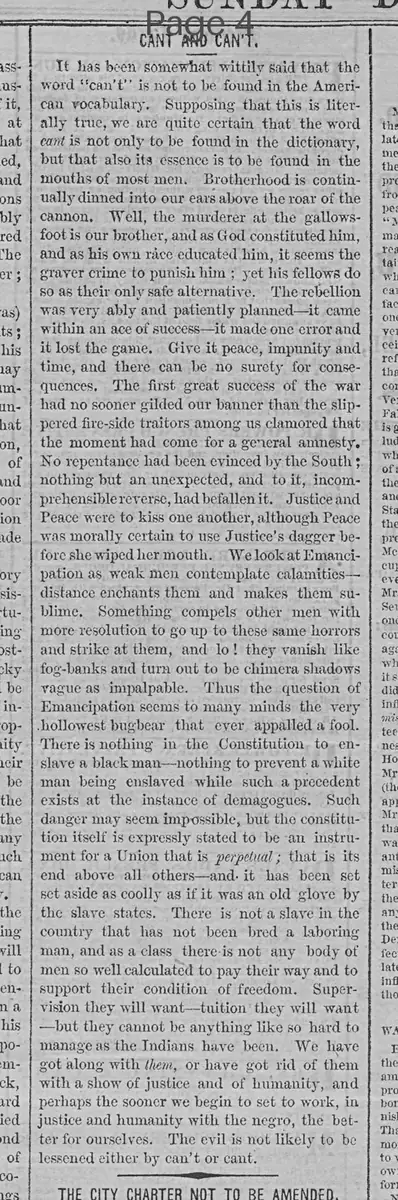
It has been somewhat wittily said that the word "can't" is not to be found in the American vocabulary. Supposing that this is literally true, we are quite certain that the word cant is not only to be found in the dictionary, but that also its essence is to be found in the mouths of most men. Brotherhood is continually dinned into our ears above the roar of the cannon. Well, the murderer at the gallows-foot is our brother, and as God constituted him, and as his own race educated him, it seems the graver crime to punish him; yet his fellows do so as their only safe alternative. The rebellion was very ably and patiently planned—it came within an ace of success—it made one error and it lost the game. Give it peace, impunity and time, and there can be no surety for consequences. The first great success of the war had no sooner gilded our banner than the slippered fire-side traitors among us clamored that the moment had come for a general amnesty. No repentance had been evinced by the South; nothing but an unexpected, and to it, incomprehensible reverse, had befallen it. Justice and Peace were to kiss one another, although Peace was morally certain to use Justice's dagger before she wiped her mouth. We look at Emancipation as weak men contemplate calamities—distance enchants them and makes them sublime. Something compels other men with more resolution to go up to these same horrors and strike at them, and lo! they vanish like fog-banks and turn out to be chimera shadows vague as impalpable. Thus the question of Emancipation seems to many minds the very hollowest bugbear that ever appalled a fool. There is nothing in the Constitution to enslave a black man—nothing to prevent a white man being enslaved while such a precedent exists at the instance of demagogues. Such danger may seem impossible, but the constitution itself is expressly stated to be an instrument for a Union that is perpetual; that is its end above all others—and it has been set aside as coolly as if it was an old glove by the slave states. There is not a slave in the country that has not been bred a laboring man, and as a class there is not any body of men so well calculated to pay their way and to support their condition of freedom. Super-vision they will want—tuition they will want—but they cannot be anything like so hard to manage as the Indians have been. We have got along with them, or have got rid of them with a show of justice and of humanity, and perhaps the sooner we begin to set to work, in justice and humanity with the negro, the better for ourselves. The evil is not likely to be lessened either by can't or cant.
It has been somewhat wittily said that the word "can't" is not to be found in the American vocabulary. Supposing that this is literally true, we are quite certain that the word cant is not only to be found in the dictionary, but that also its essence is to be found in the mouths of most men. Brotherhood is continually dinned into our ears above the roar of the cannon. Well, the murderer at the gallows-foot is our brother, and as God constituted him, and as his own race educated him, it seems the graver crime to punish him; yet his fellows do so as their only safe alternative. The rebellion was very ably and patiently planned—it came within an ace of success—it made one error and it lost the game. Give it peace, impunity and time, and there can be no surety for consequences. The first great success of the war had no sooner gilded our banner than the slippered fire-side traitors among us clamored that the moment had come for a general amnesty. No repentance had been evinced by the South; nothing but an unexpected, and to it, incomprehensible reverse, had befallen it. Justice and Peace were to kiss one another, although Peace was morally certain to use Justice's dagger before she wiped her mouth. We look at Emancipation as weak men contemplate calamities—distance enchants them and makes them sublime. Something compels other men with more resolution to go up to these same horrors and strike at them, and lo! they vanish like fog-banks and turn out to be chimera shadows vague as impalpable. Thus the question of Emancipation seems to many minds the very hollowest bugbear that ever appalled a fool. There is nothing in the Constitution to enslave a black man—nothing to prevent a white man being enslaved while such a precedent exists at the instance of demagogues. Such danger may seem impossible, but the constitution itself is expressly stated to be an instrument for a Union that is perpetual; that is its end above all others—and it has been set aside as coolly as if it was an old glove by the slave states. There is not a slave in the country that has not been bred a laboring man, and as a class there is not any body of men so well calculated to pay their way and to support their condition of freedom. Super-vision they will want—tuition they will want—but they cannot be anything like so hard to manage as the Indians have been. We have got along with them, or have got rid of them with a show of justice and of humanity, and perhaps the sooner we begin to set to work, in justice and humanity with the negro, the better for ourselves. The evil is not likely to be lessened either by can't or cant.
What sub-type of article is it?
Slavery Abolition
War Or Peace
Moral Or Religious
What keywords are associated?
Emancipation
Amnesty
Civil War Rebellion
Constitution
Hypocrisy
Cant
Brotherhood
Negro Freedom
What entities or persons were involved?
The South
Slave States
Negro
Indians
Editorial Details
Primary Topic
Support For Emancipation And Critique Of Post War Amnesty
Stance / Tone
Critical Of Hypocrisy And Supportive Of Resolute Emancipation
Key Figures
The South
Slave States
Negro
Indians
Key Arguments
Brotherhood Does Not Preclude Necessary Punishment Of Criminals Or Rebels.
Premature Amnesty Rewards Rebellion Without Repentance.
Emancipation Is Not A Constitutional Barrier But A Resolution Of Slavery's Precedent.
Freed Slaves Are Capable Of Self Support With Guidance, Unlike Indians.
The Perpetual Union Must Be Upheld Against Slave States' Actions.