Thank you for visiting SNEWPapers!
Sign up free
Editorial
February 15, 1923
The Moorefield Examiner
Moorefield, Hardy County, West Virginia
What is this article about?
The editorial critiques the modern tendency to indiscriminately abuse and criticize public officials, which discourages qualified individuals from entering public service. It advocates for fact-based criticism, praise for good work, and balanced public discourse to attract better leaders.
Clipping
OCR Quality
98%
Excellent
Full Text
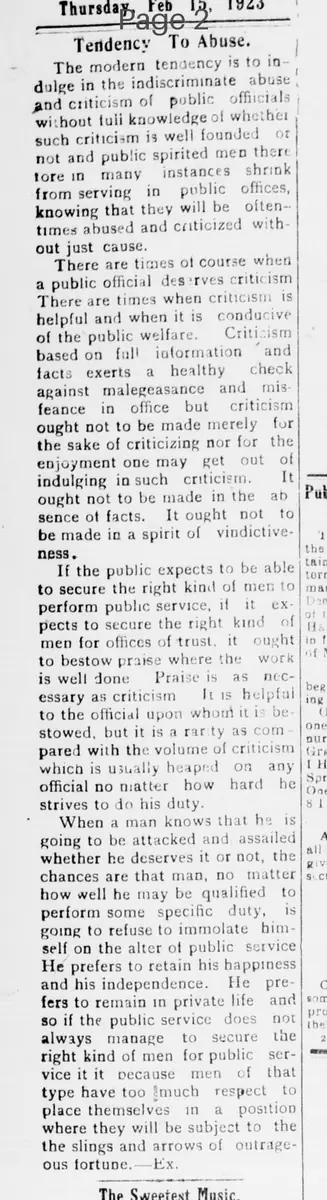
Tendency To Abuse.
The modern tendency is to indulge in the indiscriminate abuse and criticism of public officials without full knowledge of whether such criticism is well founded or not and public spirited men there fore in many instances shrink from serving in public offices, knowing that they will be often times abused and criticized without just cause.
There are times of course when a public official deserves criticism. There are times when criticism is helpful and when it is conducive of the public welfare. Criticism based on full information and facts exerts a healthy check against malfeasance and misfeasance in office but criticism ought not to be made merely for the sake of criticizing nor for the enjoyment one may get out of indulging in such criticism. It ought not to be made in the absence of facts. It ought not to be made in a spirit of vindictiveness.
If the public expects to be able to secure the right kind of men to perform public service, if it expects to secure the right kind of men for offices of trust, it ought to bestow praise where the work is well done. Praise is as necessary as criticism. It is helpful to the official upon whom it is bestowed, but it is a rarity as compared with the volume of criticism which is usually heaped on any official no matter how hard he strives to do his duty.
When a man knows that his is going to be attacked and assailed whether he deserves it or not, the chances are that man, no matter how well he may be qualified to perform some specific duty, is going to refuse to immolate himself on the altar of public service. He prefers to retain his happiness and his independence. He prefers to remain in private life and so if the public service does not always manage to secure the right kind of men for public service it is because men of that type have too much respect to place themselves in a position where they will be subject to the slings and arrows of outrageous fortune.-Ex.
The modern tendency is to indulge in the indiscriminate abuse and criticism of public officials without full knowledge of whether such criticism is well founded or not and public spirited men there fore in many instances shrink from serving in public offices, knowing that they will be often times abused and criticized without just cause.
There are times of course when a public official deserves criticism. There are times when criticism is helpful and when it is conducive of the public welfare. Criticism based on full information and facts exerts a healthy check against malfeasance and misfeasance in office but criticism ought not to be made merely for the sake of criticizing nor for the enjoyment one may get out of indulging in such criticism. It ought not to be made in the absence of facts. It ought not to be made in a spirit of vindictiveness.
If the public expects to be able to secure the right kind of men to perform public service, if it expects to secure the right kind of men for offices of trust, it ought to bestow praise where the work is well done. Praise is as necessary as criticism. It is helpful to the official upon whom it is bestowed, but it is a rarity as compared with the volume of criticism which is usually heaped on any official no matter how hard he strives to do his duty.
When a man knows that his is going to be attacked and assailed whether he deserves it or not, the chances are that man, no matter how well he may be qualified to perform some specific duty, is going to refuse to immolate himself on the altar of public service. He prefers to retain his happiness and his independence. He prefers to remain in private life and so if the public service does not always manage to secure the right kind of men for public service it is because men of that type have too much respect to place themselves in a position where they will be subject to the slings and arrows of outrageous fortune.-Ex.
What sub-type of article is it?
Moral Or Religious
Social Reform
What keywords are associated?
Public Criticism
Official Abuse
Public Service
Balanced Discourse
Praise Necessity
What entities or persons were involved?
Public Officials
Editorial Details
Primary Topic
Indiscriminate Criticism Of Public Officials
Stance / Tone
Advocacy For Balanced Criticism And Praise
Key Figures
Public Officials
Key Arguments
Indiscriminate Abuse Discourages Qualified Men From Public Service
Criticism Should Be Based On Facts And Not Vindictive
Praise Is Necessary Alongside Criticism To Encourage Good Officials
Excessive Criticism Leads To Reluctance In Entering Public Life