Thank you for visiting SNEWPapers!
Sign up free
Lynchburg Star
Lynchburg, Virginia
What is this article about?
In Feb. 1807, Gov. Claiborne urged Orleans Territory legislature to suspend habeas corpus writ. Courts and U.S. attorney deemed it unconstitutional; House resolved against it with three dissenters.
Clipping
OCR Quality
Full Text
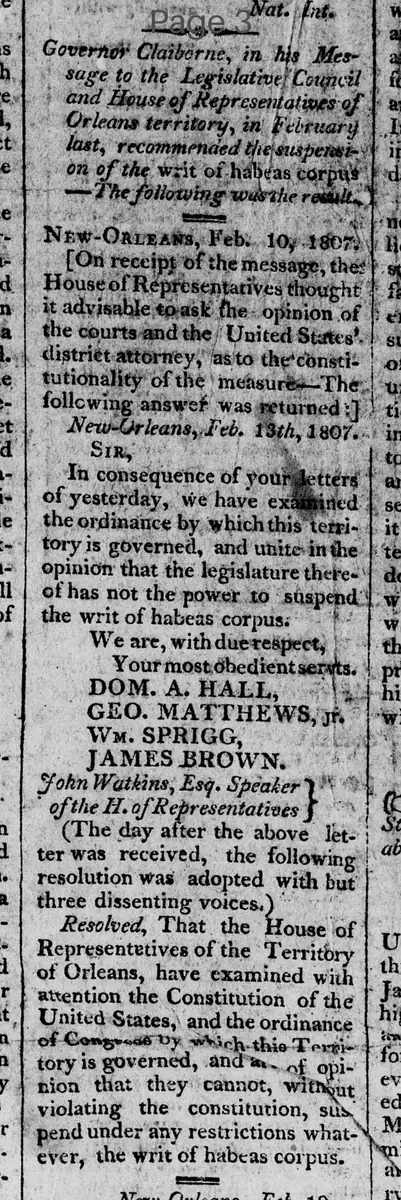
The following was the result
New-ORLEANS, Feb. 10, 1807.
[On receipt of the message, the House of Representatives thought it advisable to ask the opinion of the courts and the United States district attorney as to the constitutionality of the measure The following answer was returned:]
New-ORLEANS, Feb. 13th, 1807.
SIR,
In consequence of your letters of yesterday, we have examined the ordinance by which this territory is governed, and unite in the opinion that the legislature thereof has not the power to suspend the writ of habeas corpus:
We are, with due respect,
Your most obedient servants.
DOM. A. HALL,
GEO. MATTHEWS,
Wm. SPRIGG,
JAMES BROWN.
John Watkins, Esq. Speaker of the H. of Representatives
(The day after the above letter was received, the following resolution was adopted with but three dissenting voices.)
Resolved, That the House of Representatives of the Territory of Orleans, have examined with attention the Constitution of the United States, and the ordinance of Congress by which this Territory is governed, and are of opinion that they cannot, without violating the constitution, "suspend under any restrictions whatever, the writ of habeas corpus."
What sub-type of article is it?
What keywords are associated?
What entities or persons were involved?
Where did it happen?
Domestic News Details
Primary Location
New Orleans
Event Date
February 1807
Key Persons
Outcome
resolution adopted with but three dissenting voices, concluding that the legislature cannot suspend the writ of habeas corpus without violating the constitution.
Event Details
Governor Claiborne recommended suspension of the writ of habeas corpus to the Legislative Council and House of Representatives of Orleans territory in February 1807. The House sought opinions from courts and the United States district attorney, who on Feb. 13, 1807, stated the legislature lacks power to suspend it. The next day, the House adopted a resolution affirming they cannot suspend it without violating the constitution.