Thank you for visiting SNEWPapers!
Sign up free
Editorial
November 16, 1840
Vermont Watchman And State Journal
Montpelier, Washington County, Vermont
What is this article about?
Lieut. Gov. Camp's address to the Vermont Senate upon re-taking office, expressing reluctance but duty to serve, reviewing the bicameral legislature's benefits, advocating limited rotation for experience, economy in public spending, and procedural reforms for pay and attendance to ensure integrity.
Clipping
OCR Quality
95%
Excellent
Full Text
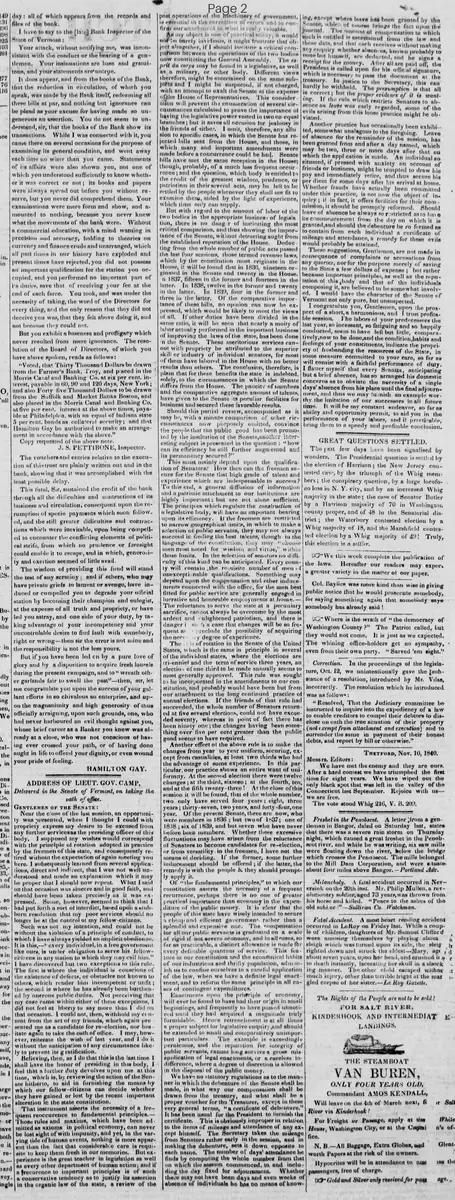
ADDRESS OF LIEUT. GOV. CAMP
Delivered in the Senate of Vermont, on taking the oath of office.
Gentlemen of The Senate:
Near the close of the last session, an opportunity was presented, when I thought I could with propriety express my desire to be excused from any further services as the presiding officer of this body. I supposed my wishes would correspond with the principle of rotation adopted in practice by the freemen of this state, and consequently retired without the expectation of again meeting you here. I subsequently learned from several applications, direct and indirect, that I was not well understood and made an explanation which it may be proper that I should now repeat. What I said on that occasion was sincere and in good faith, and should have been taken precisely as it was expressed. Some, however, seemed to think that I had put forth a sort of interdict, based upon a stubborn resolution that my poor services should no longer be at the control of my fellow-citizens.
Such was not my intention, and could not be without the violation of a principle of conduct, to which I have always yielded an implicit obedience. It is this,-" every individual, in a free government like ours, is under obligation to serve his fellow-citizens in any station to which they may call him."
I have discovered but two exceptions to this rule. The first is where the individual is conscious of the existence of defects, or obstacles not known to others, which render him incompetent or unfit; the second is where he has already been burdened by onerous public duties. Not perceiving that my case came within either of these exceptions, I did not feel at liberty to say more than I did on that occasion. I could not, then, withhold my consent from the act of my friends, which again presented me as a candidate for re-election, nor hesitate again to take the oath of office. I may, however, reiterate the wish of last year, and I do it without the anticipation of any circumstance likely to prevent its gratification.
Believing, then, as I do that this is the last time I shall have the honor of presiding in this body, I feel that a further duty devolves upon me at this time, which is, by reviewing the action of the Senate hitherto, to aid in furnishing the means by which our fellow-citizens can decide whether they have gained or lost by the recent important alteration in the state constitution.
That instrument asserts the necessity of a frequent recurrence to fundamental principles.— Those rules and maxims, which have been admitted as axioms in political economy, can never be lost sight of with impunity, and yet, in the varying tide of human events, nothing is more apparent than the fact that considerable care is requisite to keep them fresh in our memories. But experience is the great teacher in legislation as well as every other department of human action; and if recurrence to important principles is of such conservative tendency as to justify its assertion in the organic law of the state, a review of the past operations of the machinery of government, is essential to the correction of errors and to confirm our attachment to what is really valuable.
As my object is one of practical utility, it would not be merely invidious. it might frustrate that object altogether, if I should institute a critical comparison between the operations of the two bodies now constituting the General Assembly. The esprit du corps may be found in a legislative, as well as a military, or other body. Different views therefore, might be entertained on the same subjects and I might be suspected, if not charged, with an attempt to exalt the Senate at the expense of the House of Representatives. This consideration will prevent the enumeration of several circumstances calculated to prove the importance of having the legislative power vested in two co-equal branches; but it saves all occasion for jealousy in the friends of either. I omit, therefore, any allusion to specific cases, in which the Senate has rejected bills sent from the House, and those, in which many and important amendments were made before a concurrence could be had. Senate bills have met the same reception in the House: though, probably, of a much less frequent occurrence; and the question, which body is entitled to the credit of the greatest wisdom, prudence, or patriotism in their several acts, may be left to be settled by the people whenever they shall see fit to examine them, aided by the light of experience, which time only can supply.
But with regard to the amount of labor of the two bodies in the appropriate business of legislation, there is no danger of instituting the most critical comparison, and thus showing the importance of the Senate, without detracting aught from the established reputation of the House. Deducting from the whole number of public acts passed the last four sessions, those termed revenue laws, which by the constitution must originate in the House, it will be found that in 1836, nineteen originated in the Senate and twenty in the House. In 1837, fifteen in the former and fourteen in the latter. In 1838, twelve in the former and twenty in the latter. In 1839, four in the former and three in the latter. Of the comparative importance of these bills, no opinion can now be expressed, which would be likely to meet the views of all. If other duties have been divided in the same ratio, it will be seen that nearly a moiety of labor actually performed in the important business of improving the laws of the state, has been done in the Senate. These meritorious services cannot with propriety be attributed to the superior skill or industry of individual senators, for most of them have labored in the House with no better results than others. The conclusion, therefore, is plain that for these benefits the state is indebted, solely, to the circumstances in which the Senate differs from the House. The paucity of numbers and the comparative aggregate amount of talents, have given to the Senate its peculiar facilities for business and secured these favorable results.
Should this partial review, accompanied as it may be, with a minute comparison of other circumstances now purposely omitted, convince the people that the public good has been promoted by the institution of the Senate, another interesting subject is presented in the question : "how can its efficiency be still further augmented and its permanency secured?"
This must mainly depend upon the qualification of Senators." How then can the freemen secure for the Senate that high grade of talent and experience which are indispensable to success? To this end. a general diffusion of information and a patriotic attachment to our institutions are highly important: but are not alone sufficient. The principles which regulate the construction of a legislative body, will have an important bearing upon its efficiency. if the freemen are restricted to narrow geographical limits, in which to make a selection of public servants, they may not always succeed in finding the best talents, though in the language of the constitution, they may "choose men most noted for wisdom and virtue," within those limits. In the selection of senators no difficulty of this kind can be anticipated. Every county will contain the requisite number of men of unexceptionable qualifications. Something may depend upon the compensation and other inducements connected with the office, for the men best fitted for public service are generally engaged in lucrative and honorable employments at home.- The reluctance to serve the state at a pecuniary sacrifice, cannot always be overcome by the most ardent and enlightened patriotism, and there is danger in such a case that changes will be so frequent as to preclude the possibility of acquiring the necessary degree of experience.
The rule of rotation in the Senate of the United States, which is the same in principle in several of the individual states, where the elections are tri-ennial and the term of service three years, an election of one-third to be made annually seems to most generally approved. This rule was sought to be incorporated in the amendments to our constitution, and probably would have been but from our attachment to the long continued practice of annual elections. If the friends of that rule had succeeded, the whole number of Senators returned at five several elections, could not have exceeded seventy, whereas in point of fact there has been ninety one; the changes having been something over five per cent greater than the public good seems to have required.
Another effect of the above rule is to make the changes from year to year uniform, securing, except from casualties, at least two thirds who had the advantage of some experience. In this particular, our practice shows an entire want of uniformity. At the second election there were twelve changes; at the third, sixteen; at the fourth, ten, and at the fifth twenty-three! At the close of this session it will be found, that of the whole number, two only have served four years; eight, three years; thirty-seven, two years, and forty-four, one year. Of the present Senate, three are now, who were members in 1836 ; but two of 1837; one of 1838 : six of 1839, and but seven who have never before been members. Whether these excessive fluctuations may have arisen from the reluctance of Senators to become candidates for re-election, or from versatility in the freemen, I have not the means of deciding. If the former, some further inducement should be offered; if the latter, the remedy is with the people & they should promptly apply it.
Of "the fundamental principles," to which our constitution asserts the necessity of a frequent recurrence, perhaps there is no one of greater practical importance than economy in the expenditure of the public money. It is clear that the people of this state have wisely intended to secure a cheap and efficient government, rather than a splendid and expensive one. The compensation for all our public servants is graduated on a scale of rigid if not severe economy, and in all cases, so far as practicable, a distinct allowance is made for every definable quantum of service. This feature in our constitution and the economical habits of our industrious and thrifty population. admonish us to confine ourselves to a careful application of the law, when we have a definite legal enactment, and to reform the same principle in all cases of contingent expenditures.
Enactments upon the principle of economy. will ever be found to have had their origin in small beginnings, and frequently to have passed unnoticed until they had acquired a magnitude truly formidable. Hence retrenchment is at all times a proper subject for legislative enquiry, and should be extended to small and comparatively unimportant particulars The example is exceedingly pernicious, and the reputation for integrity of public servants, cannot long survive a gross misapplication of legal enactments, or a careless indifference, where a degree of discretion is allowed in the disposal of the public money.
We have no statutory regulations as to the manner in which the debenture of the Senate shall be made, in what way our compensation shall be drawn from the treasury, and what shall be a proper voucher for the Treasurer, except in these very general terms, "a certificate of debenture."
It has been usual for the President to furnish the certificate. This is obviously improper in relation to the items of mileage and attendance of any except himself. The Secretary takes the mileage from Senators rather early in the session, and in making the debenture, sets it down opposite to each name. The number of days' attendance he finds by computing the whole number from that on which the session commenced, to and including the day fixed for adjournment. Whether there may not have been days and even weeks of absence of individuals he has no means of knowing, except where leave has been granted by the Senate, which of course brings the fact upon the journal. The amount of compensation to which each is entitled is ascertained from the law and these data, and that each receives without making any enquiry whether absences, known probably to none but himself, are deducted, and he signs a receipt for the money. After all are paid off, the President is called upon for his official signature, which is necessary to pass the document at the treasury. In justice to the Secretary, this can hardly be withheld. The presumption is that all is correct; but the proper evidence of it is wanting. If the rule which restricts Senators to absence on leave was early regarded, some of the evils arising from this loose practice might be obviated.
Another practice has occasionally been exhibited, somewhat analogous to the foregoing. Leave of absence for the remainder of the session, has been granted from and after a day named, which may be two, three or more days after that on which the application is made. An individual so situated, if pressed with anxiety on account of friends or business, might be tempted to draw his pay and immediately retire, and thus secure his per diem for some days after his arrival at home.
Whether frauds have actually been committed under this practice, is not now the object of enquiry ; it in fact, it offers facilities for their commission, it should be promptly reformed. Should leave of absence be always so restricted as to have its commencement from the day on which it is granted, and should the debenture be so formed as to contain from each individual a certificate of mileage and attendance, a remedy for these evils would probably be attained.
These suggestions, Gentlemen, are not made in consequence of complaints or accusations from any quarter, nor for the purpose merely of saving to the State a few dollars of expense ; but rather because important principles, as well as the reputation of this body and that of the individuals composing it, are believed to be somewhat involved. I would have the character of the Senate of Vermont not only pure, but unsuspected.
I congratulate you, Gentlemen, upon the prospect of a short, a harmonious, and I trust profitable session. The labors of your predecessors the last year, so incessant, so fatiguing and so happily conducted, seem to have left but little, comparatively, now to be done, and the condition, habits and feelings of your constituents, indicate the propriety of husbanding the resources of the State, in some measure committed to your care, so far as will consist with a faithful performance of duty.
I flatter myself that every Senator, anticipating but a brief absence, has so arranged his domestic concerns as to obviate the necessity of a single days' absence from his place until the final adjournment, and thus we may furnish an example worthy the imitation of our successors in all future time. It will be my constant endeavor, so far as ability and opportunity permit, to aid you in the performance of your labors, and if practicable, bring them to a speedy and profitable conclusion.
Delivered in the Senate of Vermont, on taking the oath of office.
Gentlemen of The Senate:
Near the close of the last session, an opportunity was presented, when I thought I could with propriety express my desire to be excused from any further services as the presiding officer of this body. I supposed my wishes would correspond with the principle of rotation adopted in practice by the freemen of this state, and consequently retired without the expectation of again meeting you here. I subsequently learned from several applications, direct and indirect, that I was not well understood and made an explanation which it may be proper that I should now repeat. What I said on that occasion was sincere and in good faith, and should have been taken precisely as it was expressed. Some, however, seemed to think that I had put forth a sort of interdict, based upon a stubborn resolution that my poor services should no longer be at the control of my fellow-citizens.
Such was not my intention, and could not be without the violation of a principle of conduct, to which I have always yielded an implicit obedience. It is this,-" every individual, in a free government like ours, is under obligation to serve his fellow-citizens in any station to which they may call him."
I have discovered but two exceptions to this rule. The first is where the individual is conscious of the existence of defects, or obstacles not known to others, which render him incompetent or unfit; the second is where he has already been burdened by onerous public duties. Not perceiving that my case came within either of these exceptions, I did not feel at liberty to say more than I did on that occasion. I could not, then, withhold my consent from the act of my friends, which again presented me as a candidate for re-election, nor hesitate again to take the oath of office. I may, however, reiterate the wish of last year, and I do it without the anticipation of any circumstance likely to prevent its gratification.
Believing, then, as I do that this is the last time I shall have the honor of presiding in this body, I feel that a further duty devolves upon me at this time, which is, by reviewing the action of the Senate hitherto, to aid in furnishing the means by which our fellow-citizens can decide whether they have gained or lost by the recent important alteration in the state constitution.
That instrument asserts the necessity of a frequent recurrence to fundamental principles.— Those rules and maxims, which have been admitted as axioms in political economy, can never be lost sight of with impunity, and yet, in the varying tide of human events, nothing is more apparent than the fact that considerable care is requisite to keep them fresh in our memories. But experience is the great teacher in legislation as well as every other department of human action; and if recurrence to important principles is of such conservative tendency as to justify its assertion in the organic law of the state, a review of the past operations of the machinery of government, is essential to the correction of errors and to confirm our attachment to what is really valuable.
As my object is one of practical utility, it would not be merely invidious. it might frustrate that object altogether, if I should institute a critical comparison between the operations of the two bodies now constituting the General Assembly. The esprit du corps may be found in a legislative, as well as a military, or other body. Different views therefore, might be entertained on the same subjects and I might be suspected, if not charged, with an attempt to exalt the Senate at the expense of the House of Representatives. This consideration will prevent the enumeration of several circumstances calculated to prove the importance of having the legislative power vested in two co-equal branches; but it saves all occasion for jealousy in the friends of either. I omit, therefore, any allusion to specific cases, in which the Senate has rejected bills sent from the House, and those, in which many and important amendments were made before a concurrence could be had. Senate bills have met the same reception in the House: though, probably, of a much less frequent occurrence; and the question, which body is entitled to the credit of the greatest wisdom, prudence, or patriotism in their several acts, may be left to be settled by the people whenever they shall see fit to examine them, aided by the light of experience, which time only can supply.
But with regard to the amount of labor of the two bodies in the appropriate business of legislation, there is no danger of instituting the most critical comparison, and thus showing the importance of the Senate, without detracting aught from the established reputation of the House. Deducting from the whole number of public acts passed the last four sessions, those termed revenue laws, which by the constitution must originate in the House, it will be found that in 1836, nineteen originated in the Senate and twenty in the House. In 1837, fifteen in the former and fourteen in the latter. In 1838, twelve in the former and twenty in the latter. In 1839, four in the former and three in the latter. Of the comparative importance of these bills, no opinion can now be expressed, which would be likely to meet the views of all. If other duties have been divided in the same ratio, it will be seen that nearly a moiety of labor actually performed in the important business of improving the laws of the state, has been done in the Senate. These meritorious services cannot with propriety be attributed to the superior skill or industry of individual senators, for most of them have labored in the House with no better results than others. The conclusion, therefore, is plain that for these benefits the state is indebted, solely, to the circumstances in which the Senate differs from the House. The paucity of numbers and the comparative aggregate amount of talents, have given to the Senate its peculiar facilities for business and secured these favorable results.
Should this partial review, accompanied as it may be, with a minute comparison of other circumstances now purposely omitted, convince the people that the public good has been promoted by the institution of the Senate, another interesting subject is presented in the question : "how can its efficiency be still further augmented and its permanency secured?"
This must mainly depend upon the qualification of Senators." How then can the freemen secure for the Senate that high grade of talent and experience which are indispensable to success? To this end. a general diffusion of information and a patriotic attachment to our institutions are highly important: but are not alone sufficient. The principles which regulate the construction of a legislative body, will have an important bearing upon its efficiency. if the freemen are restricted to narrow geographical limits, in which to make a selection of public servants, they may not always succeed in finding the best talents, though in the language of the constitution, they may "choose men most noted for wisdom and virtue," within those limits. In the selection of senators no difficulty of this kind can be anticipated. Every county will contain the requisite number of men of unexceptionable qualifications. Something may depend upon the compensation and other inducements connected with the office, for the men best fitted for public service are generally engaged in lucrative and honorable employments at home.- The reluctance to serve the state at a pecuniary sacrifice, cannot always be overcome by the most ardent and enlightened patriotism, and there is danger in such a case that changes will be so frequent as to preclude the possibility of acquiring the necessary degree of experience.
The rule of rotation in the Senate of the United States, which is the same in principle in several of the individual states, where the elections are tri-ennial and the term of service three years, an election of one-third to be made annually seems to most generally approved. This rule was sought to be incorporated in the amendments to our constitution, and probably would have been but from our attachment to the long continued practice of annual elections. If the friends of that rule had succeeded, the whole number of Senators returned at five several elections, could not have exceeded seventy, whereas in point of fact there has been ninety one; the changes having been something over five per cent greater than the public good seems to have required.
Another effect of the above rule is to make the changes from year to year uniform, securing, except from casualties, at least two thirds who had the advantage of some experience. In this particular, our practice shows an entire want of uniformity. At the second election there were twelve changes; at the third, sixteen; at the fourth, ten, and at the fifth twenty-three! At the close of this session it will be found, that of the whole number, two only have served four years; eight, three years; thirty-seven, two years, and forty-four, one year. Of the present Senate, three are now, who were members in 1836 ; but two of 1837; one of 1838 : six of 1839, and but seven who have never before been members. Whether these excessive fluctuations may have arisen from the reluctance of Senators to become candidates for re-election, or from versatility in the freemen, I have not the means of deciding. If the former, some further inducement should be offered; if the latter, the remedy is with the people & they should promptly apply it.
Of "the fundamental principles," to which our constitution asserts the necessity of a frequent recurrence, perhaps there is no one of greater practical importance than economy in the expenditure of the public money. It is clear that the people of this state have wisely intended to secure a cheap and efficient government, rather than a splendid and expensive one. The compensation for all our public servants is graduated on a scale of rigid if not severe economy, and in all cases, so far as practicable, a distinct allowance is made for every definable quantum of service. This feature in our constitution and the economical habits of our industrious and thrifty population. admonish us to confine ourselves to a careful application of the law, when we have a definite legal enactment, and to reform the same principle in all cases of contingent expenditures.
Enactments upon the principle of economy. will ever be found to have had their origin in small beginnings, and frequently to have passed unnoticed until they had acquired a magnitude truly formidable. Hence retrenchment is at all times a proper subject for legislative enquiry, and should be extended to small and comparatively unimportant particulars The example is exceedingly pernicious, and the reputation for integrity of public servants, cannot long survive a gross misapplication of legal enactments, or a careless indifference, where a degree of discretion is allowed in the disposal of the public money.
We have no statutory regulations as to the manner in which the debenture of the Senate shall be made, in what way our compensation shall be drawn from the treasury, and what shall be a proper voucher for the Treasurer, except in these very general terms, "a certificate of debenture."
It has been usual for the President to furnish the certificate. This is obviously improper in relation to the items of mileage and attendance of any except himself. The Secretary takes the mileage from Senators rather early in the session, and in making the debenture, sets it down opposite to each name. The number of days' attendance he finds by computing the whole number from that on which the session commenced, to and including the day fixed for adjournment. Whether there may not have been days and even weeks of absence of individuals he has no means of knowing, except where leave has been granted by the Senate, which of course brings the fact upon the journal. The amount of compensation to which each is entitled is ascertained from the law and these data, and that each receives without making any enquiry whether absences, known probably to none but himself, are deducted, and he signs a receipt for the money. After all are paid off, the President is called upon for his official signature, which is necessary to pass the document at the treasury. In justice to the Secretary, this can hardly be withheld. The presumption is that all is correct; but the proper evidence of it is wanting. If the rule which restricts Senators to absence on leave was early regarded, some of the evils arising from this loose practice might be obviated.
Another practice has occasionally been exhibited, somewhat analogous to the foregoing. Leave of absence for the remainder of the session, has been granted from and after a day named, which may be two, three or more days after that on which the application is made. An individual so situated, if pressed with anxiety on account of friends or business, might be tempted to draw his pay and immediately retire, and thus secure his per diem for some days after his arrival at home.
Whether frauds have actually been committed under this practice, is not now the object of enquiry ; it in fact, it offers facilities for their commission, it should be promptly reformed. Should leave of absence be always so restricted as to have its commencement from the day on which it is granted, and should the debenture be so formed as to contain from each individual a certificate of mileage and attendance, a remedy for these evils would probably be attained.
These suggestions, Gentlemen, are not made in consequence of complaints or accusations from any quarter, nor for the purpose merely of saving to the State a few dollars of expense ; but rather because important principles, as well as the reputation of this body and that of the individuals composing it, are believed to be somewhat involved. I would have the character of the Senate of Vermont not only pure, but unsuspected.
I congratulate you, Gentlemen, upon the prospect of a short, a harmonious, and I trust profitable session. The labors of your predecessors the last year, so incessant, so fatiguing and so happily conducted, seem to have left but little, comparatively, now to be done, and the condition, habits and feelings of your constituents, indicate the propriety of husbanding the resources of the State, in some measure committed to your care, so far as will consist with a faithful performance of duty.
I flatter myself that every Senator, anticipating but a brief absence, has so arranged his domestic concerns as to obviate the necessity of a single days' absence from his place until the final adjournment, and thus we may furnish an example worthy the imitation of our successors in all future time. It will be my constant endeavor, so far as ability and opportunity permit, to aid you in the performance of your labors, and if practicable, bring them to a speedy and profitable conclusion.
What sub-type of article is it?
Constitutional
Economic Policy
Legal Reform
What keywords are associated?
Vermont Senate
Bicameral Legislature
Government Rotation
Public Economy
Legislative Procedures
Constitutional Principles
What entities or persons were involved?
Lieut. Gov. Camp
Senate Of Vermont
House Of Representatives
Freemen Of Vermont
Editorial Details
Primary Topic
Defense Of Vermont's Bicameral Legislature And Call For Procedural Reforms
Stance / Tone
Supportive Of Senate's Role And Economical, Transparent Government
Key Figures
Lieut. Gov. Camp
Senate Of Vermont
House Of Representatives
Freemen Of Vermont
Key Arguments
Duty To Serve In Government Unless Unfit Or Overburdened
Bicameral System Promotes Better Legislation Through Checks
Limited Rotation In Senate Ensures Experience And Stability
Economy In Public Expenditure Is A Fundamental Principle
Reform Pay And Attendance Procedures To Prevent Potential Fraud And Ensure Integrity