Thank you for visiting SNEWPapers!
Sign up free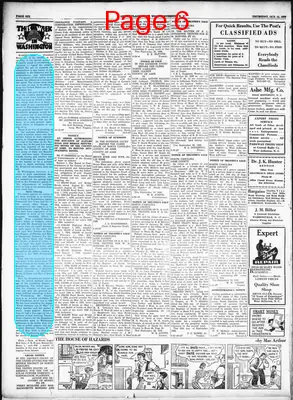
The Skyland Post
West Jefferson, Ashe County, North Carolina
What is this article about?
President Roosevelt addressed the special session of Congress on repealing the arms embargo, appealing for non-partisan approach to keep US out of European war. Congress shows partisan divide, with Republicans opposing and Democrats supporting, influenced by letters from voters mostly opposing the plan. Key Republican figures include Vandenberg, who gains politically from the debate.
Clipping

OCR Quality
Full Text
This is Event 1 of 2. The full text below covers all events in this component.
President Roosevelt, in his address at the opening of the special session of Congress which is considering his proposal to repeal the embargo against the sale of weapons and ammunition to any nation at war, appealed to the Senators and Representatives, and inferentially to the people of the nation, to approach the subject in a non-partisan spirit. The nation must stand as a unit, he said, in its efforts to keep the United States out of the European war.
On that last part of his appeal, that the country should be of a single mind about keeping out of war, his message struck a responsive chord. And there is doubt in the mind of any experienced observer in Washington that if there were general agreement that the President's program would keep the country out of war, Congress would go a long way, almost unanimously, to back him up. But there is no such general agreement, either in Congress or outside of it.
There is no way of checking up on the partisan affiliations of nearly a million voters who have written letters to their representatives in Congress urging action one way or the other on the Neutrality Act in the past few weeks. The vast majority of the letters oppose the President's plan. But how many of them are Republicans and how many Democrats nobody knows, and whether they are motivated by sincere belief in the matter, or by a partisan desire to block anything which Mr. Roosevelt advocates, none can tell.
In Washington, however, it is easier to draw conclusions. Senators and Representatives, with few exceptions, are paying slight heed to the President's appeal for "the adjournment of partisanship" so long as the present European crisis lasts.
Party Line-up
The battle against the repeal of the arms embargo is so definitely a battle of Republicans against Democrats that it has had the effect, among other things, of bringing back into support of the Administration many Democrats who have been opponents of the President in most of his recent program, including Alfred E. Smith. Even venerable Senator Carter Glass, of Virginia, whose feud with Mr. Roosevelt has been of more than six years' duration, is back again in the same fold with such New Dealers as Senators Pepper, of Florida, and Bilbo of Mississippi. Senators Pat Harrison, Harry Byrd and "Cotton Ed" Smith, of South Carolina, also are back. The fight therefore, is distinctly a party battle, each side believing that its victory will strengthen its party's chances of success in the 1940 Presidential election.
That, and not neutrality in any real sense, is the actual issue. The wheel-horses of the battle on the Republican side are Senators Arthur Vandenberg of Michigan, Hiram Johnson of California, Borah of Idaho and Nye of North Dakota.
That the Republicans intend to take the fullest political advantage of the neutrality debates is undisputed. The belief here is that the member of that party who will gain the greatest personal political advantage is Senator Vandenberg. Mr. Vandenberg is an avowed candidate for the Presidency, as he was in 1936. He has been sounding the slogan: "Keep America out of War" for many months, and has gained a much larger popular following than he had a year ago, by his repetition of that warning. Vandenberg's chances for the Republican nomination seem to Washington politicians to be better than ever. Polls of public opinion still show District Attorney Thomas E. Dewey of New York in first place but with Vandenberg gaining, and far ahead of Senator Taft.
What sub-type of article is it?
What keywords are associated?
What entities or persons were involved?
Where did it happen?
Domestic News Details
Primary Location
Washington
Key Persons
Outcome
ongoing partisan battle between republicans and democrats over repeal of arms embargo, with each side viewing victory as strengthening chances in 1940 presidential election
Event Details
President Roosevelt addressed the special session of Congress on repealing the arms embargo, appealing for non-partisan approach to keep US out of European war. Congress shows partisan divide, with Republicans opposing and Democrats supporting, influenced by letters from voters mostly opposing the plan. Key Republican figures include Vandenberg, who gains politically from the debate.