Thank you for visiting SNEWPapers!
Sign up free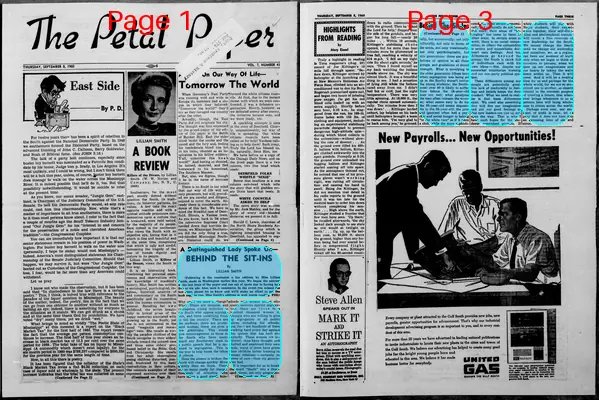
Editorial
September 8, 1960
The Petal Paper
Petal, Forrest County, Mississippi
What is this article about?
Lillian Smith concludes her address on sit-ins, urging the South to break silence on segregation. She highlights support from ministers, students, and women, emphasizes regional diversity, and hopes student protests will foster new leadership for desegregation and healing.
Merged-components note: Continuation of Lillian Smith's address 'Behind The Sit-Ins' from page 1 to page 3, forming a single editorial piece.
Clippings
1 of 2
OCR Quality
98%
Excellent
Full Text
A
Distinguished
Lady
Spoke
On
BEHIND
THE
SIT-INS
By
LILLIAN SMITH
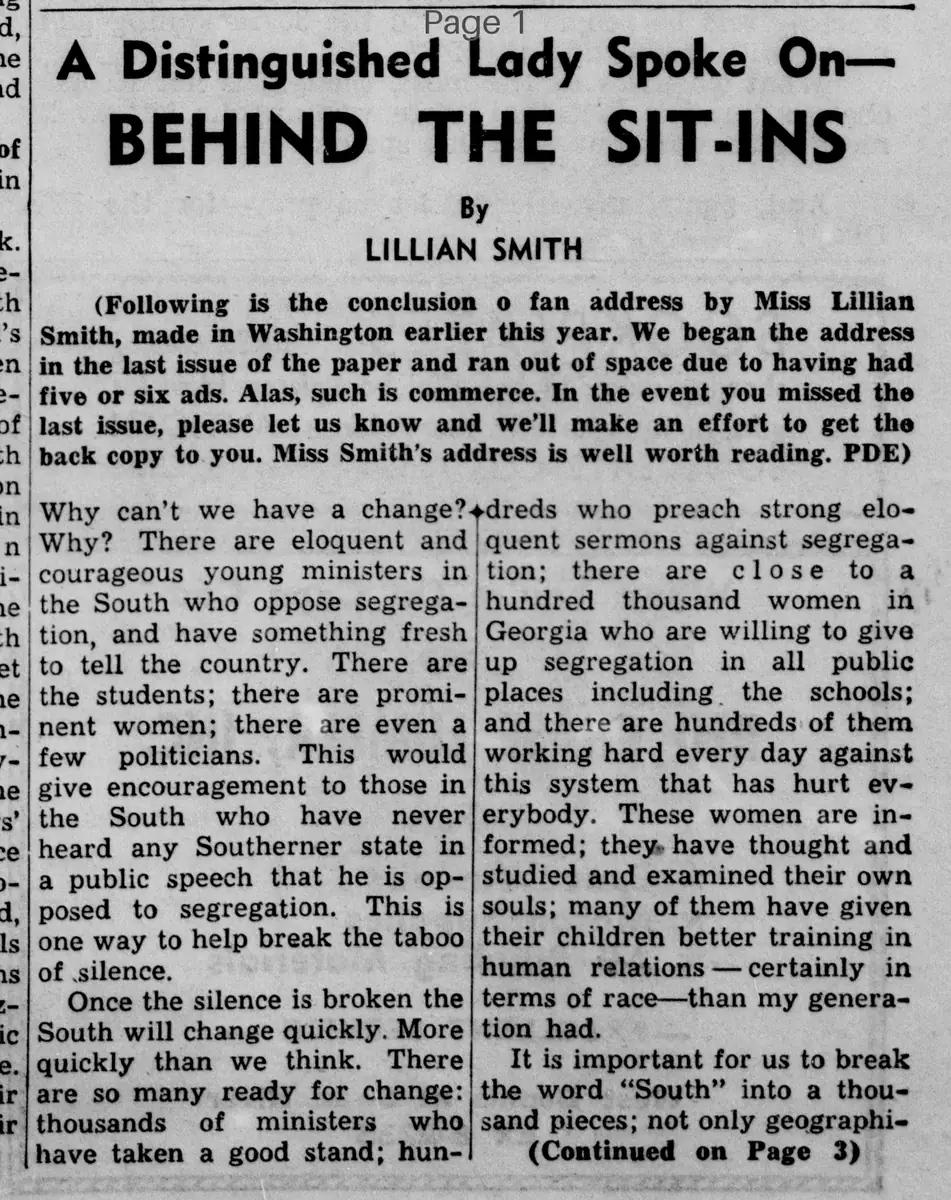
(Following is the conclusion of an address by Miss Lillian Smith, made in Washington earlier this year. We began the address in the last issue of the paper and ran out of space due to having had five or six ads. Alas, such is commerce. In the event you missed the last issue, please let us know and we'll make an effort to get the back copy to you. Miss Smith's address is well worth reading. PDE)
Why can't we have a change? Why? There are eloquent and courageous young ministers in the South who oppose segregation, and have something fresh to tell the country. There are the students; there are prominent women; there are even a few politicians. This would give encouragement to those in the South who have never heard any Southerner state in a public speech that he is opposed to segregation. This is one way to help break the taboo of silence.
Once the silence is broken the South will change quickly. More quickly than we think. There are so many ready for change: thousands of ministers who have taken a good stand; hundreds who preach strong eloquent sermons against segregation; there are close to a hundred thousand women in Georgia who are willing to give up segregation in all public places including the schools; and there are hundreds of them working hard every day against this system that has hurt everybody. These women are informed: they have thought and studied and examined their own souls; many of them have given their children better training in human relations—certainly in terms of race—than my generation had.
It is important for us to break the word "South" into a thousand pieces; not only geographi-
(Continued on Page 3)
Behind
The Sit-Ins
(Continued from Page 1)
cally, but economically; not only culturally, not only in terms of the sexes, not only vocationally, not only psychologically, but into generations: there are gradations of opinion in all these groups, and gradations of moral strength. What is terrifying to the older generation (those born when segregation was being set up in the South) doesn't bother the young students; the Southerner over 40 is likely to suffer from taboos the 18-year-old does not feel; what paralyzes the men often releases the women; what seems easy to do for the 25-year-old seems impossible to the 50-year-old; the poor and ignorant often feel a psychic and social hunger to belong "to the white race" as if it were a club, while the more sophisticated, the more secure economically and culturally do not have this need; their sense of "belonging" has come to them in other ways. In certain areas of work, there is no racial competition; in others the competition is severe and exacerbates dormant race feelings. And too, differences go beyond the groups; the South is chock full of individuals each with his own ideas - this, despite our somewhat totalitarian training and our one-party political system.
These differences among our people are potentially good; this lack of conformity in feelings and beliefs keeps the door cracked. What we need to realize is that these differences exist. We need also something that will fire our imagination and stir our good feelings so that new leaders can rise up and open the way. That is why I have such hopes for the students nonviolent protests. If
white students will join with Negro students, their experiences together, their self-discipline and philosophical training will create a fine reservoir of new leadership for the South.
We cannot change the South until we change our leadership and ourselves; we, as a region, can have our moment of truth only when we begin to think of ourselves as persons, when we open up our imaginations and our hearts by taking the walls down within us. Then it will come. And it will be a healing time for us and perhaps for the whole world, for we are so sensitized one to another, so closely related in the common purpose of creating a future, that whatever brings wholeness to us as persons here will bring wholeness to others across the world.
Perhaps even now, our moment of truth is near; let us pray that it does not turn into an agonizing time of sin and error.
Distinguished
Lady
Spoke
On
BEHIND
THE
SIT-INS
By
LILLIAN SMITH
(Following is the conclusion of an address by Miss Lillian Smith, made in Washington earlier this year. We began the address in the last issue of the paper and ran out of space due to having had five or six ads. Alas, such is commerce. In the event you missed the last issue, please let us know and we'll make an effort to get the back copy to you. Miss Smith's address is well worth reading. PDE)
Why can't we have a change? Why? There are eloquent and courageous young ministers in the South who oppose segregation, and have something fresh to tell the country. There are the students; there are prominent women; there are even a few politicians. This would give encouragement to those in the South who have never heard any Southerner state in a public speech that he is opposed to segregation. This is one way to help break the taboo of silence.
Once the silence is broken the South will change quickly. More quickly than we think. There are so many ready for change: thousands of ministers who have taken a good stand; hundreds who preach strong eloquent sermons against segregation; there are close to a hundred thousand women in Georgia who are willing to give up segregation in all public places including the schools; and there are hundreds of them working hard every day against this system that has hurt everybody. These women are informed: they have thought and studied and examined their own souls; many of them have given their children better training in human relations—certainly in terms of race—than my generation had.
It is important for us to break the word "South" into a thousand pieces; not only geographi-
(Continued on Page 3)
Behind
The Sit-Ins
(Continued from Page 1)
cally, but economically; not only culturally, not only in terms of the sexes, not only vocationally, not only psychologically, but into generations: there are gradations of opinion in all these groups, and gradations of moral strength. What is terrifying to the older generation (those born when segregation was being set up in the South) doesn't bother the young students; the Southerner over 40 is likely to suffer from taboos the 18-year-old does not feel; what paralyzes the men often releases the women; what seems easy to do for the 25-year-old seems impossible to the 50-year-old; the poor and ignorant often feel a psychic and social hunger to belong "to the white race" as if it were a club, while the more sophisticated, the more secure economically and culturally do not have this need; their sense of "belonging" has come to them in other ways. In certain areas of work, there is no racial competition; in others the competition is severe and exacerbates dormant race feelings. And too, differences go beyond the groups; the South is chock full of individuals each with his own ideas - this, despite our somewhat totalitarian training and our one-party political system.
These differences among our people are potentially good; this lack of conformity in feelings and beliefs keeps the door cracked. What we need to realize is that these differences exist. We need also something that will fire our imagination and stir our good feelings so that new leaders can rise up and open the way. That is why I have such hopes for the students nonviolent protests. If
white students will join with Negro students, their experiences together, their self-discipline and philosophical training will create a fine reservoir of new leadership for the South.
We cannot change the South until we change our leadership and ourselves; we, as a region, can have our moment of truth only when we begin to think of ourselves as persons, when we open up our imaginations and our hearts by taking the walls down within us. Then it will come. And it will be a healing time for us and perhaps for the whole world, for we are so sensitized one to another, so closely related in the common purpose of creating a future, that whatever brings wholeness to us as persons here will bring wholeness to others across the world.
Perhaps even now, our moment of truth is near; let us pray that it does not turn into an agonizing time of sin and error.
What sub-type of article is it?
Social Reform
Slavery Abolition
What keywords are associated?
Segregation Opposition
Sit Ins
Southern Change
Racial Issues
Student Protests
Women Against Segregation
Breaking Silence
Nonviolent Protests
What entities or persons were involved?
Lillian Smith
Young Ministers
Students
Prominent Women
Women In Georgia
Negro Students
White Students
Editorial Details
Primary Topic
Breaking Silence On Opposition To Segregation In The South
Stance / Tone
Hopeful Advocacy For Desegregation And Change
Key Figures
Lillian Smith
Young Ministers
Students
Prominent Women
Women In Georgia
Negro Students
White Students
Key Arguments
Eloquent Young Ministers, Students, Women, And Politicians Oppose Segregation And Need Platforms To Speak Publicly
Breaking The Taboo Of Silence Will Lead To Rapid Change In The South
Thousands Of Ministers And Nearly 100,000 Women In Georgia Are Ready To End Segregation In Public Places Including Schools
The South Must Be Understood In Its Diverse Gradations Across Geography, Economy, Culture, Sexes, Vocations, Psychology, And Generations
Differences Among Southern People Keep The Door Open For Change And Can Foster New Leadership
Student Nonviolent Protests, Especially If White And Negro Students Join, Will Create A Reservoir Of New Leadership
Change Requires Altering Leadership And Personal Mindsets To Remove Internal Walls
The South's Moment Of Truth Is Near And Could Heal The Region And The World