Thank you for visiting SNEWPapers!
Sign up free
Literary
March 19, 1857
The Perrysburg Journal
Perrysburg, Wood County, Ohio
What is this article about?
Kate Proctor resists her father's plan to board the new minister, Rev. Calvin Leader, due to prejudice against his stern demeanor. She meets charming Charles Lindsay and falls in love, unaware he is the minister. After his inspiring sermon, she learns the truth and joyfully agrees to marry him, embracing 'boarding the minister for life.'
Clipping
OCR Quality
95%
Excellent
Full Text
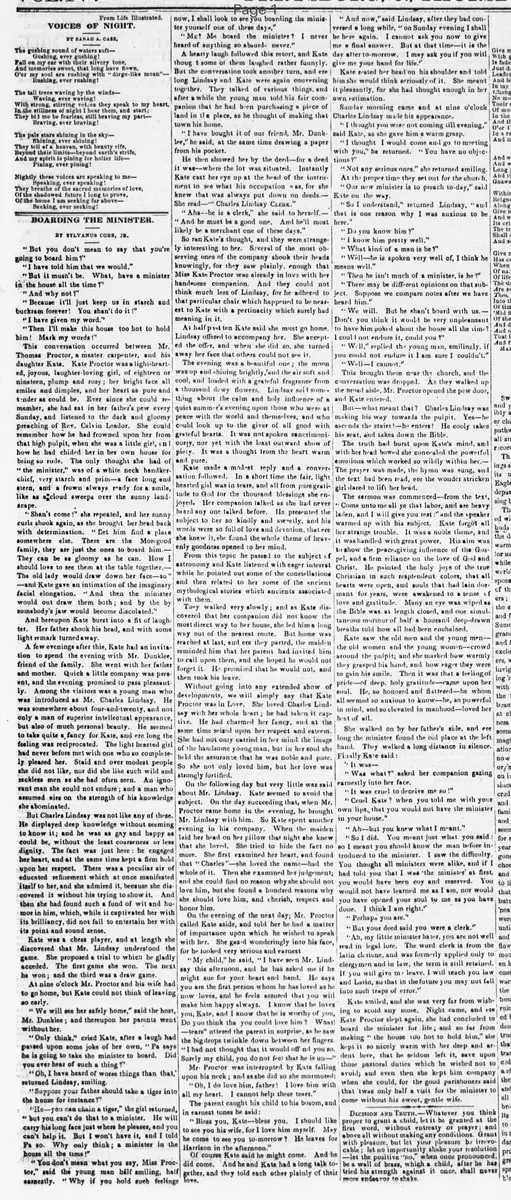
BOARDING THE MINISTER
BY SYLVANUS COBB, JR.
"But you don't mean to say that you're going to board him?"
"I have told him that we would."
"But it mustn't be. What, have a minister in the house all the time?"
"And why not?"
"Because it'll just keep us in starch and buckram forever! You shan't do it!"
"I have given my word."
"Then I'll make this house too hot to hold him! Mark my words!"
This conversation occurred between Mr. Thomas Proctor, a master carpenter, and his daughter Kate. Kate Proctor was a light-hearted, joyous, laughter-loving girl, of eighteen or nineteen, plump and rosy: her bright face all smiles and dimples, and her heart as pure and tender as could be. Ever since she could remember, she had sat in her father's pew every Sunday, and listened to the dark and gloomy preaching of Rev. Calvin Leader. She could remember how he had frowned upon her from that high pulpit, when she was a little girl, and how he had chided her in her own house for being so rude. The only thought she had of "the minister" was of a white neck handkerchief, very starch and prim—a face long and stern, and a frown always ready for a smile, like as a cloud sweeps over the sunny landscape.
"Shan't come!" she repeated, and her sunny curls shook again, as she brought her head back with determination. "Let him find a place somewhere else. There are the Moregood family, they are just the ones to board him. They can be as gloomy as he can. How should love to see them at the table together. The old lady would draw down her face—so"—and Kate gave an intimation of the imaginary facial elongation. "And then the minister would outdraw them both; and by the by somebody's jaw would become dislocated."
And hereupon Kate burst into a fit of laughter. Her father shook his head, and with some light remark turned away.
A few evenings after this, Kate had an invitation to spend the evening with Mr. Dunklee, friend of the family. She went with her father and mother. Quite a little company was present, and the evening promised to pass pleasantly. Among the visitors was a young man who was introduced as Mr. Charles Lindsay. He was somewhere about four-and-twenty, and not only a man of superior intellectual appearance, but also of much personal beauty. He seemed to take quite a fancy for Kate, and ere long the feeling was reciprocated. The light-hearted girl had never before met with one who so completely pleased her. Staid and over-modest people she did not like, nor did she like such wild and reckless men as she had often seen. An ignorant man she could not endure; and a man who assumed airs on the strength of his knowledge she abominated.
But Charles Lindsay was not like any of these. He displayed deep knowledge without seeming to know it; and he was as gay and happy as could be, without the least coarseness or less dignity. The fact was just here: he engaged her heart, and at the same time kept a firm hold upon her respect. There was a peculiar air of educated refinement which at once manifested itself to her, and she admired it, because she discovered it without his trying to show it. And then she had found such a fund of wit and humor in him, which, while it captivated her with its brilliancy, did not fail to entertain her with its point and sound sense.
Kate was a chess player, and at length she discovered that Mr. Lindsay understood the game. She proposed a trial to which he gladly acceded. The first game she won. The next he won; and the third was a draw game.
At nine o'clock Mr. Proctor and his wife had to go home, but Kate could not think of leaving so early.
"We will see her safely home," said the host, Mr. Dunklee; and thereupon her parents went without her.
"Only think," cried Kate, after a laugh had passed upon some joke of her own, "Pa says he is going to take the minister to board. Did you ever hear of such a thing?"
"Oh, I have heard of worse things than that," returned Lindsay, smiling.
"Suppose your father should take a tiger into the house for instance?"
"Ho—you can chain a tiger," the girl returned, "but you can't do that to a minister. He will carry his long face just where he pleases, and you can't help it. But I won't have it, and I told Pa so. Why only think; a minister in the house all the time!"
"You don't mean what you say, Miss Proctor," said the young man half smiling, half earnestly. "Why if you hold such feelings now, I shall look to see you boarding the minister yourself one of these days."
"Me? Me board the minister? I never heard of anything so absurd—never."
A hearty laugh followed this retort, and Kate thought some of them laughed rather funnily. But the conversation took another turn, and ere long Lindsay and Kate were again conversing together. They talked of various things, and after a while the young man told his fair companion that he had been purchasing a piece of land in the place, as he thought of making that town his home.
"I have bought it of our friend, Mr. Dunklee," he said, at the same time drawing a paper from his pocket.
He then showed her by the deed—for a deed it was—where the lot was situated. Instantly Kate cast her eye up at the head of the instrument to see what his occupation was, for she knew that was always put down on deeds.
She read—“Charles Lindsay, Clerk."
"Aha—he is a clerk," she said to herself. "And he must be a good one. And he'll most likely be a merchant one of these days."
So ran Kate's thought, and they were strangely interesting to her. Several of the most observing ones of the company shook their heads knowingly, for they saw plainly enough that Miss Kate Proctor was already in love with her handsome companion. And they could not think much less of Lindsay, for he adhered to that particular chair which happened to be nearest to Kate with a pertinacity which surely had meaning in it.
At half-past ten Kate said she must go home. Lindsay offered to accompany her. She accepted the offer, and when she did so, she turned away her face that others could not see it.
The evening was a beautiful one; the moon was up and shining brightly, and the air soft and cool, and loaded with a grateful fragrance from thousand dewy flowers. Lindsay said something about the calm and holy influence of a quiet summer's evening upon those who were at peace with the world and themselves, and who could look up to the giver of all good with grateful hearts. It was not spoken sanctimoniously, nor yet with the least outward show of piety. It was a thought from the heart warm and pure.
Kate made a modest reply and a conversation followed. In a short time the fair, light-hearted girl was in tears, and all from pure gratitude to God for the thousand blessings she enjoyed. Her companion talked as she had never heard any one talked before. He presented the subject to her so kindly and sweetly, and his words were so full of love and devotion, that ere she knew it, she found the whole theme of heavenly goodness opened to her mind.
From this topic he passed to the subject of astronomy and Kate listened with eager interest while he pointed out some of the constellations and then related to her some of the ancient mythological stories which ancients associated with them.
They walked very slowly; and as Kate discovered that her companion did not know the most direct way to her house, she led him a long way out of the nearest route. But home was reached at last, and ere they parted, the maiden reminded him that her parents had invited him to call upon them, and she hoped he would not forget it. He promised that he would not, and then took his leave.
Without going into any extended show of developments, we will simply say that Kate Proctor was in love. She loved Charles Lindsay with her whole heart; he had taken it captive. He had charmed her fancy, and at the same time seized upon her respect and esteem. She had not only carried in her mind the image of the handsome young man, but in her soul she held the assurance that he was noble and pure. So she not only loved him, but her love was strongly fortified.
On the following day but very little was said about Mr. Lindsay. Kate seemed to avoid the subject. On the day succeeding that, when Mr. Proctor came home in the evening, he brought Mr. Lindsay with him. So Kate spent another evening in his company. When the maiden laid her head on her pillow that night she knew that she loved. She tried to hide the fact no more. She first examined her heart, and found that "Charles"—she loved the name—had the whole of it. Then she examined her judgment; and she could find no reason why she should not love him, but she found a hundred reasons why she should love him, and cherish, respect and honor him.
On the evening of the next day: Mr. Proctor called Kate aside, and told her he had a matter of importance upon which he wished to speak with her. She gazed wonderingly into his face, for he looked very serious and earnest.
"My child," he said, "I have seen Mr. Lindsay this afternoon, and he has asked me if he might sue for your heart and hand. He says you are the first person whom he has loved as he now loves, and he feels assured that you will make him happy always. I know that he loves you, Kate, and I know that he is worthy of you. Do you think that you could love him? What!—tears" uttered the parent in surprise, as he saw the big drops twinkle down between her fingers.
Surely my child, you do not feel that he
Mr. Proctor was interrupted by Kate falling upon his neck; and as she did so she murmured:
"Oh, I do love him, father! I love him with all my heart. I cannot help these tears."
The parent caught his child to his bosom, and in earnest tones he said:
"Bless you, Kate—bless you. I should like to see you his wife, for I love him myself. May he come to see you to-morrow? He leaves for Harrison in the afternoon."
Of course Kate said he might come. And he did come. And he and Kate had a long talk together, and they told each other plainly of their love.
Kate rested her head on his shoulder and told him she would think seriously of it. She meant it pleasantly, for she had thought enough in her own estimation.
Sunday morning came and at nine o'clock Charles Lindsay made his appearance.
"I thought you were not coming till evening," said Kate, as she gave him a warm grasp.
"I thought I would come and go to meeting with you," he returned. "You have no objections?"
"Not any serious ones," she returned smiling.
At the proper time they set out for the church.
"Our new minister is to preach to-day," said Kate on the way.
"So I understand," returned Lindsay, "and that is one reason why I was anxious to be here."
"Do you know him?"
"I know him pretty well."
"What kind of a man is he?"
"Well—he is spoken very well of, I think he means well."
"Then he isn't much of a minister, is he?"
"There may be different opinions on that subject. Suppose we compare notes after we have heard him."
"We will. But he shan't board with us. Don't you think it would be very unpleasant to have him poked about the house all the time? I could not endure it, could you?"
"Well," replied the young man, smilingly, "if you could not endure it I am sure I couldn't."
"Well—I cannot."
This brought them near the church, and the conversation was dropped. As they walked up the broad aisle, Mr. Proctor opened the pew door, and Kate entered.
But—what meant that? Charles Lindsay was making his way towards the pulpit. Yes—he ascends the stairs!—he enters! He coolly takes his seat, and takes down the Bible.
The truth had burst upon Kate's mind, and with her head bowed she concealed the powerful emotions which worked so wildly within her. The prayer was made, the hymn was sung, and the text had been read, ere the wonder-stricken girl dared to lift her head.
The sermon was commenced—from the text, "Come unto me all ye that labor, and are heavy laden, and I will give you rest:" and the speaker warmed up with his subject. Kate forgot all her strange trouble. It was a noble theme, and it was handled with great power. His aim was to show the peace-giving influence of the Gospel, and a firm reliance on the love of God and Christ. He painted the holy joys of the true Christian in such resplendent colors, that all hearts were open, and souls that had lain dormant for years, were awakened to a sense of love and gratitude. Many an eye was wiped as the Bible was at length closed, and one simultaneous murmur of half a thousand deep-drawn breaths told how all had been enchained.
Kate saw the old men and the young men—the old women and the young women—crowd around the pulpit; and she marked how warmly they grasped his hand, and how eager they were to gain his smile. Then it was that a feeling of pride—of deep, holy gratitude—came upon her soul. He, so honored and flattered—he whom all seemed so anxious to know—he, so powerful in mind, and so elevated in manhood—loved her best of all.
She walked on by her father's side, and ere long the minister found the old place at the left hand. They walked a long distance in silence. Finally Kate said:
It was—
"Was what?" asked her companion gazing earnestly into her face.
"It was cruel to deceive me so!"
"Cruel Kate? when you told me with your own lips, that you would not have the minister in your house."
"Ah—but you knew what I meant."
"So I did. You meant just what you said: so I meant you should know the man before introduced to the minister. I saw the difficulty. You thought all ministers were alike, and if I had told you that I was 'the minister' at first, you would have been coy and reserved. You would not have learned me as I am, nor would you have opened your soul to me as you have done. I think I am right."
"Perhaps you are."
"But your deed said you were a clerk."
"Ah, my little minister hater, you are not well read in legal lore. The word clerk is from the Latin clericus, and was formerly applied only to clergymen and in law, the term is still retained. If you will give me leave, I will teach you law and Latin, so that in the future you may not fall into such traps of error."
Kate smiled, and she was very far from wishing to scold any more. Night came, and ere Kate Proctor slept again, she had concluded to board the minister for life; and so far from making "the house too hot to hold him," she kept it so nicely warm with her deep and ardent love, that he seldom left it, save upon those pastoral duties which he wished not to avoid; and even then she kept him company when she could, for the good parishioners said that 'twas only half a visit for the minister to come without his sweet, gentle wife.
BY SYLVANUS COBB, JR.
"But you don't mean to say that you're going to board him?"
"I have told him that we would."
"But it mustn't be. What, have a minister in the house all the time?"
"And why not?"
"Because it'll just keep us in starch and buckram forever! You shan't do it!"
"I have given my word."
"Then I'll make this house too hot to hold him! Mark my words!"
This conversation occurred between Mr. Thomas Proctor, a master carpenter, and his daughter Kate. Kate Proctor was a light-hearted, joyous, laughter-loving girl, of eighteen or nineteen, plump and rosy: her bright face all smiles and dimples, and her heart as pure and tender as could be. Ever since she could remember, she had sat in her father's pew every Sunday, and listened to the dark and gloomy preaching of Rev. Calvin Leader. She could remember how he had frowned upon her from that high pulpit, when she was a little girl, and how he had chided her in her own house for being so rude. The only thought she had of "the minister" was of a white neck handkerchief, very starch and prim—a face long and stern, and a frown always ready for a smile, like as a cloud sweeps over the sunny landscape.
"Shan't come!" she repeated, and her sunny curls shook again, as she brought her head back with determination. "Let him find a place somewhere else. There are the Moregood family, they are just the ones to board him. They can be as gloomy as he can. How should love to see them at the table together. The old lady would draw down her face—so"—and Kate gave an intimation of the imaginary facial elongation. "And then the minister would outdraw them both; and by the by somebody's jaw would become dislocated."
And hereupon Kate burst into a fit of laughter. Her father shook his head, and with some light remark turned away.
A few evenings after this, Kate had an invitation to spend the evening with Mr. Dunklee, friend of the family. She went with her father and mother. Quite a little company was present, and the evening promised to pass pleasantly. Among the visitors was a young man who was introduced as Mr. Charles Lindsay. He was somewhere about four-and-twenty, and not only a man of superior intellectual appearance, but also of much personal beauty. He seemed to take quite a fancy for Kate, and ere long the feeling was reciprocated. The light-hearted girl had never before met with one who so completely pleased her. Staid and over-modest people she did not like, nor did she like such wild and reckless men as she had often seen. An ignorant man she could not endure; and a man who assumed airs on the strength of his knowledge she abominated.
But Charles Lindsay was not like any of these. He displayed deep knowledge without seeming to know it; and he was as gay and happy as could be, without the least coarseness or less dignity. The fact was just here: he engaged her heart, and at the same time kept a firm hold upon her respect. There was a peculiar air of educated refinement which at once manifested itself to her, and she admired it, because she discovered it without his trying to show it. And then she had found such a fund of wit and humor in him, which, while it captivated her with its brilliancy, did not fail to entertain her with its point and sound sense.
Kate was a chess player, and at length she discovered that Mr. Lindsay understood the game. She proposed a trial to which he gladly acceded. The first game she won. The next he won; and the third was a draw game.
At nine o'clock Mr. Proctor and his wife had to go home, but Kate could not think of leaving so early.
"We will see her safely home," said the host, Mr. Dunklee; and thereupon her parents went without her.
"Only think," cried Kate, after a laugh had passed upon some joke of her own, "Pa says he is going to take the minister to board. Did you ever hear of such a thing?"
"Oh, I have heard of worse things than that," returned Lindsay, smiling.
"Suppose your father should take a tiger into the house for instance?"
"Ho—you can chain a tiger," the girl returned, "but you can't do that to a minister. He will carry his long face just where he pleases, and you can't help it. But I won't have it, and I told Pa so. Why only think; a minister in the house all the time!"
"You don't mean what you say, Miss Proctor," said the young man half smiling, half earnestly. "Why if you hold such feelings now, I shall look to see you boarding the minister yourself one of these days."
"Me? Me board the minister? I never heard of anything so absurd—never."
A hearty laugh followed this retort, and Kate thought some of them laughed rather funnily. But the conversation took another turn, and ere long Lindsay and Kate were again conversing together. They talked of various things, and after a while the young man told his fair companion that he had been purchasing a piece of land in the place, as he thought of making that town his home.
"I have bought it of our friend, Mr. Dunklee," he said, at the same time drawing a paper from his pocket.
He then showed her by the deed—for a deed it was—where the lot was situated. Instantly Kate cast her eye up at the head of the instrument to see what his occupation was, for she knew that was always put down on deeds.
She read—“Charles Lindsay, Clerk."
"Aha—he is a clerk," she said to herself. "And he must be a good one. And he'll most likely be a merchant one of these days."
So ran Kate's thought, and they were strangely interesting to her. Several of the most observing ones of the company shook their heads knowingly, for they saw plainly enough that Miss Kate Proctor was already in love with her handsome companion. And they could not think much less of Lindsay, for he adhered to that particular chair which happened to be nearest to Kate with a pertinacity which surely had meaning in it.
At half-past ten Kate said she must go home. Lindsay offered to accompany her. She accepted the offer, and when she did so, she turned away her face that others could not see it.
The evening was a beautiful one; the moon was up and shining brightly, and the air soft and cool, and loaded with a grateful fragrance from thousand dewy flowers. Lindsay said something about the calm and holy influence of a quiet summer's evening upon those who were at peace with the world and themselves, and who could look up to the giver of all good with grateful hearts. It was not spoken sanctimoniously, nor yet with the least outward show of piety. It was a thought from the heart warm and pure.
Kate made a modest reply and a conversation followed. In a short time the fair, light-hearted girl was in tears, and all from pure gratitude to God for the thousand blessings she enjoyed. Her companion talked as she had never heard any one talked before. He presented the subject to her so kindly and sweetly, and his words were so full of love and devotion, that ere she knew it, she found the whole theme of heavenly goodness opened to her mind.
From this topic he passed to the subject of astronomy and Kate listened with eager interest while he pointed out some of the constellations and then related to her some of the ancient mythological stories which ancients associated with them.
They walked very slowly; and as Kate discovered that her companion did not know the most direct way to her house, she led him a long way out of the nearest route. But home was reached at last, and ere they parted, the maiden reminded him that her parents had invited him to call upon them, and she hoped he would not forget it. He promised that he would not, and then took his leave.
Without going into any extended show of developments, we will simply say that Kate Proctor was in love. She loved Charles Lindsay with her whole heart; he had taken it captive. He had charmed her fancy, and at the same time seized upon her respect and esteem. She had not only carried in her mind the image of the handsome young man, but in her soul she held the assurance that he was noble and pure. So she not only loved him, but her love was strongly fortified.
On the following day but very little was said about Mr. Lindsay. Kate seemed to avoid the subject. On the day succeeding that, when Mr. Proctor came home in the evening, he brought Mr. Lindsay with him. So Kate spent another evening in his company. When the maiden laid her head on her pillow that night she knew that she loved. She tried to hide the fact no more. She first examined her heart, and found that "Charles"—she loved the name—had the whole of it. Then she examined her judgment; and she could find no reason why she should not love him, but she found a hundred reasons why she should love him, and cherish, respect and honor him.
On the evening of the next day: Mr. Proctor called Kate aside, and told her he had a matter of importance upon which he wished to speak with her. She gazed wonderingly into his face, for he looked very serious and earnest.
"My child," he said, "I have seen Mr. Lindsay this afternoon, and he has asked me if he might sue for your heart and hand. He says you are the first person whom he has loved as he now loves, and he feels assured that you will make him happy always. I know that he loves you, Kate, and I know that he is worthy of you. Do you think that you could love him? What!—tears" uttered the parent in surprise, as he saw the big drops twinkle down between her fingers.
Surely my child, you do not feel that he
Mr. Proctor was interrupted by Kate falling upon his neck; and as she did so she murmured:
"Oh, I do love him, father! I love him with all my heart. I cannot help these tears."
The parent caught his child to his bosom, and in earnest tones he said:
"Bless you, Kate—bless you. I should like to see you his wife, for I love him myself. May he come to see you to-morrow? He leaves for Harrison in the afternoon."
Of course Kate said he might come. And he did come. And he and Kate had a long talk together, and they told each other plainly of their love.
Kate rested her head on his shoulder and told him she would think seriously of it. She meant it pleasantly, for she had thought enough in her own estimation.
Sunday morning came and at nine o'clock Charles Lindsay made his appearance.
"I thought you were not coming till evening," said Kate, as she gave him a warm grasp.
"I thought I would come and go to meeting with you," he returned. "You have no objections?"
"Not any serious ones," she returned smiling.
At the proper time they set out for the church.
"Our new minister is to preach to-day," said Kate on the way.
"So I understand," returned Lindsay, "and that is one reason why I was anxious to be here."
"Do you know him?"
"I know him pretty well."
"What kind of a man is he?"
"Well—he is spoken very well of, I think he means well."
"Then he isn't much of a minister, is he?"
"There may be different opinions on that subject. Suppose we compare notes after we have heard him."
"We will. But he shan't board with us. Don't you think it would be very unpleasant to have him poked about the house all the time? I could not endure it, could you?"
"Well," replied the young man, smilingly, "if you could not endure it I am sure I couldn't."
"Well—I cannot."
This brought them near the church, and the conversation was dropped. As they walked up the broad aisle, Mr. Proctor opened the pew door, and Kate entered.
But—what meant that? Charles Lindsay was making his way towards the pulpit. Yes—he ascends the stairs!—he enters! He coolly takes his seat, and takes down the Bible.
The truth had burst upon Kate's mind, and with her head bowed she concealed the powerful emotions which worked so wildly within her. The prayer was made, the hymn was sung, and the text had been read, ere the wonder-stricken girl dared to lift her head.
The sermon was commenced—from the text, "Come unto me all ye that labor, and are heavy laden, and I will give you rest:" and the speaker warmed up with his subject. Kate forgot all her strange trouble. It was a noble theme, and it was handled with great power. His aim was to show the peace-giving influence of the Gospel, and a firm reliance on the love of God and Christ. He painted the holy joys of the true Christian in such resplendent colors, that all hearts were open, and souls that had lain dormant for years, were awakened to a sense of love and gratitude. Many an eye was wiped as the Bible was at length closed, and one simultaneous murmur of half a thousand deep-drawn breaths told how all had been enchained.
Kate saw the old men and the young men—the old women and the young women—crowd around the pulpit; and she marked how warmly they grasped his hand, and how eager they were to gain his smile. Then it was that a feeling of pride—of deep, holy gratitude—came upon her soul. He, so honored and flattered—he whom all seemed so anxious to know—he, so powerful in mind, and so elevated in manhood—loved her best of all.
She walked on by her father's side, and ere long the minister found the old place at the left hand. They walked a long distance in silence. Finally Kate said:
It was—
"Was what?" asked her companion gazing earnestly into her face.
"It was cruel to deceive me so!"
"Cruel Kate? when you told me with your own lips, that you would not have the minister in your house."
"Ah—but you knew what I meant."
"So I did. You meant just what you said: so I meant you should know the man before introduced to the minister. I saw the difficulty. You thought all ministers were alike, and if I had told you that I was 'the minister' at first, you would have been coy and reserved. You would not have learned me as I am, nor would you have opened your soul to me as you have done. I think I am right."
"Perhaps you are."
"But your deed said you were a clerk."
"Ah, my little minister hater, you are not well read in legal lore. The word clerk is from the Latin clericus, and was formerly applied only to clergymen and in law, the term is still retained. If you will give me leave, I will teach you law and Latin, so that in the future you may not fall into such traps of error."
Kate smiled, and she was very far from wishing to scold any more. Night came, and ere Kate Proctor slept again, she had concluded to board the minister for life; and so far from making "the house too hot to hold him," she kept it so nicely warm with her deep and ardent love, that he seldom left it, save upon those pastoral duties which he wished not to avoid; and even then she kept him company when she could, for the good parishioners said that 'twas only half a visit for the minister to come without his sweet, gentle wife.
What sub-type of article is it?
Prose Fiction
What themes does it cover?
Love Romance
Religious
What keywords are associated?
Minister Boarding
Romance
Prejudice
Family
Church
Love
Sermon
Proposal
What entities or persons were involved?
By Sylvanus Cobb, Jr.
Literary Details
Title
Boarding The Minister
Author
By Sylvanus Cobb, Jr.
Key Lines
"But You Don't Mean To Say That You're Going To Board Him?"
"Shan't Come!" She Repeated, And Her Sunny Curls Shook Again, As She Brought Her Head Back With Determination.
"It Was Cruel To Deceive Me So!"
"Ah, My Little Minister Hater, You Are Not Well Read In Legal Lore. The Word Clerk Is From The Latin Clericus, And Was Formerly Applied Only To Clergymen"
Night Came, And Ere Kate Proctor Slept Again, She Had Concluded To Board The Minister For Life