Thank you for visiting SNEWPapers!
Sign up free
Story
March 8, 1885
Springfield Globe Republic
Springfield, Clark County, Ohio
What is this article about?
Article explores the extensive memorization demands on actors, exemplified by Edwin Booth's repertory of 16 plays requiring at least 200,000 words. Includes anecdotes from Harry Watkins, elder Booth, and Mr. Barrett on methods of learning lines, such as by eye, ear, or writing.
Clipping
OCR Quality
96%
Excellent
Full Text
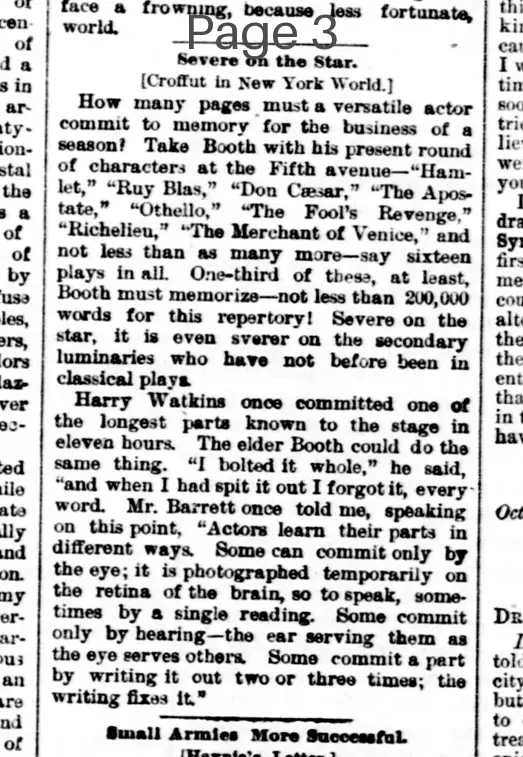
Severe on the Star.
[Croffut in New York World.]
How many pages must a versatile actor commit to memory for the business of a season? Take Booth with his present round of characters at the Fifth avenue-"Hamlet," "Ruy Blas," "Don Caesar," "The Apostate," "Othello," "The Fool's Revenge," "Richelieu," "The Merchant of Venice," and not less than as many more-say sixteen plays in all. One-third of these, at least, Booth must memorize-not less than 200,000 words for this repertory! Severe on the star, it is even severer on the secondary luminaries who have not before been in classical plays.
Harry Watkins once committed one of the longest parts known to the stage in eleven hours. The elder Booth could do the same thing. "I bolted it whole," he said, "and when I had spit it out I forgot it, every word." Mr. Barrett once told me, speaking on this point, "Actors learn their parts in different ways. Some can commit only by the eye; it is photographed temporarily on the retina of the brain, so to speak, sometimes by a single reading. Some commit only by hearing-the ear serving them as the eye serves others. Some commit a part by writing it out two or three times; the writing fixes it."
[Croffut in New York World.]
How many pages must a versatile actor commit to memory for the business of a season? Take Booth with his present round of characters at the Fifth avenue-"Hamlet," "Ruy Blas," "Don Caesar," "The Apostate," "Othello," "The Fool's Revenge," "Richelieu," "The Merchant of Venice," and not less than as many more-say sixteen plays in all. One-third of these, at least, Booth must memorize-not less than 200,000 words for this repertory! Severe on the star, it is even severer on the secondary luminaries who have not before been in classical plays.
Harry Watkins once committed one of the longest parts known to the stage in eleven hours. The elder Booth could do the same thing. "I bolted it whole," he said, "and when I had spit it out I forgot it, every word." Mr. Barrett once told me, speaking on this point, "Actors learn their parts in different ways. Some can commit only by the eye; it is photographed temporarily on the retina of the brain, so to speak, sometimes by a single reading. Some commit only by hearing-the ear serving them as the eye serves others. Some commit a part by writing it out two or three times; the writing fixes it."
What sub-type of article is it?
Curiosity
Biography
What themes does it cover?
Triumph
What keywords are associated?
Actor Memorization
Booth Repertory
Learning Lines
Theater Demands
Classical Plays
What entities or persons were involved?
Booth
Harry Watkins
Elder Booth
Mr. Barrett
Croffut
Where did it happen?
Fifth Avenue
Story Details
Key Persons
Booth
Harry Watkins
Elder Booth
Mr. Barrett
Croffut
Location
Fifth Avenue
Story Details
Versatile actor Booth memorizes at least 200,000 words for 16 plays in his repertory at the Fifth Avenue theater. Anecdotes highlight rapid learning: Harry Watkins memorized a long part in eleven hours; elder Booth forgot lines after performance; Mr. Barrett describes methods including visual, auditory, and writing approaches.