Thank you for visiting SNEWPapers!
Sign up free
Virginia Argus
Richmond, Virginia
What is this article about?
An analytical essay critiquing the British Empire's political system, arguing that praises by Montesquieu and Delolme overlook practical corruption in parliament, judiciary, and monarchy under Stuart and Hanoverian rulers, leading to eroded liberties and constitutional balance.
Clipping
OCR Quality
Full Text
RICHMOND.
FRIDAY, JUNE 30 1809.
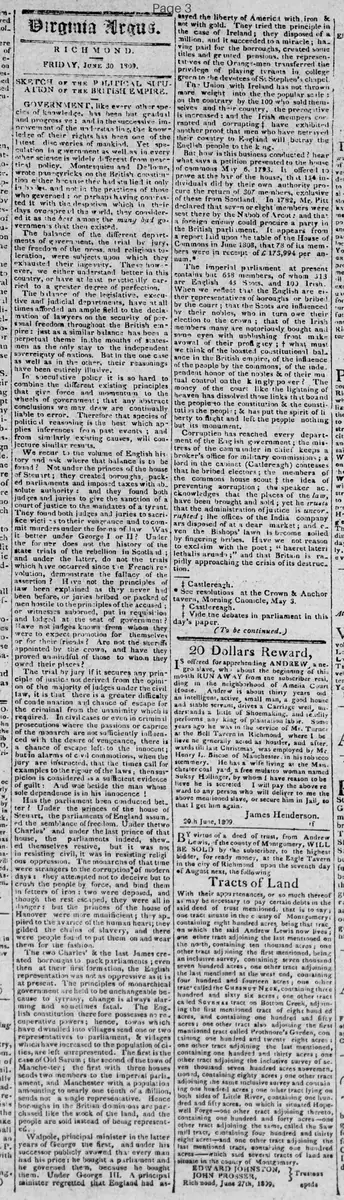
SKETCH OF THE POLITICAL SITUATION OF THE BRITISH EMPIRE.
GOVERNMENT, like every other species of knowledge, has been but gradual and progressive : and in the successive improvement of the understanding the knowledge of their rights has been one of the latest discoveries of mankind. Yet speculation in government as well as in every other science is widely different from practical policy. Montesquieu and Delolme. wrote panegyricks on the British constitution either because they had studied it only in books. and not in the practices of those who governed : or perhaps having contrasted it with the despotism which in their days overspread the world, they considered it as the best among the many bad governments that then existed.
The balance of the different departments of government, the trial by jury, the freedom of the press. and religious toleration, were subjects upon which they exhausted their ingenuity. These however, we either understand better in this country, or have at least practically carried to a greater degree of perfection.
The balance of the legislative, executive and judicial departments, have at all times afforded an ample field to the declamation of lawyers on the security of personal freedom throughout the British empire: just as a similar balance has been a perpetual theme in the mouths of statesmen as the only stay to the independent sovereignty of nations. But in the one case as well as in the other, their reasonings have been entirely illusive.
In speculative policy it is so hard to combine the different existing principles that give force and momentum to the wheels of government; that any abstract conclusions we may draw are continually liable to error. Therefore that species of political reasoning is the best which applies inferences from past events; and from similarly existing causes, will conjecture similar results.
We recur to the volume of English history and ask where that balance is to be found? Not under the princes of the house of Stuart: they created boroughs, packed parliaments and imposed taxes with absolute authority : and they found both judges and juries to give the sanction of a court of justice to the mandates of a tyrant. They found both judges and juries to sacrifice victims to their vengeance and to commit murders under the forms of law Was it better under George I or II? Under the former does not the history of the state trials of the rebellion in Scotland ; and under the latter, do not the trials which have occurred since the French revolution, demonstrate the fallacy of the assertion ? Have not the principles of law been explained as they never had been before, or juries bribed or packed of men hostile to the principles of the accused ; or witnesses suborned, put in requisition and lodged at the seat of government? Have not judges known from whom they were to expect promotion for themselves or for their friends? Are not the sheriffs appointed by the crown, and have they proved unmindful of those to whom they owed their places?
The trial by jury if it secures any principle of justice not derived from the opinion of the majority of judges under the civil law, it is that there is a greater difficulty of condemnation and chance of escape for the criminal from the unanimity which is required. In civil cases or even in criminal prosecutions where the passions or caprice of the monarch are not sufficiently influenced with the desire of vengeance, there is a chance of escape left to the innocent; but in alarms of civil commotions, when the jury are instructed, that the times call for examples to the rigour of the laws; then suspicion is considered as a sufficient evidence of guilt : And woe betide the man whose sole dependence is in his innocence !
Has the parliament been conducted better? Under the princes of the house of Stuart, the parliaments of England assumed the semblance of freedom. Under the two Charles' and under the last prince of that house, the parliaments indeed, shewed themselves restive, but it was not in resisting civil, it was in resisting religious oppression. The monarchs of that time were strangers to the corruption of modern days : they attempted not to deceive but to crush the people by force, and bind them in fetters of iron : two were deposed, and though the rest escaped, they were all in danger: but the princes of the house of Hanover were more munificent; they applied to the avarice of the human heart; they gilded the chains of slavery, and there were people found to put them on and wear them for the fashion.
The two Charles'& the last James created boroughs to pack parliaments ; even then at their first formation, the English representation was not as oppressive as it is at present. The principles of monarchical government are held to be unchangeable because to tyranny, change is always alarming and sometimes fatal. The English constitution therefore possesses no recuperative powers; hence, towns which have dwindled into villages send one or two representatives to parliament, & villages which have increased to the population of cities, are left unrepresented. The first is the Case of Old Sarum; the second of the town of Manchester; the first with three houses sends two members to the imperial parliament, and Manchester with a population amounting to nearly one tenth of a million, sends not a single representative. Hence boroughs in the British dominions are purchased like the stock of the land, and the people are sold instead of being represented.
Walpole, principal minister in the latter years of George the first, and under his successor publicly avowed that every man had his price: he bought a parliament and he governed them, because he bought them. Under George III. A principal minister regretted that England had assayed the liberty of America with iron &
not with gold. They tried the principle in the case of Ireland; they disposed of a million. and it succeeded to a miracle; having paid for the boroughs, Created some titles and granted pensions. the representatives of the Orange-men transferred the privilege of playing tyrants in. college green to the devotees of St Stephen's chapel.
The Union with Ireland has not thrown more weight into the popular scale : on the contrary by the 100 who sold themselves and their country, the prerogative is increased: and the Irish members corrupted and corrupting have exhibited another proof that men who have betrayed their country to England will betray the English people to the king.
But how is this business conducted ? hear what says a petition presented to the house of commons May 6, 1793. It offered to prove at the bar of the house, that 44 individuals did by their own authority procure the return of 307 members, exclusive of these from Scotland. In 1782, Mr. Pitt declared that seven or eight members were sent there by the Nabob of Arcot: and that a foreign enemy could procure a party in the British parliament. It appears from a report laid upon the table of the House of Commons in June 1808, that 78 of its members were in receipt of £617,994 per annum.*
The imperial parliament at present contains but 658 members, of whom 513 are English 45 Scots, and 100 Irish. When we reflect that the English are either representatives of boroughs or bribed by the court: that the Scots are influenced by their nobles, who in turn owe their election to the crown : that of the Irish members many are notoriously bought and some even with unblushing front make avowal of their prodigacy ; what must we think of the boasted constitutional balance in the British empire, of the influence of the people by the commons, of the independent honor of the nobles & of their mutual control on the kingly power? The money of the court like the lightning of heaven has dissolved those links that bound the people to the constitution & the constitution the people; & has put the spirit of liberty to flight and left the people nothing but its monument.
Corruption has reached every department of the English government; the mistress of the commander in chief keeps a broker's office for military commissions; a lord in the cabinet (Castlereagh) confesses that he bribed electors; the members of the commons house scout the idea of preventing corruption; the speaker acknowledges that the places of the law, have been bought and sold; yet he trusts that the administration of justice is uncorrupted; the offices of the India company are disposed of at a dear market; and even the Bishops'lawn is become soiled by fingering bribes. Have we not reason to exclaim with the poet; "haeret lateri lethalis arundo;" and that Britain is rapidly approaching the crisis of its destruction.
*Castlereagh.
See resolutions at the Crown & Anchor tavera, Morning Chronicle, May 3.
†Castlereagh.
Vide the debates in parliament in this day's paper.
(To be continued.)
What sub-type of article is it?
What keywords are associated?
What entities or persons were involved?
Where did it happen?
Foreign News Details
Primary Location
British Empire
Key Persons
Outcome
corruption has eroded constitutional balance, leading to potential destruction of britain.
Event Details
The essay critiques the British constitution's practical failures, including corruption in parliament through bought boroughs and members, biased judiciary and juries, and monarchical influence, contrasting speculative ideals with historical realities under Stuart and Hanoverian rulers.