Thank you for visiting SNEWPapers!
Sign up free
Editorial
August 4, 1795
Gazette Of The United States
Philadelphia, Philadelphia County, Pennsylvania
What is this article about?
An anonymous Federalist in Alexandria, Virginia, criticizes U.S. Senator George Mason for prematurely publishing the Jay Treaty with Britain, violating Senate secrecy and the Constitution. Accuses him of seeking popularity over patriotism and references his opposition during the Whiskey Rebellion.
Clipping
OCR Quality
92%
Excellent
Full Text
From the COLUMBIAN MIRROR,
Printed at ALEXANDRIA, VIRGINIA.
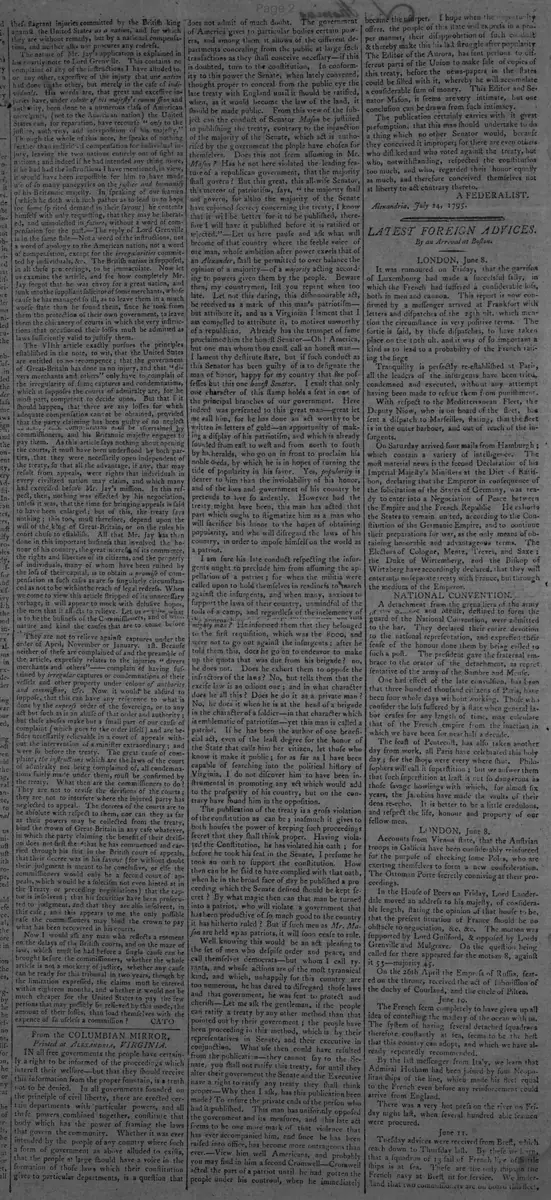
IN all free governments the people have certainly a right to be informed of the proceedings which interest their welfare—but that they should receive this information from the proper fountain, is a truth not to be denied. In all governments founded on the principle of civil liberty, there are erected certain departments with particular powers, and all these powers combined together, constitute that body which has the power of framing the laws that govern the community. Whether it was ever intended by the people of any country where such a form of government as above alluded to exists, that the people at large should have a voice in the formation of those laws which their constitution gives to particular departments, is a question that does not admit of much doubt. The government of America gives to particular bodies certain powers, and among them it allows of the different departments concealing from the public at large such transactions as they shall conceive necessary—if this is doubted, turn to the constitution. In conformity to this power the Senate, when lately convened, thought proper to conceal from the public eye the late treaty with England until it should be ratified, when, as it would become the law of the land, it should be made public. From this view of the subject can the conduct of Senator Mason be justified in publishing the treaty, contrary to the injunction of the majority of the Senate, 'which act is authorized by the government the people have chosen for themselves. Does this not seem assuming in Mr. Mason? Has he not here violated the leading feature of a republican government, that the majority shall govern? But this great, this all-wise Senator, this meteor of patriotism, says, "the majority shall not govern, for altho the majority of the Senate have enjoined secrecy concerning the treaty, I know that it will be better for it to be published, therefore I will have it published before it is ratified or rejected." Let us here pause and ask what will become of that country where the feeble voice of one man, whose ambition after power excels that of an Alexander, shall be permitted to over balance the opinion of a majority—of a majority acting according to powers given them by the people. Beware then, my countrymen, lest you repent when too late. Let not this daring, this dishonourable act, be received as a mark of this man's patriotism—but attribute it, and as a Virginian I lament that I am compelled to attribute it, to motives unworthy of a republican. Already has the trumpet of fame proclaimed him the honest Senator—Oh! America, but one man whom thou canst call an honest man—I lament thy destitute state, but if such conduct as this Senator has been guilty of is to designate the man of honor, happy for my country that she possesses but this one honest Senator. I exult that only one character of this stamp holds a seat in one of the principal branches of our government. Here indeed was presented to this great man—great let me call him, for he has done an act worthy to be written in letters of gold—an opportunity of making a display of his patriotism, and which is already sounded from east to west and from north to south by his heralds, who go on in front to proclaim his noble deeds, by which he is in hopes of turning the tide of popularity in his favor. Yes, popularity is dearer to him than the inviolability of his honor, and of the laws and government of his country he pretends to love so ardently. However bad the treaty, might have been, this man has acted that part which ought to stigmatize him as a man who will sacrifice his honor to the hopes of obtaining popularity, and who will disregard the laws of his country, in order to impose himself on the world as a patriot.
I am sure his late conduct respecting the insurgents ought to preclude him from assuming the appellation of a patriot; for when the militia were called upon to hold themselves in readiness to march against the insurgents, and when many, anxious to support the laws of their country, unmindful of the toils of a camp, and regardless of the inclemency of an approaching winter, this mighty man? He informed them that they belonged to the first requisition, which was the 8000, and were not to go out against the insurgents: after he told them this, does he go on to endeavor to make up the quota that was due from his brigade? no, he does not. Does he exhort them to oppose the infractors of the laws? No, but tells them that the excise law is an odious one; and in what character does he all this? Does he do it as a private man? No, he does it when he is at the head of a brigade in the character of a soldier—in that character which is emblematic of patriotism—yet this man is called a patriot. If he has been the author of one beneficial act, even of the least degree for the honor of the State that calls him her citizen, let those who know it make it public; for as far as I have been capable of searching into the political history of Virginia, I do not discover him to have been instrumental in promoting any act which would add to the prosperity of his country, but on the contrary have found him in the opposition.
The publication of the treaty is a gross violation of the constitution as can be; inasmuch it gives to both houses the power of keeping such proceedings secret that they shall think proper. Having violated the Constitution, he has violated his oath; for before he took his seat in the Senate, I presume he took an oath to support the constitution. How then can he be said to have complied with that oath, when he in the broad face of day he published a proceeding which the Senate desired should be kept secret? By what magic then can that man be turned into a patriot, who will violate a government that has been productive of so much good to the country it has hitherto ruled? But if such men as Mr. Mason are held up as patriots, it will soon cease to rule. Well knowing this would be an act pleasing to the set of men who despise order and peace, and call themselves democrats—but whom I call tyrants, and whose actions are of the most tyrannical kind, and which, unhappily for this country are too numerous, he has dared to disregard those laws and that government, he was sent to protect and cherish—Let me ask the gentleman, if the people can ratify a treaty by any other method than that pointed out by their government; the people have been proceeding in this method, which is by their representatives in Senate, and their executive in conjunction. What use then could have resulted from the publication—they cannot say to the Senate, you shall not ratify this treaty, for until they alter their government the Senate and the Executive have a right to ratify any treaty they shall think proper—Why then I ask, has this publication been made? To ensure the private ends of the person who had it published. This man has uniformly opposed the government and its measures, and this late act seems to be one more mark of that violence that has ever accompanied him, and since he has been raised into office, has become more outrageous than ever. View him well Americans, and probably you may find in him a second Cromwell—Cromwell acted the part of a patriot until he had gotten the people under his controul, when he immediately became the usurper. I hope when the posterity offers, the people of this State will express in a proper manner, their disapprobation of such conduct & thereby make this his last struggle after popularity.
The Editor of the Aurora, has sent persons to different parts of the Union to make sale of copies of this treaty, before the news-papers in the states could be filled with it, whereby he will accumulate a considerable sum of money. This Editor and Senator Mason, it seems are very intimate, but one conclusion can be drawn from such intimacy.
The publication certainly carries with it great presumption, that this man should undertake to do a thing which no other Senator would, because they conceived it improper; for there are even others who disliked and who voted against the treaty, but who, notwithstanding, respected the constitution too much, and who, regarded their honor equally as much, and therefore conceived themselves not at liberty to act contrary thereto.
A FEDERALIST.
Alexandria, July 24, 1795.
Printed at ALEXANDRIA, VIRGINIA.
IN all free governments the people have certainly a right to be informed of the proceedings which interest their welfare—but that they should receive this information from the proper fountain, is a truth not to be denied. In all governments founded on the principle of civil liberty, there are erected certain departments with particular powers, and all these powers combined together, constitute that body which has the power of framing the laws that govern the community. Whether it was ever intended by the people of any country where such a form of government as above alluded to exists, that the people at large should have a voice in the formation of those laws which their constitution gives to particular departments, is a question that does not admit of much doubt. The government of America gives to particular bodies certain powers, and among them it allows of the different departments concealing from the public at large such transactions as they shall conceive necessary—if this is doubted, turn to the constitution. In conformity to this power the Senate, when lately convened, thought proper to conceal from the public eye the late treaty with England until it should be ratified, when, as it would become the law of the land, it should be made public. From this view of the subject can the conduct of Senator Mason be justified in publishing the treaty, contrary to the injunction of the majority of the Senate, 'which act is authorized by the government the people have chosen for themselves. Does this not seem assuming in Mr. Mason? Has he not here violated the leading feature of a republican government, that the majority shall govern? But this great, this all-wise Senator, this meteor of patriotism, says, "the majority shall not govern, for altho the majority of the Senate have enjoined secrecy concerning the treaty, I know that it will be better for it to be published, therefore I will have it published before it is ratified or rejected." Let us here pause and ask what will become of that country where the feeble voice of one man, whose ambition after power excels that of an Alexander, shall be permitted to over balance the opinion of a majority—of a majority acting according to powers given them by the people. Beware then, my countrymen, lest you repent when too late. Let not this daring, this dishonourable act, be received as a mark of this man's patriotism—but attribute it, and as a Virginian I lament that I am compelled to attribute it, to motives unworthy of a republican. Already has the trumpet of fame proclaimed him the honest Senator—Oh! America, but one man whom thou canst call an honest man—I lament thy destitute state, but if such conduct as this Senator has been guilty of is to designate the man of honor, happy for my country that she possesses but this one honest Senator. I exult that only one character of this stamp holds a seat in one of the principal branches of our government. Here indeed was presented to this great man—great let me call him, for he has done an act worthy to be written in letters of gold—an opportunity of making a display of his patriotism, and which is already sounded from east to west and from north to south by his heralds, who go on in front to proclaim his noble deeds, by which he is in hopes of turning the tide of popularity in his favor. Yes, popularity is dearer to him than the inviolability of his honor, and of the laws and government of his country he pretends to love so ardently. However bad the treaty, might have been, this man has acted that part which ought to stigmatize him as a man who will sacrifice his honor to the hopes of obtaining popularity, and who will disregard the laws of his country, in order to impose himself on the world as a patriot.
I am sure his late conduct respecting the insurgents ought to preclude him from assuming the appellation of a patriot; for when the militia were called upon to hold themselves in readiness to march against the insurgents, and when many, anxious to support the laws of their country, unmindful of the toils of a camp, and regardless of the inclemency of an approaching winter, this mighty man? He informed them that they belonged to the first requisition, which was the 8000, and were not to go out against the insurgents: after he told them this, does he go on to endeavor to make up the quota that was due from his brigade? no, he does not. Does he exhort them to oppose the infractors of the laws? No, but tells them that the excise law is an odious one; and in what character does he all this? Does he do it as a private man? No, he does it when he is at the head of a brigade in the character of a soldier—in that character which is emblematic of patriotism—yet this man is called a patriot. If he has been the author of one beneficial act, even of the least degree for the honor of the State that calls him her citizen, let those who know it make it public; for as far as I have been capable of searching into the political history of Virginia, I do not discover him to have been instrumental in promoting any act which would add to the prosperity of his country, but on the contrary have found him in the opposition.
The publication of the treaty is a gross violation of the constitution as can be; inasmuch it gives to both houses the power of keeping such proceedings secret that they shall think proper. Having violated the Constitution, he has violated his oath; for before he took his seat in the Senate, I presume he took an oath to support the constitution. How then can he be said to have complied with that oath, when he in the broad face of day he published a proceeding which the Senate desired should be kept secret? By what magic then can that man be turned into a patriot, who will violate a government that has been productive of so much good to the country it has hitherto ruled? But if such men as Mr. Mason are held up as patriots, it will soon cease to rule. Well knowing this would be an act pleasing to the set of men who despise order and peace, and call themselves democrats—but whom I call tyrants, and whose actions are of the most tyrannical kind, and which, unhappily for this country are too numerous, he has dared to disregard those laws and that government, he was sent to protect and cherish—Let me ask the gentleman, if the people can ratify a treaty by any other method than that pointed out by their government; the people have been proceeding in this method, which is by their representatives in Senate, and their executive in conjunction. What use then could have resulted from the publication—they cannot say to the Senate, you shall not ratify this treaty, for until they alter their government the Senate and the Executive have a right to ratify any treaty they shall think proper—Why then I ask, has this publication been made? To ensure the private ends of the person who had it published. This man has uniformly opposed the government and its measures, and this late act seems to be one more mark of that violence that has ever accompanied him, and since he has been raised into office, has become more outrageous than ever. View him well Americans, and probably you may find in him a second Cromwell—Cromwell acted the part of a patriot until he had gotten the people under his controul, when he immediately became the usurper. I hope when the posterity offers, the people of this State will express in a proper manner, their disapprobation of such conduct & thereby make this his last struggle after popularity.
The Editor of the Aurora, has sent persons to different parts of the Union to make sale of copies of this treaty, before the news-papers in the states could be filled with it, whereby he will accumulate a considerable sum of money. This Editor and Senator Mason, it seems are very intimate, but one conclusion can be drawn from such intimacy.
The publication certainly carries with it great presumption, that this man should undertake to do a thing which no other Senator would, because they conceived it improper; for there are even others who disliked and who voted against the treaty, but who, notwithstanding, respected the constitution too much, and who, regarded their honor equally as much, and therefore conceived themselves not at liberty to act contrary thereto.
A FEDERALIST.
Alexandria, July 24, 1795.
What sub-type of article is it?
Constitutional
Partisan Politics
What keywords are associated?
Jay Treaty
Senator Mason
Constitutional Violation
Senate Secrecy
Patriotism Critique
Whiskey Rebellion
Federalist Perspective
What entities or persons were involved?
Senator Mason
Senate
Jay Treaty
England
A Federalist
Editor Of The Aurora
Cromwell
Editorial Details
Primary Topic
Criticism Of Senator Mason For Leaking The Jay Treaty
Stance / Tone
Strongly Critical Of Mason, Supportive Of Constitutional Secrecy And Majority Rule
Key Figures
Senator Mason
Senate
Jay Treaty
England
A Federalist
Editor Of The Aurora
Cromwell
Key Arguments
Publishing The Treaty Violates Senate Secrecy And The Constitution
Mason Prioritizes Personal Popularity Over Patriotism And Law
His Actions During The Whiskey Rebellion Show Lack Of Support For Government
Majority Rule Is A Core Principle Of Republican Government
Leaking Aids Democrats/Tyrants Opposing Order
Mason's History Is One Of Opposition To Beneficial Measures