Thank you for visiting SNEWPapers!
Sign up free
The Augusta Courier
Augusta, Richmond County, Georgia
What is this article about?
Governor Ernest V. Vandiver addresses the Georgia Legislature in extraordinary session, denouncing federal courts for approving Republican convention nominations while outlawing Georgia's Democratic statewide primaries. He defends the county unit system, asserts vote equality, and urges legislative action on reapportionment to avoid judicial intervention, referencing cases like Baker v. Carr, Toombs, and Sanders.
Clipping
OCR Quality
Full Text
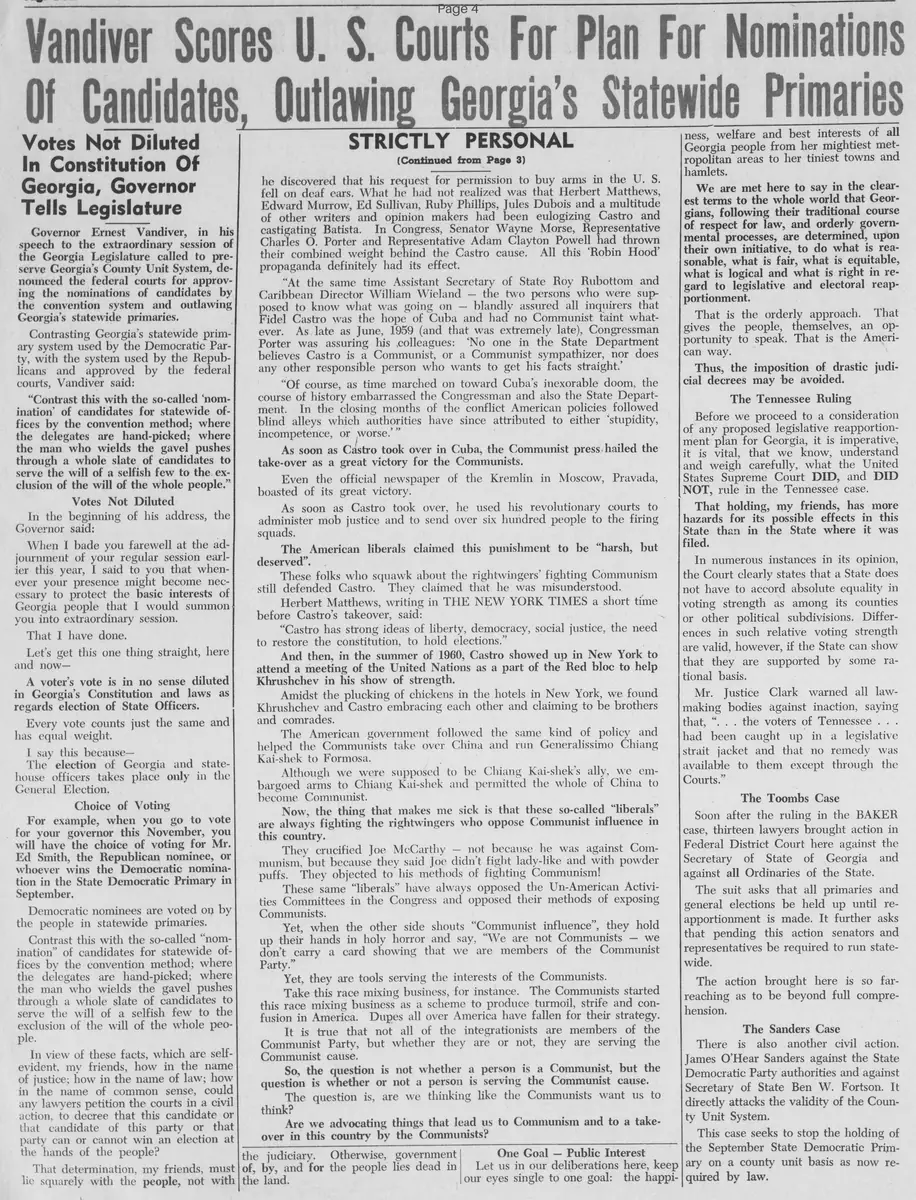
Votes Not Diluted In Constitution Of Georgia,
Governor Tells Legislature
Governor Ernest V. Vandiver, in his speech to the extraordinary session of the Georgia Legislature called to preserve Georgia's County Unit System, denounced the federal courts for approving the nominations of candidates by the convention system and outlawing Georgia's statewide primaries.
Contrasting Georgia's statewide primary system used by the Democratic Party, with the system used by the Republicans and approved by the federal courts, Vandiver said:
"Contrast this with the so-called nomination of candidates for statewide offices by the convention method; where the delegates are hand-picked; where the man who wields the gavel pushes through a whole slate of candidates to serve the will of a selfish few to the exclusion of the will of the whole people."
Votes Not Diluted
In the beginning of his address, the Governor said:
When I bade you farewell at the adjournment of your regular session earlier this year, I said to you that whenever your presence might become necessary to protect the basic interests of Georgia people that I would summon you into extraordinary session.
That I have done.
Let's get this one thing straight, here and now-
A voter's vote is in no sense diluted in Georgia's Constitution and laws as regards election of State Officers.
Every vote counts just the same and has equal weight.
I say this because-
The election of Georgia and state-house officers takes place only in the General Election.
Choice of Voting
For example, when you go to vote for your governor this November, you will have the choice of voting for Mr. Ed Smith, the Republican nominee, or whoever wins the Democratic nomination in the State Democratic Primary in September.
Democratic nominees are voted on by the people in statewide primaries.
Contrast this with the so-called "nomination" of candidates for statewide offices by the convention method; where the delegates are hand-picked; where the man who wields the gavel pushes through a whole slate of candidates to serve the will of a selfish few to the exclusion of the will of the whole people.
In view of these facts, which are self-evident, my friends, how in the name of justice; how in the name of law; how in the name of common sense, could any lawyers petition the courts in a civil action, to decree that this candidate or that candidate of this party or that party can or cannot win an election at the hands of the people?
That determination, my friends, must lie squarely with the people, not with the judiciary. Otherwise, government of, by, and for the people lies dead in the land.
Let us in our deliberations here, keep our eyes single to one goal: the happiness, welfare and best interests of all Georgia people from her mightiest metropolitan areas to her tiniest towns and hamlets.
We are met here to say in the clearest terms to the whole world that Georgians, following their traditional course of respect for law, and orderly governmental processes, are determined, upon their own initiative, to do what is reasonable, what is fair, what is equitable, what is logical and what is right in regard to legislative and electoral reapportionment.
That is the orderly approach. That gives the people, themselves, an opportunity to speak. That is the American way.
Thus, the imposition of drastic judicial decrees may be avoided.
The Tennessee Ruling
Before we proceed to a consideration of any proposed legislative reapportionment plan for Georgia, it is imperative, it is vital, that we know, understand and weigh carefully, what the United States Supreme Court DID, and DID NOT, rule in the Tennessee case.
That holding, my friends, has more hazards for its possible effects in this State than in the State where it was filed.
In numerous instances in its opinion, the Court clearly states that a State does not have to accord absolute equality in voting strength as among its counties or other political subdivisions. Differences in such relative voting strength are valid, however, if the State can show that they are supported by some rational basis.
Mr. Justice Clark warned all law-making bodies against inaction, saying that, ". . . the voters of Tennessee . . . had been caught up in a legislative strait jacket and that no remedy was available to them except through the Courts."
The Toombs Case
Soon after the ruling in the BAKER case, thirteen lawyers brought action in Federal District Court here against the Secretary of State of Georgia and against all Ordinaries of the State.
The suit asks that all primaries and general elections be held up until reapportionment is made. It further asks that pending this action senators and representatives be required to run statewide.
The action brought here is so far-reaching as to be beyond full comprehension.
The Sanders Case
There is also another civil action. James O'Hear Sanders against the State Democratic Party authorities and against Secretary of State Ben W. Fortson. It directly attacks the validity of the County Unit System.
This case seeks to stop the holding of the September State Democratic Primary on a county unit basis as now required by law.
What sub-type of article is it?
What themes does it cover?
What keywords are associated?
What entities or persons were involved?
Where did it happen?
Story Details
Key Persons
Location
Georgia
Story Details
Governor Vandiver's speech to the Georgia Legislature criticizes federal courts for invalidating statewide primaries and approving convention nominations, defends vote equality in Georgia's system, and calls for legislative reapportionment to address court challenges like Baker v. Carr, Toombs, and Sanders cases.