Thank you for visiting SNEWPapers!
Sign up free
The Evening Telegraph
Philadelphia, Philadelphia County, Pennsylvania
What is this article about?
On May 8, 1870, France held a plebiscite on the Emperor's reforms, resulting in a majority approval for the government (estimated 5 million yes vs. 3 million no), though Paris voted strongly against with 182,881 no vs. 138,790 yes. The vote passed peacefully under heavy military presence.
Clipping
OCR Quality
Full Text
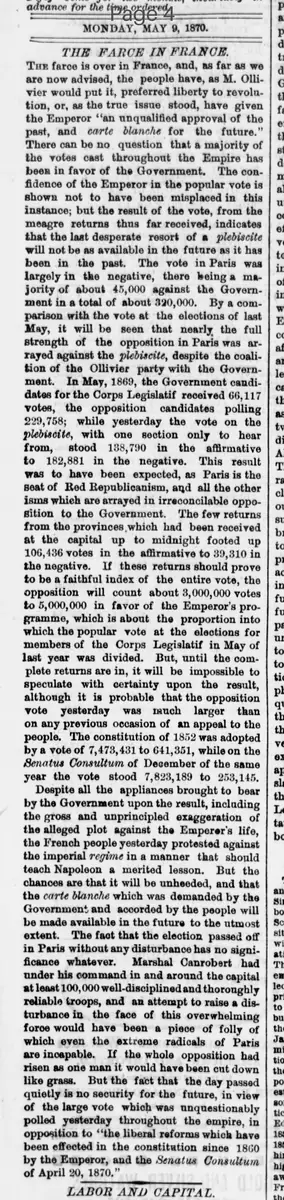
THE FARCE IN FRANCE.
The farce is over in France, and, as far as we are now advised, the people have, as M. Ollivier would put it, preferred liberty to revolution, or, as the true issue stood, have given the Emperor "an unqualified approval of the past, and carte blanche for the future."
There can be no question that a majority of the votes cast throughout the Empire has been in favor of the Government. The confidence of the Emperor in the popular vote is shown not to have been misplaced in this instance: but the result of the vote, from the meagre returns thus far received, indicates that the last desperate resort of a plebiscite will not be as available in the future as it has been in the past. The vote in Paris was largely in the negative, there being a majority of about 45,000 against the Government in a total of about 320,000. By a comparison with the vote at the elections of last May, it will be seen that nearly the full strength of the opposition in Paris was arrayed against the plebiscite, despite the coalition of the Ollivier party with the Government. In May, 1869, the Government candidates for the Corps Legislatif received 66,117 votes, the opposition candidates polling 229,758; while yesterday the vote on the plebiscite, with one section only to hear from, stood 138,790 in the affirmative to 182,881 in the negative. This result was to have been expected, as Paris is the seat of Red Republicanism, and all the other isms which are arrayed in irreconcilable opposition to the Government. The few returns from the provinces which had been received at the capital up to midnight footed up 106,436 votes in the affirmative to 39,310 in the negative. If these returns should prove to be a faithful index of the entire vote, the opposition will count about 3,000,000 votes to 5,000,000 in favor of the Emperor's programme, which is about the proportion into which the popular vote at the elections for members of the Corps Legislatif in May of last year was divided. But, until the complete returns are in, it will be impossible to speculate with certainty upon the result, although it is probable that the opposition vote yesterday was much larger than on any previous occasion of an appeal to the people. The constitution of 1852 was adopted by a vote of 7,473,431 to 641,351, while on the Senatus Consultum of December of the same year the vote stood 7,823,189 to 253,145. Despite all the appliances brought to bear by the Government upon the result, including the gross and unprincipled exaggeration of the alleged plot against the Emperor's life, the French people yesterday protested against the imperial regime in a manner that should teach Napoleon a merited lesson. But the chances are that it will be unheeded, and that the carte blanche which was demanded by the Government and accorded by the people will be made available in the future to the utmost extent. The fact that the election passed off in Paris without any disturbance has no significance whatever. Marshal Canrobert had under his command in and around the capital at least 100,000 well-disciplined and thoroughly reliable troops, and an attempt to raise a disturbance in the face of this overwhelming force would have been a piece of folly of which even the extreme radicals of Paris are incapable. If the whole opposition had risen as one man it would have been cut down like grass. But the fact that the day passed quietly is no security for the future, in view of the large vote which was unquestionably polled yesterday throughout the empire, in opposition to the liberal reforms which have been effected in the constitution since 1860 by the Emperor, and the Senatus Consultum of April 20, 1870.
What sub-type of article is it?
What keywords are associated?
What entities or persons were involved?
Where did it happen?
Foreign News Details
Primary Location
France
Event Date
1870 05 08
Key Persons
Outcome
majority in favor of the government (estimated 5,000,000 yes to 3,000,000 no); paris voted against with 182,881 negative to 138,790 affirmative; no disturbances occurred.
Event Details
The French Empire held a plebiscite on the Emperor's program and constitutional reforms, resulting in overall approval but strong opposition in Paris and provinces. The vote passed peacefully under heavy military guard in the capital. Comparisons to prior votes show increased opposition.