Thank you for visiting SNEWPapers!
Sign up free
Story
January 31, 1915
The Daily Journal
East Saint Louis, Saint Clair County, Illinois
What is this article about?
Article emphasizes daily bathing's role in health, contrasts past without bathrooms to modern norms, discusses cold bath benefits and risks, and alternatives like towel rubs for the infirm.
Clipping
OCR Quality
100%
Excellent
Full Text
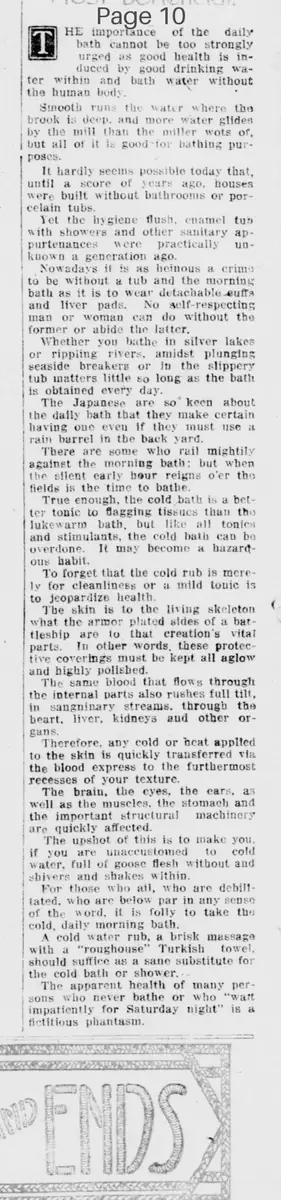
The Importance of the Daily Bath
The importance of the daily bath cannot be too strongly urged as good health is induced by good drinking water within and bath water without the human body.
Smooth runs the water where the brook is deep, and more water glides by the mill than the miller wots or but all of it is good for bathing purposes.
It hardly seems possible today that, until a score of years ago, houses were built without bathrooms or porcelain tubs.
Yet the hygiene flush, enamel tub with showers and other sanitary appurtenances were practically unknown a generation ago.
Nowadays it is as heinous a crime to be without a tub and the morning bath as it is to wear detachable cuffs and liver pads. No self-respecting man or woman can do without the former or abide the latter.
Whether you bathe in silver lakes or rippling rivers, amidst plunging seaside breakers or in the slippery tub matters little so long as the bath is obtained every day.
The Japanese are so keen about the daily bath that they make certain having one even if they must use a rain barrel in the back yard.
There are some who rail mightily against the morning bath; but when the silent early hour reigns o'er the fields is the time to bathe.
True enough, the cold bath is a better tonic to flagging tissues than the lukewarm bath, but like all tonics and stimulants, the cold bath can be overdone. It may become a hazardous habit.
To forget that the cold rub is merely for cleanliness or a mild tonic is to jeopardize health.
The skin is to the living skeleton what the armor plated sides of a battleship are to that creation's vital parts. In other words, these protective coverings must be kept all aglow and highly polished.
The same blood that flows through the internal parts also rushes full tilt, in sanguinary streams, through the heart, liver, kidneys and other organs.
Therefore, any cold or heat applied to the skin is quickly transferred via the blood express to the furthermost recesses of your texture.
The brain, the eyes, the ears, as well as the muscles, the stomach and the important structural machinery are quickly affected.
The upshot of this is to make you, if you are unaccustomed to cold water, full of goose flesh without and shivers and shakes within.
For those who ail, who are debilitated, who are below par in any sense of the word, it is folly to take the cold, daily morning bath.
A cold water rub, a brisk massage with a "roughhouse" Turkish towel should suffice as a sane substitute for the cold bath or shower.
The apparent health of many persons who never bathe or who "wait impatiently for Saturday night" is a fictitious phantasm.
Ends
The importance of the daily bath cannot be too strongly urged as good health is induced by good drinking water within and bath water without the human body.
Smooth runs the water where the brook is deep, and more water glides by the mill than the miller wots or but all of it is good for bathing purposes.
It hardly seems possible today that, until a score of years ago, houses were built without bathrooms or porcelain tubs.
Yet the hygiene flush, enamel tub with showers and other sanitary appurtenances were practically unknown a generation ago.
Nowadays it is as heinous a crime to be without a tub and the morning bath as it is to wear detachable cuffs and liver pads. No self-respecting man or woman can do without the former or abide the latter.
Whether you bathe in silver lakes or rippling rivers, amidst plunging seaside breakers or in the slippery tub matters little so long as the bath is obtained every day.
The Japanese are so keen about the daily bath that they make certain having one even if they must use a rain barrel in the back yard.
There are some who rail mightily against the morning bath; but when the silent early hour reigns o'er the fields is the time to bathe.
True enough, the cold bath is a better tonic to flagging tissues than the lukewarm bath, but like all tonics and stimulants, the cold bath can be overdone. It may become a hazardous habit.
To forget that the cold rub is merely for cleanliness or a mild tonic is to jeopardize health.
The skin is to the living skeleton what the armor plated sides of a battleship are to that creation's vital parts. In other words, these protective coverings must be kept all aglow and highly polished.
The same blood that flows through the internal parts also rushes full tilt, in sanguinary streams, through the heart, liver, kidneys and other organs.
Therefore, any cold or heat applied to the skin is quickly transferred via the blood express to the furthermost recesses of your texture.
The brain, the eyes, the ears, as well as the muscles, the stomach and the important structural machinery are quickly affected.
The upshot of this is to make you, if you are unaccustomed to cold water, full of goose flesh without and shivers and shakes within.
For those who ail, who are debilitated, who are below par in any sense of the word, it is folly to take the cold, daily morning bath.
A cold water rub, a brisk massage with a "roughhouse" Turkish towel should suffice as a sane substitute for the cold bath or shower.
The apparent health of many persons who never bathe or who "wait impatiently for Saturday night" is a fictitious phantasm.
Ends
What sub-type of article is it?
Curiosity
Medical Curiosity
What themes does it cover?
Moral Virtue
Recovery
Misfortune
What keywords are associated?
Daily Bath
Hygiene
Cold Bath
Health Tonic
Bathing History
Story Details
Story Details
Advocates daily bathing for health, notes historical lack of bathrooms, praises Japanese habits, warns against overdoing cold baths, suggests alternatives for the weak.