Thank you for visiting SNEWPapers!
Sign up free
Editorial
October 8, 1804
Jenks' Portland Gazette
Portland, Cumberland County, Maine
What is this article about?
Editorial critiques President Thomas Jefferson's pardon of James Thompson Callender, convicted for libeling President Adams, claiming it unconstitutionally restored a fine already paid to the U.S. government. Includes documents and argues it sets a dangerous precedent.
Clipping
OCR Quality
85%
Good
Full Text
No. XVI.
Review of Mr. Jefferson's Administration.
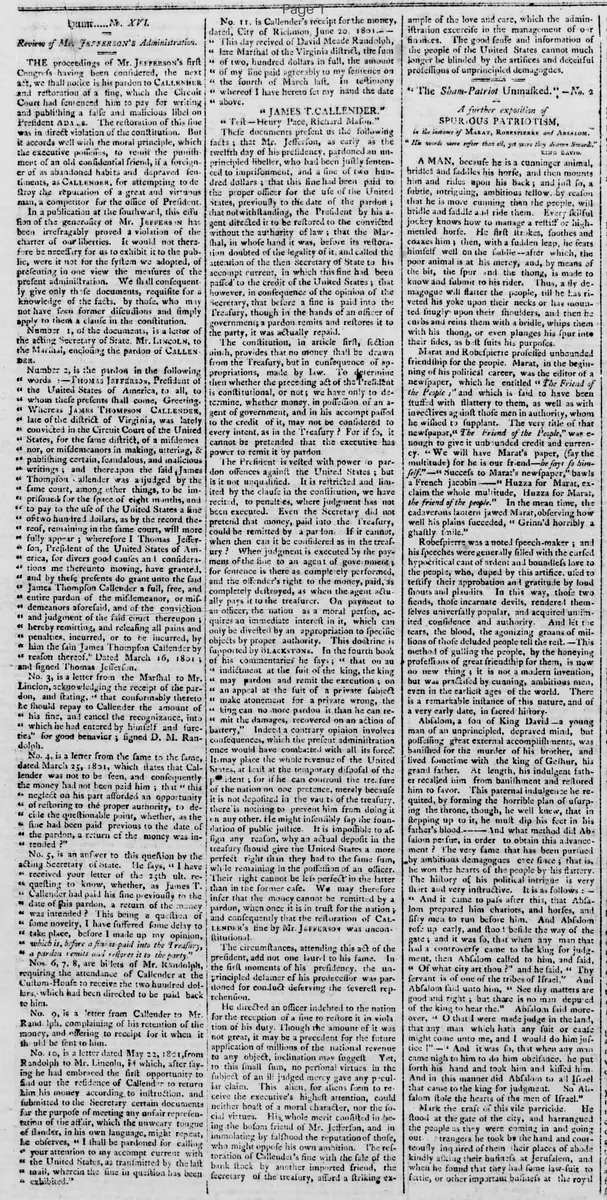
THE proceedings of Mr. Jefferson's first Congress having been considered, the next act, we shall notice is his pardon to Callender and restoration of a fine, which the Circuit Court had sentenced him to pay for writing and publishing a false and malicious libel on President Adams. The restoration of this fine was in direct violation of the constitution. But it accords well with the moral principle, which the executive possesses, to remit the punishment of an old confidential friend, a foreigner of as abandoned habits and depraved sentiments, as Callender, for attempting to destroy the reputation of a great and virtuous man, a competitor for the office of President.
In a publication at the southward, this exercise of the generosity of Mr. Jefferson has been irrefragably proved a violation of the charter of our liberties. It would not therefore be necessary for us to exhibit it to the public, were it not for the system we adopted, of presenting in one view the measures of the present administration. We shall consequently give only the documents, requisite for a knowledge of the facts. by those. who may not have seen former discussions and imply apply to them a clause in the constitution.
Number 1, of the documents, is a letter of the acting Secretary of State. Mr. Lincoln, to the Marshal, enclosing the pardon of Callender.
Number 2, is the pardon in the following words:--
"Thomas Jefferson, President of the United States of America, to all, to whom these presents shall come, Greeting.
"Whereas James Thompson Callender,
"late of the district of Virginia, was lately
"convicted in the Circuit Court of the United
"States. for the same district. of a misdemeanor
"or misdemeanors in making, uttering, &
"publishing certain, scandalous, and malicious
"writings ; and thereupon the said James
"Thompson Callender was adjudged by the
"same court, among other things, to be im-
"prisoned for the space of eight months, and
"to pay to the use of the United States a fine
"of two hundred dollars, as by the record the.
"thereof, remaining in the same court, will more
"fully appear ; wherefore I Thomas Jeffer-
"son, President of the United States of Am-
"erica, for divers good causes and considera-
"tions me thereunto moving, have granted,
"and by these presents do grant unto the said
"James Thompson Callender a full, free, and
"entire pardon of the misdemeanor, or mi-
"demeanors aforesaid, and of the conviction
"and judgment of the said court thereupon ;
"hereby remitting, and releasing all pains and
"penalties, incurred, or to be incurred, by
"him the said James Thompson Callender by
"reason thereof." Dated March 16, 1801 ;
and signed Thomas Jefferson.
No. 3, is a letter from the Marshal to Mr.
Lincoln, acknowledging the receipt of the par-
don, and stating, " that conformably thereto
he should repay to Callender the amount of
"his fine, and cancel the recognizance, into
"which he had entered by himself and sure-
ties" for good behavior ; signed D. M. Ran-
dolph.
No. 4. is a letter from the same to the same,
dated March 25, 1801, which states that Cal-
lender was not to be seen, and consequently
the money had not been paid him ; that " this
"neglect on his part afforded an opportunity
"of restoring to the proper authority, to de-
"cide the questionable point, whether, as the
"fine had been paid previous to the date of
"the pardon, a return of the money was in-
"tended ?"
No. 5, is an answer to this question by the
acting Secretary of State. He says, " I have
"received your letter of the 22th ult. re-
"questing to know, whether, as James T.
"Callender had paid his fine previously to the
"date of his pardon, a return of the money
"was intended ? This being a question of
"some novelty, I have suffered some delay to
"take place, before I made up my opinion,
"which is, before a fine is paid into the Treasury.
a pardon remits said restores it to the party."
Nos. 6, 7, 8, are billets of Mr. Randolph,
requiring the attendance of Callender at the
Custom-House to receive the two hundred dol-
lars, which had been directed to be paid back
to him.
No. 9, is a letter from Callender to Mr.
Randolph, complaining of his retention of the
money, and offering to receipt for it when it
"the could be sent to him.
No. 10, is a letter dated May 22, 1801,from
Randolph to Mr. Lincoln, in which, after say-
ing he had embraced the first opportunity to
"find out the residence of Callender to return
"him his money according to instruction. and
"submitted to the Secretary certain documents
"for the purpose of meeting any unfair represen-
"tation of the affair, which the unwearied tongue
"of slander, in his own language, might repeat,
"he observes, " I shall be pardoned for calling
"your attention to my account current with
"the United States, as transmitted by the last
"mail, wherein the fine in question has been
"exhibited."
No. 11. is Callender's receipt for the money,
dated, City of Richmond, June 20. 1801.--
" This day received of David Meade Randolph,
"late Marshal of the Virginia district, the sum
"of two, hundred dollars in full, the amount
"of my fine paid agreeably to my sentence on
"the fourth of March last. In testimony
"whereof I have hereto set my hand the date
"above.
"JAMES T. CALLENDER."
"Witness-Henry Pace, Richard Mason."
These documents present us the following
facts : that Mr. Jefferson, as early as the
twelfth day of his presidency, pardoned an un-
principled libeller, who had been justly sen-
tenced to imprisonment, and a fine of two hun-
dred dollars ; -that this fine had been paid to
the proper officer for the use of the United
States, previously to the date of the pardon ;
that notwithstanding, the President by his a-
gent directed it to be restored to the convicted
without the authority of law ; that the Mar-
shal, in whose hand it was, before its restora-
tion doubted of the legality of it, and called the
attention of the then Secretary of State to his
account current, in which this fine had been
passed to the credit of the United States ; that
however, in consequence of the opinion of the
Secretary, that before a fine is paid into the
Treasury, though in the hands of an officer of
government; a pardon remits and restores it to
the party, it was actually repaid.
The constitution, in article ii, section
ninth, provides that no money shall be drawn
from the Treasury, but in consequence of ap-
propriations, made by law. To determine
then whether the preceding act of the President
is constitutional, or not; we have only to de-
termine, whether money. in possession of an a-
gent of government, and in his account passed
to the credit of it, may not be considered to
every intent, as in the Treasury ? For if so, it
cannot be pretended that the executive has
power to remit it by pardon.
The President is vested with power to par-
don offences against the United States ; but
is it not unqualified. It is restricted and lim-
ited by the clause in the constitution, we have
recited, to penalties. where judgment has not
been executed. Even the Secretary did not
pretend that money, paid into the. Treasury,
could be remitted by a pardon. If it cannot,
when then can it be considered as in the trea-
sury ? When judgment is executed by the pay-
ment of the fine to an agent of government;
for sentence is there as completely performed,
and the offender's right to the money, paid, as
completely destroyed, as when the agent actu-
ally passes it to the treasurer. On payment to
an officer, the nation as a moral person, ac-
quires an immediate interest in it, which can
only be divested by an appropriation to specific
objects by proper authority." This doctrine is
supported by Blackstone. In the fourth book
of his commentaries he says; " that on an
"indictment at the suit of the king, the king
"may pardon and remit the execution ; on
"an appeal at the suit of a private subject
"make atonement for a private wrong, the
"king can no more pardon it than he can re-
"mit the damages, recovered on an action of
"battery," Indeed a contrary opinion involves
consequences, which the present administration
once would have combated with all its force.
It may place the whole revenue of the United
States, at least at the temporary disposal of the
president ; for if he can control the treasure
of the nation on one pretence, merely because
it is not deposited in the vaults of the treasury.
there is nothing to prevent him from doing it
on any other. He might insensibly sap the foun-
dation of public justice. It is impossible to as-
sign any reason, why an actual deposit in the
treasury should give the United States a more
perfect right than they had to the same sum,
while remaining in the possession of an officer.
Their right cannot be less perfect in the latter
than in the former case. We may therefore
infer that the money cannot be remitted by a
pardon, when once it is in trust for the nation ;
and consequently that the restoration of Cal-
lender's fine by Mr. Jefferson Was unconsti-
tutional.
The circumstances, attending this act of the
president, add not one laurel to his fame. In
the first moments of his presidency, the un-
principled defamer of his predecessor was par-
donned for conduct deserving the severest rep-
reprehension.
He directed an officer indebted to the nation
for the reception of a fine to restore it in viola-
tion of his duty. Though the amount of it was
not great, it may be a precedent for the future
application of millions of the national revenue
to any object, inclination may suggest Yet,
to this small sum, no personal virtues in the
subject of an ill judged mercy gave any pecul-
iar claim. This alien, for aliens seem to re-
ceive the executive's highest attention, could
neither boast of a moral character, nor the so-
cial virtues. His whole merit consisted in be-
ing the bosom friend of Mr. Jefferson, and in
immolating by falsehood the reputation of those,
who might oppose his own ambition. The res-
toration of Callender's fine with the sale of the
bank stock by another imported friend, the
secretary of the treasury, afford a striking ex-
ample of the love and care. which the adminis-
tration exercise in the management of our
finances. The good sense and information of
the people of the United States cannot much
longer be blinded by the artifices and deceitful
professions of unprincipled demagogues.
Review of Mr. Jefferson's Administration.
THE proceedings of Mr. Jefferson's first Congress having been considered, the next act, we shall notice is his pardon to Callender and restoration of a fine, which the Circuit Court had sentenced him to pay for writing and publishing a false and malicious libel on President Adams. The restoration of this fine was in direct violation of the constitution. But it accords well with the moral principle, which the executive possesses, to remit the punishment of an old confidential friend, a foreigner of as abandoned habits and depraved sentiments, as Callender, for attempting to destroy the reputation of a great and virtuous man, a competitor for the office of President.
In a publication at the southward, this exercise of the generosity of Mr. Jefferson has been irrefragably proved a violation of the charter of our liberties. It would not therefore be necessary for us to exhibit it to the public, were it not for the system we adopted, of presenting in one view the measures of the present administration. We shall consequently give only the documents, requisite for a knowledge of the facts. by those. who may not have seen former discussions and imply apply to them a clause in the constitution.
Number 1, of the documents, is a letter of the acting Secretary of State. Mr. Lincoln, to the Marshal, enclosing the pardon of Callender.
Number 2, is the pardon in the following words:--
"Thomas Jefferson, President of the United States of America, to all, to whom these presents shall come, Greeting.
"Whereas James Thompson Callender,
"late of the district of Virginia, was lately
"convicted in the Circuit Court of the United
"States. for the same district. of a misdemeanor
"or misdemeanors in making, uttering, &
"publishing certain, scandalous, and malicious
"writings ; and thereupon the said James
"Thompson Callender was adjudged by the
"same court, among other things, to be im-
"prisoned for the space of eight months, and
"to pay to the use of the United States a fine
"of two hundred dollars, as by the record the.
"thereof, remaining in the same court, will more
"fully appear ; wherefore I Thomas Jeffer-
"son, President of the United States of Am-
"erica, for divers good causes and considera-
"tions me thereunto moving, have granted,
"and by these presents do grant unto the said
"James Thompson Callender a full, free, and
"entire pardon of the misdemeanor, or mi-
"demeanors aforesaid, and of the conviction
"and judgment of the said court thereupon ;
"hereby remitting, and releasing all pains and
"penalties, incurred, or to be incurred, by
"him the said James Thompson Callender by
"reason thereof." Dated March 16, 1801 ;
and signed Thomas Jefferson.
No. 3, is a letter from the Marshal to Mr.
Lincoln, acknowledging the receipt of the par-
don, and stating, " that conformably thereto
he should repay to Callender the amount of
"his fine, and cancel the recognizance, into
"which he had entered by himself and sure-
ties" for good behavior ; signed D. M. Ran-
dolph.
No. 4. is a letter from the same to the same,
dated March 25, 1801, which states that Cal-
lender was not to be seen, and consequently
the money had not been paid him ; that " this
"neglect on his part afforded an opportunity
"of restoring to the proper authority, to de-
"cide the questionable point, whether, as the
"fine had been paid previous to the date of
"the pardon, a return of the money was in-
"tended ?"
No. 5, is an answer to this question by the
acting Secretary of State. He says, " I have
"received your letter of the 22th ult. re-
"questing to know, whether, as James T.
"Callender had paid his fine previously to the
"date of his pardon, a return of the money
"was intended ? This being a question of
"some novelty, I have suffered some delay to
"take place, before I made up my opinion,
"which is, before a fine is paid into the Treasury.
a pardon remits said restores it to the party."
Nos. 6, 7, 8, are billets of Mr. Randolph,
requiring the attendance of Callender at the
Custom-House to receive the two hundred dol-
lars, which had been directed to be paid back
to him.
No. 9, is a letter from Callender to Mr.
Randolph, complaining of his retention of the
money, and offering to receipt for it when it
"the could be sent to him.
No. 10, is a letter dated May 22, 1801,from
Randolph to Mr. Lincoln, in which, after say-
ing he had embraced the first opportunity to
"find out the residence of Callender to return
"him his money according to instruction. and
"submitted to the Secretary certain documents
"for the purpose of meeting any unfair represen-
"tation of the affair, which the unwearied tongue
"of slander, in his own language, might repeat,
"he observes, " I shall be pardoned for calling
"your attention to my account current with
"the United States, as transmitted by the last
"mail, wherein the fine in question has been
"exhibited."
No. 11. is Callender's receipt for the money,
dated, City of Richmond, June 20. 1801.--
" This day received of David Meade Randolph,
"late Marshal of the Virginia district, the sum
"of two, hundred dollars in full, the amount
"of my fine paid agreeably to my sentence on
"the fourth of March last. In testimony
"whereof I have hereto set my hand the date
"above.
"JAMES T. CALLENDER."
"Witness-Henry Pace, Richard Mason."
These documents present us the following
facts : that Mr. Jefferson, as early as the
twelfth day of his presidency, pardoned an un-
principled libeller, who had been justly sen-
tenced to imprisonment, and a fine of two hun-
dred dollars ; -that this fine had been paid to
the proper officer for the use of the United
States, previously to the date of the pardon ;
that notwithstanding, the President by his a-
gent directed it to be restored to the convicted
without the authority of law ; that the Mar-
shal, in whose hand it was, before its restora-
tion doubted of the legality of it, and called the
attention of the then Secretary of State to his
account current, in which this fine had been
passed to the credit of the United States ; that
however, in consequence of the opinion of the
Secretary, that before a fine is paid into the
Treasury, though in the hands of an officer of
government; a pardon remits and restores it to
the party, it was actually repaid.
The constitution, in article ii, section
ninth, provides that no money shall be drawn
from the Treasury, but in consequence of ap-
propriations, made by law. To determine
then whether the preceding act of the President
is constitutional, or not; we have only to de-
termine, whether money. in possession of an a-
gent of government, and in his account passed
to the credit of it, may not be considered to
every intent, as in the Treasury ? For if so, it
cannot be pretended that the executive has
power to remit it by pardon.
The President is vested with power to par-
don offences against the United States ; but
is it not unqualified. It is restricted and lim-
ited by the clause in the constitution, we have
recited, to penalties. where judgment has not
been executed. Even the Secretary did not
pretend that money, paid into the. Treasury,
could be remitted by a pardon. If it cannot,
when then can it be considered as in the trea-
sury ? When judgment is executed by the pay-
ment of the fine to an agent of government;
for sentence is there as completely performed,
and the offender's right to the money, paid, as
completely destroyed, as when the agent actu-
ally passes it to the treasurer. On payment to
an officer, the nation as a moral person, ac-
quires an immediate interest in it, which can
only be divested by an appropriation to specific
objects by proper authority." This doctrine is
supported by Blackstone. In the fourth book
of his commentaries he says; " that on an
"indictment at the suit of the king, the king
"may pardon and remit the execution ; on
"an appeal at the suit of a private subject
"make atonement for a private wrong, the
"king can no more pardon it than he can re-
"mit the damages, recovered on an action of
"battery," Indeed a contrary opinion involves
consequences, which the present administration
once would have combated with all its force.
It may place the whole revenue of the United
States, at least at the temporary disposal of the
president ; for if he can control the treasure
of the nation on one pretence, merely because
it is not deposited in the vaults of the treasury.
there is nothing to prevent him from doing it
on any other. He might insensibly sap the foun-
dation of public justice. It is impossible to as-
sign any reason, why an actual deposit in the
treasury should give the United States a more
perfect right than they had to the same sum,
while remaining in the possession of an officer.
Their right cannot be less perfect in the latter
than in the former case. We may therefore
infer that the money cannot be remitted by a
pardon, when once it is in trust for the nation ;
and consequently that the restoration of Cal-
lender's fine by Mr. Jefferson Was unconsti-
tutional.
The circumstances, attending this act of the
president, add not one laurel to his fame. In
the first moments of his presidency, the un-
principled defamer of his predecessor was par-
donned for conduct deserving the severest rep-
reprehension.
He directed an officer indebted to the nation
for the reception of a fine to restore it in viola-
tion of his duty. Though the amount of it was
not great, it may be a precedent for the future
application of millions of the national revenue
to any object, inclination may suggest Yet,
to this small sum, no personal virtues in the
subject of an ill judged mercy gave any pecul-
iar claim. This alien, for aliens seem to re-
ceive the executive's highest attention, could
neither boast of a moral character, nor the so-
cial virtues. His whole merit consisted in be-
ing the bosom friend of Mr. Jefferson, and in
immolating by falsehood the reputation of those,
who might oppose his own ambition. The res-
toration of Callender's fine with the sale of the
bank stock by another imported friend, the
secretary of the treasury, afford a striking ex-
ample of the love and care. which the adminis-
tration exercise in the management of our
finances. The good sense and information of
the people of the United States cannot much
longer be blinded by the artifices and deceitful
professions of unprincipled demagogues.
What sub-type of article is it?
Constitutional
Partisan Politics
Moral Or Religious
What keywords are associated?
Jefferson Pardon
Callender Fine
Constitutional Violation
Presidential Power
Libel Conviction
Partisan Critique
Moral Depravity
What entities or persons were involved?
Thomas Jefferson
James Thompson Callender
President Adams
Mr. Lincoln
D. M. Randolph
Blackstone
Editorial Details
Primary Topic
Critique Of Jefferson's Pardon And Restoration Of Fine To Callender
Stance / Tone
Strongly Critical And Accusatory
Key Figures
Thomas Jefferson
James Thompson Callender
President Adams
Mr. Lincoln
D. M. Randolph
Blackstone
Key Arguments
Pardon Of Callender Violated The Constitution By Restoring A Fine Already Paid To The Government
Fine In Possession Of A Government Agent Is Equivalent To Being In The Treasury
Presidential Pardon Power Is Limited To Unexecuted Judgments
Act Favors A Depraved Foreigner And Libeler Of Adams
Sets Dangerous Precedent For Executive Control Over National Revenue
Reflects Poor Moral Judgment And Favoritism In Administration