Thank you for visiting SNEWPapers!
Sign up free
Martinsburg Gazette And Public Advertiser
Martinsburg, Berkeley County, West Virginia
What is this article about?
Continuation of Mr. Brown's speech in the abolition debate, defending slavery by comparing slaves' conditions favorably to European serfs, critiquing African colonization efforts like Sierra Leone, refuting economic harms to Virginia, and using 1829 export data to show slave states' productivity equals or exceeds non-slave states.
Clipping
OCR Quality
Full Text
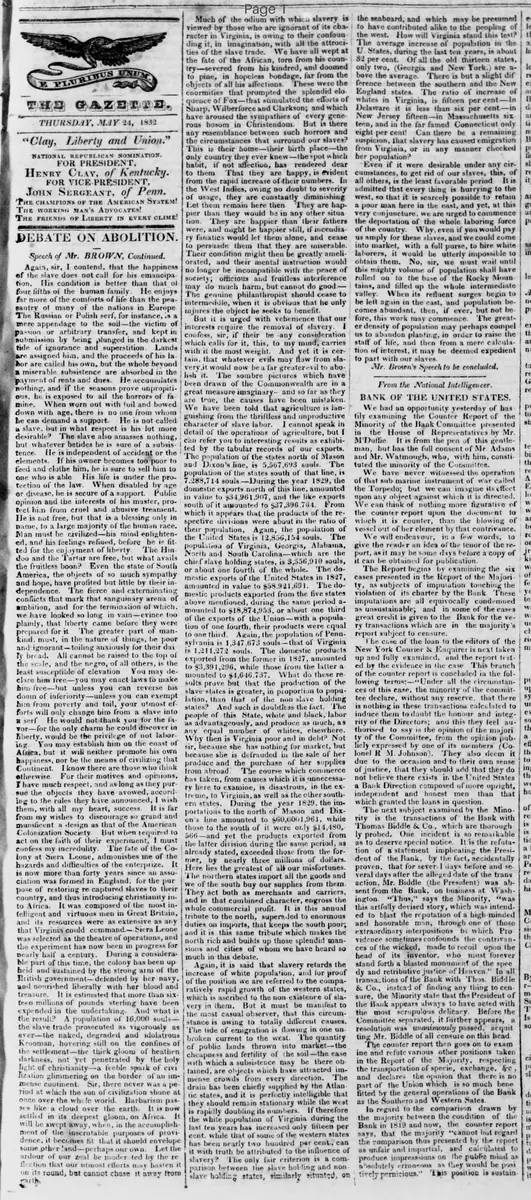
Speech of Mr. BROWN, Continued.
Again, sir, I contend, that the happiness of the slave does not call for his emancipation. His condition is better than that of four fifths of the human family. He enjoys far more of the comforts of life than the peasantry of many of the nations in Europe. The Russian or Polish serf, for instance, is a mere appendage to the soil—the victim of passion or arbitrary transfer, and kept in submission by being plunged in the darkest tide of ignorance and superstition. Lands are assigned him, and the proceeds of his labor are called his own, but the whole beyond a miserable subsistence are absorbed in the payment of rents and dues. He accumulates nothing, and if the seasons prove unpropitious, he is exposed to all the horrors of famine. When worn out with toil and bowed down with age, there is no one from whom he can demand a support. He is not called a slave, but in what respect is his lot more desirable? The slave also amasses nothing, but whatever betides he is sure of a subsistence. He is independent of accident or the elements. If his owner becomes too poor to feed and clothe him, he is sure to sell him to one who is able. His life is under the protection of the law. When disabled by age or disease, he is secure of a support. Public opinion and the interests of his master, protect him from cruel and abusive treatment. He is not free, but that is a blessing only in name, to a large majority of the human race. Man must be civilized—his mind enlightened, and his feelings refined, before he is fitted for the enjoyment of liberty. The Hindoo and the Tartar are free, but what avails the fruitless boon? Even the state of South America, the objects of so much sympathy and hope, have profited but little by their independence. The fierce and exterminating conflicts that mark that sanguinary arena of ambition, and for the termination of which we have looked so long in vain—evince too plainly, that liberty came before they were prepared for it. The greater part of mankind, must, in the nature of things, be poor and ignorant—toiling anxiously for their daily bread. All cannot be raised to the top of the scale, and the negro, of all others, is the least susceptible of elevation. You may declare him free—you may enact laws to make him free—but unless you can reverse his doom of inferiority—unless you can exempt him from poverty and toil, your utmost efforts will only change him from a slave into a serf. He would not thank you for the favor—for the only charm he could discover in liberty, would be the privilege of not laboring. You may establish him on the coast of Africa, but it will neither promote his own happiness, nor be the means of civilizing that Continent. I know there are those who think otherwise. For their motives and opinions, I have much respect. and as long as they pursue the objects they have avowed, according to the rules they have announced, I wish them, with all my heart, success. It is far from my wishes to discourage so grand and munificent a design as that of the American Colonization Society. But when required to act on the faith of their experiment, I must confess my incredulity. The fate of the Colony at Sierra Leone, admonishes me of the hazards and difficulties of the enterprize. It is now more than forty years since an association was formed in England, for the purpose of restoring recaptured slaves to their country, and thus introducing christianity into Africa. It was composed of the most intelligent and virtuous men in Great Britain, and its resources were as extensive as any that Virginia could command.—Sierra Leone was selected as the theatre of operations, and the experiment has now been in progress for nearly half a century. During a considerable part of this time, the colony has been upheld and sustained by the strong arm of the British government—defended by her navy, and nourished liberally with her blood and treasure. It is estimated that more than sixteen millions of pounds sterling have been expended in the undertaking. And what is the result? A population of 16,000 souls—the slave trade prosecuted as vigorously as ever—the naked, degraded and idolatrous Krooman, hovering still on the confines of the settlement—the thick gloom of heathen darkness, not yet penetrated by the holy light of christianity—a feeble spark of civilization glimmering on the border of an immense continent. Sir, there never was a period at which the sun of civilization shone at once over the whole world. Barbarism passes like a cloud over the earth. It is now settled in its deepest gloom, on Africa. It will be swept away, when, in the accomplishment of the inscrutable purposes of providence, it becomes fit that it should envelope some other land—perhaps our own. Let the ardour of our zeal be moderated by the reflection that our utmost efforts may hasten it on its round, but cannot chase it away from earth.
Much of the odium with which slavery is viewed by those who are ignorant of its character in Virginia, is owing to their confounding it, in imagination, with all the atrocities of the slave trade. We have all wept at the fate of the African, torn from his country—severed from his kindred, and doomed to pine, in hopeless bondage, far from the objects of all his affections. These were the enormities that prompted the splendid eloquence of Fox—that stimulated the efforts of Sharp, Wilberforce and Clarkson; and which have aroused the sympathies of every generous bosom in Christendom. But is there any resemblance between such horrors and the circumstances that surround our slaves? This is their home—their birth place—the only country they ever knew—the spot which habit, if not affection, has rendered dear to them. That they are happy, is evident from the rapid increase of their numbers. In the West Indies, owing no doubt to severity of usage, they are constantly diminishing. Let them remain here then. They are happier than they would be in any other situation. They are happier than their fathers were, and might be happier still, if incendiary fanatics would let them alone, and cease to persuade them that they are miserable. Their condition might then be greatly ameliorated, and their mental instruction would no longer be incompatible with the peace of society; officious and fruitless interference may do much harm, but cannot do good.—The genuine philanthropist should cease to intermeddle, when it is obvious that he only injures the object he seeks to benefit. But it is urged with vehemence that our interests require the removal of slavery. I confess, sir, if there be any consideration which calls for it, this, to my mind, carries with it the most weight. And yet it is certain, that whatever evils may flow from slavery, it would now be a far greater evil to abolish it. The sombre pictures which have been drawn of the Commonwealth are in a great measure imaginary—and so far as they are true, the causes have been mistaken. We have been told that agriculture is languishing from the thriftless and unproductive character of slave labor. I cannot speak in detail of the operations of agriculture, but I can refer you to interesting results as exhibited by the tabular records of our exports. The population of the states north of Mason and Dixon's line, is 5,567,693 souls. The population of the states south of that line, is 7,288,714 souls.—During the year 1829, the domestic exports north of this line, amounted in value to $34,961,907, and the like exports south of it amounted to $37,396,764. From which it appears that the products of the respective divisions were about in the ratio of their population. Again, the population of the United States is 12,856,154 souls. The population of Virginia, Georgia, Alabama, North and South Carolina—which are the chief slave holding states, is 3,856,910 souls, or about one fourth of the whole. The domestic exports of the United States in 1827, amounted in value to $58,921,691. The domestic products exported from the five states above mentioned, during the same period amounted to $18,874,953, or about one third of the exports of the Union—with a population of one fourth, their products were equal to one third. Again, the population of Pennsylvania is 1,347,673 souls—that of Virginia is 1,211,272 souls. The domestic products exported from the former in 1827, amounted to $3,391,296, while those from the latter amounted to $4,646,737. What do these results prove but that the production of the slave states is greater, in proportion to population, than that of the non slave holding states? And such is doubtless the fact. The people of this State, white and black, labor as advantageously, and produce as much, as any equal number of whites, elsewhere. Why then is Virginia poor and in debt? Not sir, because she has nothing for market, but because she is defrauded in the sale of her produce and the purchase of her supplies from abroad. The course which commerce has taken, from causes which it is unnecessary here to examine, is disastrous, in the extreme, to Virginia, as well as the other southern states. During the year 1829, the importations to the north of Mason and Dixon's line amounted to $60,001,961, while those to the south of it were only $14,480,566—and yet the products exported from the latter division during the same period, as already stated, exceeded those from the former, by nearly three millions of dollars. Here lies the greatest of all our misfortunes. The northern states import all the goods and we of the south buy our supplies from them. They act both as merchants and carriers, and in that combined character, engross the whole commercial profit. It is this annual tribute to the north, superadded to enormous duties on imports, that keeps the south poor; and it is this same tribute which makes the north rich and builds up those splendid mansions and cities of whom we have heard so much in this debate. Again, it is said that slavery retards the increase of white population, and for proof of the position we are referred to the comparatively rapid growth of the western states, which is ascribed to the non existence of slavery in them. But it must be manifest to the most casual observer, that this circumstance is owing to totally different causes. The tide of emigration is flowing in one unbroken current to the west. The quantity of public lands thrown into market—the cheapness and fertility of the soil—the ease with which a subsistence may be there obtained, are objects which have attracted immense crowds from every direction. The drain has been chiefly supplied by the Atlantic states, and it is perfectly intelligible that they should remain stationary while the west is rapidly doubling its numbers. If therefore the white population of Virginia during the last ten years has increased only fifteen per cent. while that of some of the western states has been nearly two hundred per cent., can it with truth be attributed to the influence of slavery? The only fair criterion is a comparison between the slave holding and non-slave holding states, similarly situated, on the seaboard, and which may be presumed to have contributed alike to the peopling of the west. How will Virginia stand this test? The average increase of population in the U. States, during the last ten years, is about 32 per cent. Of all the old thirteen states, only two, (Georgia and New York,) are above the average. There is but a slight difference between the southern and the New England states. The ratio of increase of whites in Virginia, is fifteen per cent—In Delaware it is less than six per cent.—in New Jersey fifteen—in Massachusetts sixteen, and in the far famed Connecticut only eight per cent! Can there be a remaining suspicion, that slavery has caused emigration from Virginia, or in any manner checked her population? Even if it were desirable under any circumstances, to get rid of our slaves, this, of all others, is the least favorable period. It is admitted that every thing is hurrying to the west, so that it is scarcely possible to retain a poor man here in the east, and yet, at this very conjuncture, we are urged to commence the deportation of the whole laboring force of the country. Why, even if you would pay us amply for these slaves, and we could come into market, with a full purse, to hire white laborers, it would be utterly impossible to obtain them. No, sir, we must wait until this mighty volume of population shall have rolled on to the base of the Rocky Mountains, and filled up the whole intermediate valley. When its reflux surges begin to be left again in the east, and population becomes abundant, then, if ever, but not before, this work may commence. The greater density of population may perhaps compel us to abandon planting, in order to raise the staff of life, and then from a mere calculation of interest, it may be deemed expedient to part with our slaves.
Mr. Brown's Speech to be concluded.
What sub-type of article is it?
What themes does it cover?
What keywords are associated?
What entities or persons were involved?
Where did it happen?
Story Details
Key Persons
Location
Virginia
Event Date
1829
Story Details
Mr. Brown argues that slaves in Virginia are happier and better provided for than many free peasants in Europe and elsewhere, critiques the American Colonization Society and Sierra Leone colony's failures, distinguishes Virginia slavery from the slave trade, presents economic data showing slave states' productivity, attributes Southern poverty to Northern commercial dominance, and argues against immediate abolition due to population shifts westward.