Thank you for visiting SNEWPapers!
Sign up free
Liberty Advocate
Liberty, Amite County, Mississippi
What is this article about?
Major J. Downing's letter to the New York Express outlines the US claim to the disputed territory based on the 1783 treaty, which defines the boundary by highlands dividing waters to the St. Lawrence and Bay of Fundy. He criticizes England's position for enabling a passage to Canada and proposes duty-free timber exports to maintain peace.
Clipping
OCR Quality
Full Text
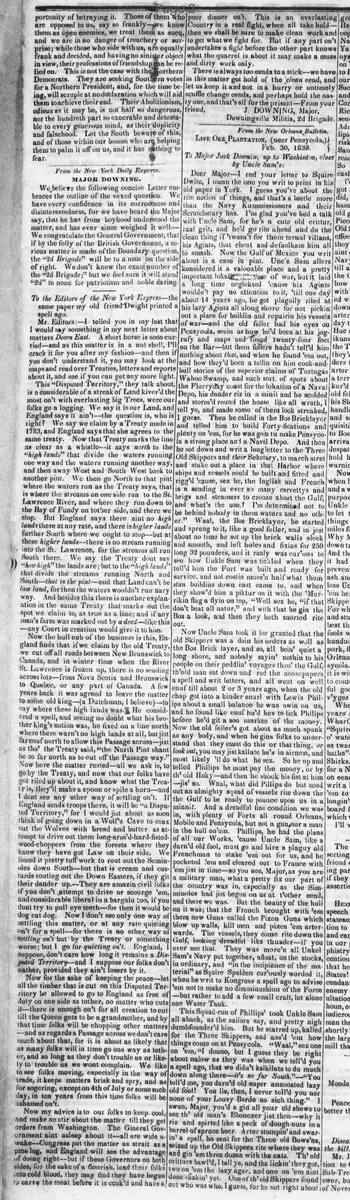
MAJOR DOWNING.
We believe the following concise Letter embraces the outline of the vexed question. We have every confidence in its correctness and disinterestedness, for we have heard the Major say, that he has from boyhood understood the matter, and has ever since weighed it well.—We congratulate the General Government, that if by the folly of the British Government, a serious matter is made of the Boundary question, the "2d Brigade" will be to a man on the side of right. We don't know the exact number of the "2d Brigade:" but we feel sure it will stand "2d" to none for patriotism and noble daring.
To the Editors of the New York Express—the same paper my old friend Dwight printed a spell ago.
This "Disputed Territory," they talk about is a considerable of a streak of Land kivered the most on't with everlasting big Trees, were our folks go a logging. We say it is our Land, and England says it ain't—the question is, who is right? We say we claim by a Treaty made in 1783, and England says that she agrees to the same treaty. Now that Treaty marks the line as clear as a whistle—it says north to the "high lands" that divide the waters running one way and the waters running another way, and then away West and South West back to another pint. We then go North to that pint where the waters run as the Treaty says, that is where the streams on one side run to the St. Lawrence River, and where they run down to the Bay of Fundy on t'other side, and there we stop. But England says there aint no high lands there at any rate, and there is higher lands further South where we ought to stop—but at these higher lands—there is no stream running into the St. Lawrence, for the streams all run South there. We say the Treaty dont say "how high" the lands are; but to the "high lands" that divide the streams running North and South—that is the pint—and that Land can't be low land, for then the waters wouldn't run nary way. And besides this there is another explanation in the same Treaty that marks out the spot we claim to, as true as a line; and if any man's farm was marked out by a deed—like this—any Court in creation would give it to him.
Now the hull nub of the business is this, England finds that if we claim by the old Treaty, we cut off all roads between New Brunswick to Canada, and in winter time when the River St. Lawrence is frozen up, there is no sending across lots—from Nova Scotia and Brunswick to Quebec, or any part of Canada. A few years back it was agreed to leave the matter to some old king—(a Dutchman, I believe)—to say where these high lands was. He considered a spell, and seeing no doubt what his brother king's notion was, he fixed on a line north where there warn't no high lands at all, but jist farenuf north to allow this Passage across—jist as tho' the Treaty said, "the North Pint shant be so far north as to cut off the Passage way."
Now here the matter rested—all we ask is, to go by the Treaty, and now that our folks have got riled up about it, and know what the Treaty is, they'll make a spoon or spile a horn—and I dont see any other way of settling on't. If England sends troops there, it will be "a Disputed Territory," for I would jist about as soon think of going down in a Wolf's Cave to coax out the Wolves with bread and butter as attempt to drive out them long-arm'd-hard-fisted-wood-choppers from the forests where they know they have got Law on their side. We found it pretty tuff work to rout out the Seminoles down South—but that is cream and custards routing out the Down Easters, if they git their dander up.—They are amazin civil folks if you don't attempt to drive or scourge 'em, and considerable liboral in a bargain too, if you dont try to pull eye teeth—for then it would be dog eat dog. Now I don't see only one way of settling this matter, or at any rate quieting on't for a spell—for there is no other way ol settling on't but by the Treaty or something worse; but I go for quieting on't. England, suppose, don't care how long it remains a Disputed Territory—and I suppose our folks don't nather, provided they ain't losers by it.
Now for the sake of keeping the peace—let all the timber that is cut on this Disputed Territory be allowed to go to England as free of duty on one side as tother, no matter who cuts it—there is enough on't for all creation to cut till the Queen gets to be a grandmother, and by that time folks will be chopping other matters—and as regards a Passage across we don't care much about that, for it is about as likely that us many folks will in time go one way as t'other, and so long as they don't trouble us or likely to trouble us we wont complain. We like to see folks moving, especially in the way of trade, it keeps matters brisk and spry, and as for sogering, except on 4th of July or some such day, in ten years rom this tine folks will be ashamed on't.
Now my advice is to our folks to keep-cool and make no stir about the matter till they get orders from Washington. The Gineral Government aint asleep about it—all are wide awake—Congress put the matter as strait as a pine log, and England will see the advantage of doing right—but if these Governors on both sides, for the sake of a flourish, lead their folks t into cold blood, they may find they have begun to carve the meat before it is cooked and have a poor dinner on't. This is an everlasting Country in a real fight, when all take hold—then we shall be sure to make clean work and to get what we fight for. But if any part on't undertakes a fight before the other part knows what the quarrel is about it may make a muss and dirty work only.
There is always too eends to a stick—we have in this matter got hold of the 'clean eend, and let us keep it and not in a hurry or untimely scufle change eends, and perhaps hold the nasty one, and that's all for the prisent—From your friend,
J. DOWNING. Major,
To Major Jack Downin, up to Washington, close by Uncle Sam's:
What sub-type of article is it?
What themes does it cover?
What keywords are associated?
What entities or persons were involved?
Letter to Editor Details
Author
J. Downing. Major
Recipient
To The Editors Of The New York Express
Main Argument
the us rightfully claims the disputed territory per the 1783 treaty, which clearly delineates the boundary by highlands dividing northern and southern waters; england seeks alteration for a canada passage. to preserve peace, allow duty-free timber export from the area regardless of cutter.
Notable Details