Thank you for visiting SNEWPapers!
Sign up free
The Daily Gate City
Keokuk, Lee County, Iowa
What is this article about?
On July 20, the U.S. House and Senate overrode President Johnson's veto of the Reconstruction bill, passed related appropriations, and handled Indian peace treaties, nominations, investigations, and adjournment resolutions amid debates.
Merged-components note: Continuation of the 'FROM WASHINGTON' congressional proceedings article, split across columns on the same page.
Clipping
OCR Quality
Full Text
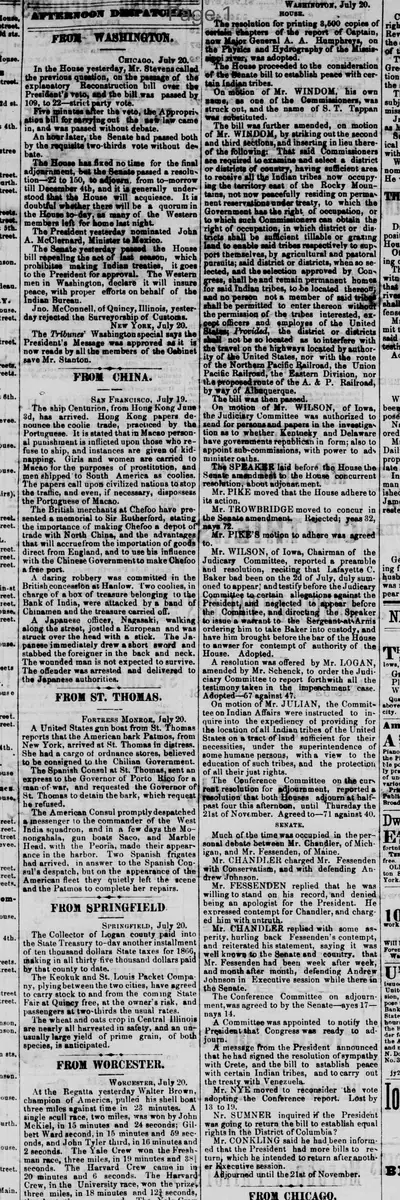
CHICAGO, July 20.—In the House yesterday, Mr. Stevens called the previous question, on the passage of the explanatory Reconstruction bill over the President's veto, and the bill was passed by 109 to 22—strict party vote. Five minutes after the veto, the Appropriation bill for carrying out the new law came in, and was passed without debate. An hour later, the Senate had passed both by the requisite two-thirds vote without debate. The House has fixed no time for the final adjournment, but the Senate passed a resolution 22 to 15, to adjourn from to-morrow till December 4th, and it is generally understood that the House will acquiesce. It is doubtful whether there will be a quorum in the House to-day, as many of the Western members left for home last night. The President yesterday nominated John A. McClernand, Minister to Mexico. The Senate yesterday passed the House bill repealing the act of last session, which prohibits making Indian treaties, it goes to the President for approval. The Western men in Washington, declare it will insure peace, with proper efforts on behalf of the Indian Bureau. Jno. McConnell, of Quincy, Illinois, yesterday rejected the Surveyorship of Customs. New York, July 20.—The Tribune's Washington special says the President's Message was approved as it is now reads by all the members of the Cabinet save Mr. Stanton.
The resolution for printing 8,600 copies of certain chapters of the report of Captain, now Major General A. A. Humphreys, on the Physics and Hydrography of the Mississippi river was adopted.
The House proceeded to the consideration of the Senate bill to establish peace with certain Indian tribes.
On motion of Mr. WINDOM, his own name, as one of the Commissioners, was struck out, and the name of S. T. Tappan was substituted.
The bill was further amended, on motion of Mr. WINDOM, by striking out the second and third sections, and inserting in lieu thereof the following: That said Commissioners are required to examine and select a district or districts of country, having sufficient area to receive all the Indian tribes now occupying the territory east of the Rocky Mountains, not now peacefully residing on permanent reservations under treaty, to which the Government has the right of occupation, or to which such Commissioners can obtain the right of occupation, in which district or districts shall be sufficient tillable or grazing land to enable said tribes respectively to support themselves, by agricultural and pastoral pursuits; said district or districts, when so selected, and the selection approved by Congress, shall be and remain permanent homes for said Indian tribes, to be located thereon and no person not a member of said tribes shall be permitted to enter thereon without the permission of the tribes interested, except officers and employees of the United States: Provided, the district or districts not be so located as to interfere with the travel on the highways located by authority of the United States, nor with the route of the Northern Pacific Railroad, the Union Pacific Railroad, the Eastern Division, nor the proposed route of the A. & P. Railroad, by way of Albuquerque.
The bill was then passed.
On motion of Mr. WILSON, of Iowa, the Judiciary Committee was authorized to send for persons and papers in the investigation as to whether Kentucky and Delaware have governments republican in form; also to appoint sub-committees, with power to administer oaths.
The SPEAKER laid before the House the Senate amendment to the House concurrent resolution about adjournment.
Mr. PIKE moved that the House adhere to its action.
Mr. TROWBRIDGE moved to concur in the Senate amendment. Rejected; yeas 32, nays 72.
Mr. PIKE'S motion to adhere was agreed to.
Mr. WILSON, of Iowa, Chairman of the Judiciary Committee, reported a preamble and resolution, reciting that Lafayette C. Baker had been on the 2d of July, duly summoned to appear, and testify before the Judiciary Committee to certain allegations against the President, and neglected to appear before the Committee, and directing the Speaker to issue a warrant to the Sergeant-at-Arms ordering him to take Baker into custody, and have him brought before the bar of the House to answer for contempt of authority of the House. Adopted.
A resolution was offered by Mr. LOGAN, amended by Mr. Schenck, to order the Judiciary Committee to report forthwith all the testimony taken in the impeachment case. Adopted—57 against 47.
On motion of Mr. JULIAN, the Committee on Indian Affairs were instructed to inquire into the expediency of providing for the location of all Indian tribes of the United States on a tract of land sufficient for their necessities, under the superintendence of some humane persons, with a view to the education of such tribes, and the protection of all their just rights.
The Conference Committee on the current resolution for adjournment, reported a resolution that both Houses adjourn at half-past four this afternoon, until Thursday the 21st of November. Agreed to—71 against 40.
SENATE.
Much of the time was occupied in the personal debate between Mr. Chandler, of Michigan, and Mr. Fessenden, of Maine.
Mr. CHANDLER charged Mr. Fessenden with Conservatism, and with defending Andrew Johnson.
Mr. FESSENDEN replied that he was willing to stand on his record, and denied being an apologist for the President. He expressed contempt for Chandler, and charged him with untruth.
Mr. CHANDLER replied with some asperity, hurling back Fessenden's contempt, and reiterated his statement, saying it was well known to the Senate and country, that Mr. Fessenden had been week after week, and month after month, defending Andrew Johnson in Executive session while there in the Senate.
The Conference Committee on adjournment, was agreed to by the Senate—ayes 17—nays 14.
A Committee was appointed to notify the President that Congress was ready to adjourn.
A message from the President announced that he had signed the resolution of sympathy with Crete, and the bill to establish peace with certain Indian tribes, and to carry out the treaty with Venezuela.
Mr. NYE moved to reconsider the vote adopting the Conference report. Lost by 13 to 19.
Mr. SUMNER inquired if the President was going to return the bill to establish equal rights in the District of Columbia?
Mr. CONKLING said he had been informed that the President had more bills to return, which he intended to return after another Executive session.
Adjourned until the 21st of November.
What sub-type of article is it?
What keywords are associated?
What entities or persons were involved?
Where did it happen?
Domestic News Details
Primary Location
Washington
Event Date
July 20
Key Persons
Outcome
reconstruction bill passed over veto 109-22 in house and by two-thirds in senate; appropriation bill passed; indian peace bill passed with amendments; adjournment set for november 21; warrant issued for lafayette c. baker; impeachment testimony to be reported; president nominated mcclernand and signed indian peace bill.
Event Details
Congressional proceedings included overriding the President's veto on the Reconstruction bill, passing appropriations and Indian treaty bills, nominations, investigations into state governments and impeachment, personal debates in Senate, and setting adjournment date.