Thank you for visiting SNEWPapers!
Sign up free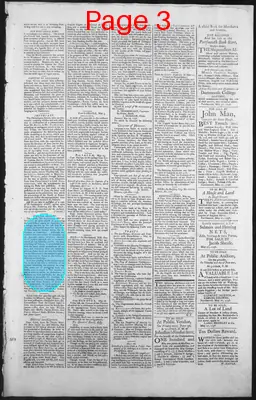
Story
May 28, 1796
The New Hampshire Gazette
Portsmouth, Rockingham County, New Hampshire
What is this article about?
Dr. Lettsom sends 100 specimens of ores from Spanish mines and 20-30 preserved birds and quadrupeds from London to Cambridge's natural history cabinet to promote mineralogy and animal preservation among Americans.
Clipping
OCR Quality
97%
Excellent
Full Text
NATURAL HISTORY
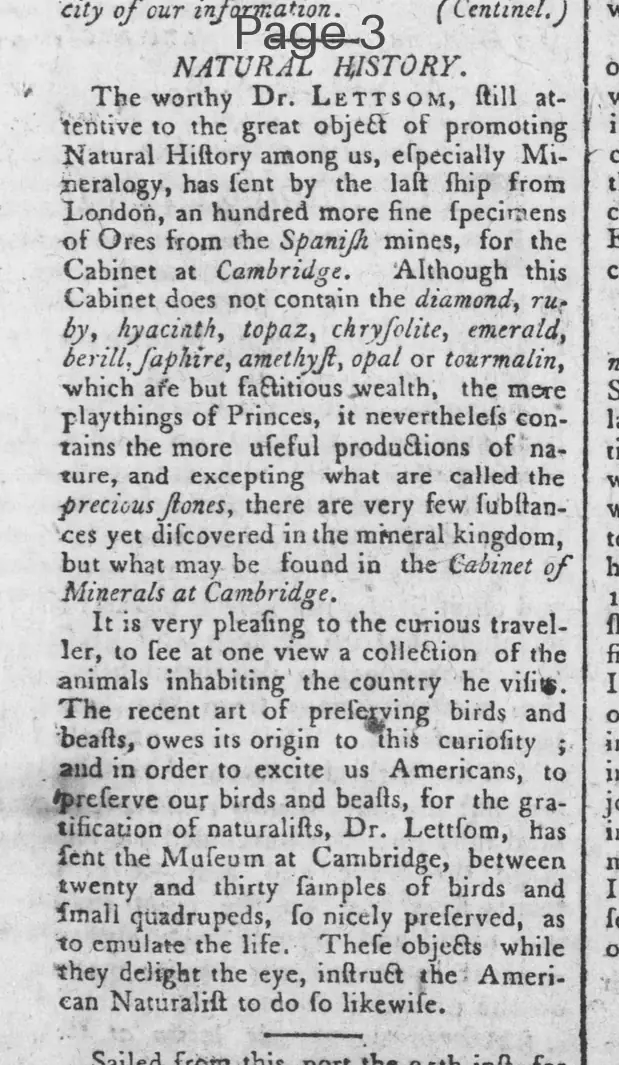
The worthy Dr. Lettsom, still attentive to the great object of promoting Natural History among us, especially Mineralogy, has sent by the last ship from London, an hundred more fine specimens of Ores from the Spanish mines, for the Cabinet at Cambridge. Although this Cabinet does not contain the diamond, ruby, hyacinth, topaz, chrysolite, emerald, berill, sapphire, amethyst, opal or tourmalin, which are but factitious wealth, the mere playthings of Princes, it nevertheless contains the more useful productions of nature, and excepting what are called the precious stones, there are very few substances yet discovered in the mineral kingdom, but what may be found in the Cabinet of Minerals at Cambridge.
It is very pleasing to the curious traveller, to see at one view a collection of the animals inhabiting the country he visits. The recent art of preserving birds and beasts, owes its origin to this curiosity ; and in order to excite us Americans, to preserve our birds and beasts, for the gratification of naturalists, Dr. Lettsom, has sent the Museum at Cambridge, between twenty and thirty samples of birds and small quadrupeds, so nicely preserved, as to emulate the life. These objects while they delight the eye, instruct the American Naturalist to do so likewise.
The worthy Dr. Lettsom, still attentive to the great object of promoting Natural History among us, especially Mineralogy, has sent by the last ship from London, an hundred more fine specimens of Ores from the Spanish mines, for the Cabinet at Cambridge. Although this Cabinet does not contain the diamond, ruby, hyacinth, topaz, chrysolite, emerald, berill, sapphire, amethyst, opal or tourmalin, which are but factitious wealth, the mere playthings of Princes, it nevertheless contains the more useful productions of nature, and excepting what are called the precious stones, there are very few substances yet discovered in the mineral kingdom, but what may be found in the Cabinet of Minerals at Cambridge.
It is very pleasing to the curious traveller, to see at one view a collection of the animals inhabiting the country he visits. The recent art of preserving birds and beasts, owes its origin to this curiosity ; and in order to excite us Americans, to preserve our birds and beasts, for the gratification of naturalists, Dr. Lettsom, has sent the Museum at Cambridge, between twenty and thirty samples of birds and small quadrupeds, so nicely preserved, as to emulate the life. These objects while they delight the eye, instruct the American Naturalist to do so likewise.
What sub-type of article is it?
Curiosity
Historical Event
What themes does it cover?
Exploration
Moral Virtue
What keywords are associated?
Natural History
Mineralogy
Dr Lettsom
Cambridge Cabinet
Preserved Specimens
Spanish Mines
What entities or persons were involved?
Dr. Lettsom
Where did it happen?
Cambridge
Story Details
Key Persons
Dr. Lettsom
Location
Cambridge
Event Date
By The Last Ship From London
Story Details
Dr. Lettsom sends specimens of ores from Spanish mines and preserved birds and quadrupeds to Cambridge's cabinet and museum to promote natural history and encourage Americans to preserve local fauna.