Thank you for visiting SNEWPapers!
Sign up free
The Dallas Daily Herald
Dallas, Dallas County, Texas
What is this article about?
In a Washington interview on September 14, 1882, Second Assistant Postmaster-General Elmer discusses postal reforms: returning $1.5M surplus to treasury, achieving another surplus, proposing two-cent letter postage next year, and raising fourth-class matter rates to eliminate $3M annual losses, arguing current rates undercut express companies and burden the public.
Clipping
OCR Quality
Full Text
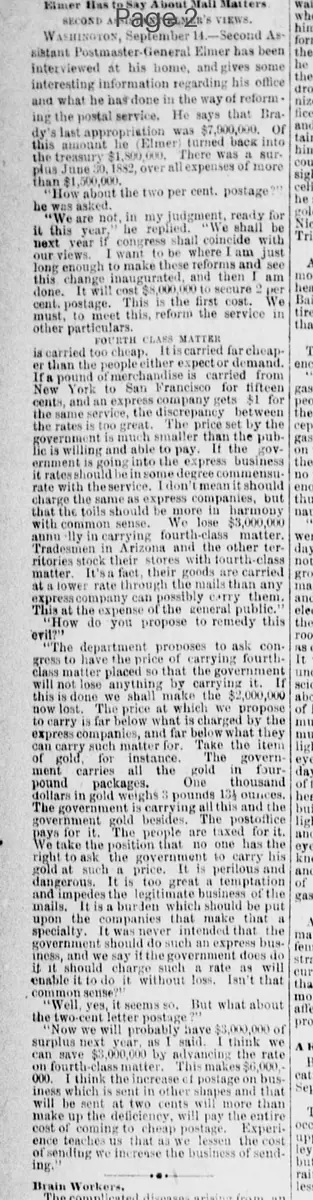
"How about the two per cent. postage?" he was asked.
"We are not, in my judgment, ready for it this year," he replied. "We shall be next year if congress shall coincide with our views. I want to be where I am just long enough to make these reforms and see this change inaugurated, and then I am done. It will cost $8,000,000 to secure 2 per cent. postage. This is the first cost. We must, to meet this, reform the service in other particulars."
FOURTH CLASS MATTER
is carried too cheap. It is carried far cheaper than the people either expect or demand. If a pound of merchandise is carried from New York to San Francisco for fifteen cents, and an express company gets $1 for the same service, the discrepancy between the rates is too great. The price set by the government is much smaller than the public is willing and able to pay. If the government is going into the express business it rates should be in some degree commensurate with the service. I don't mean it should charge the same as express companies, but that the tolls should be more in harmony with common sense. We lose $3,000,000 annually in carrying fourth-class matter. Tradesmen in Arizona and the other territories stock their stores with fourth-class matter. It's a fact, their goods are carried at a lower rate through the mails than any express company can possibly carry them. This at the expense of the general public."
"How do you propose to remedy this evil?"
"The department proposes to ask congress to have the price of carrying fourth class matter placed so that the government will not lose anything by carrying it. If this is done we shall make the $2,000,000 now lost. The price at which we propose to carry is far below what is charged by the express companies, and far below what they can carry such matter for. Take the item of gold, for instance. The government carries all the gold in four-pound packages. One thousand dollars in gold weighs 3 pounds 15 ounces. The government is carrying all this and the government gold besides." The postoffice pays for it. The people are taxed for it. We take the position that no one has the right to ask the government to carry his gold at such a price. It is perilous and dangerous. It is too great a temptation and impedes the legitimate business of the mails. It is a burden which should be put upon the companies that make that a specialty. It was never intended that the government should do such an express business, and we say if the government does do it it should charge such a rate as will enable it to do it without loss. Isn't that common sense?"
"Well, yes, it seems so. But what about the two-cent letter postage?"
"Now we will probably have $3,000,000 of surplus next year, as I said. I think we can save $8,000,000 by advancing the rate on fourth-class matter. This makes $5,000,000. I think the increase of postage on business which is sent in other shapes and that will be sent at two cents will more than make up the deficiency, will pay the entire cost of coming to cheap postage. Experience teaches us that as we lessen the cost of sending we increase the business of sending."
What sub-type of article is it?
What keywords are associated?
What entities or persons were involved?
Where did it happen?
Domestic News Details
Primary Location
Washington
Event Date
September 14, 1882
Key Persons
Outcome
turned back $1,500,000 into treasury; surplus over $1,500,000 as of june 30, 1882; proposes reforms to achieve two-cent postage and eliminate $3,000,000 annual loss on fourth-class matter
Event Details
Second Assistant Postmaster-General Elmer interviewed at home on postal service reforms, including returning surplus funds, readiness for two-cent postage next year pending Congress approval, and increasing rates on fourth-class matter to cover costs and reduce losses, citing examples like cheap carriage of merchandise and gold.