Thank you for visiting SNEWPapers!
Sign up free
The New York Herald
New York, New York County, New York
What is this article about?
Military insurrection erupted in Seville on the night of 13th instant, involving regiments shouting for liberty, constitution, and the Queen; clashes resulted in casualties and insurgents retreating after seizing cannons. On 17th, Spanish government expelled British Minister Sir Henry Bulwer, accusing him of fomenting the revolt with British funds; he left Madrid promptly.
Clipping
OCR Quality
Full Text
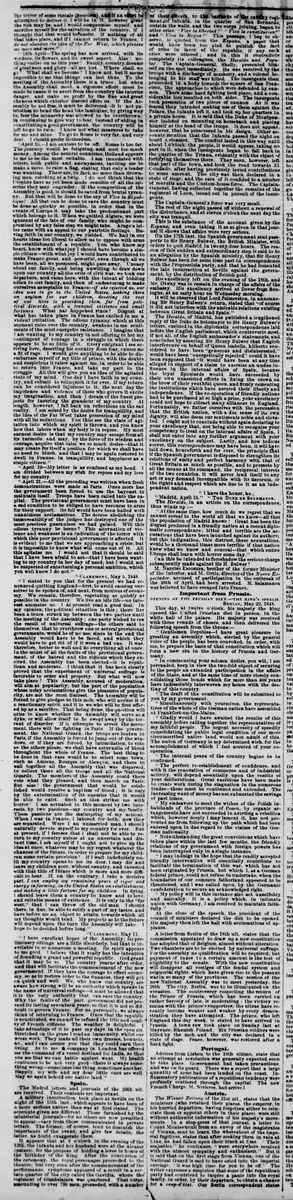
The Madrid letters and journals of the 20th ult. are received. Their contents are important. A military insurrection took place at Seville on the night of the 13th inst., which appears to have been of a more serious nature than was at first stated. The accounts given are different. Those furnished by the ministerial journals—for no others are now permitted to appear—vary from those communicated in private letters. The former, of course, tend to diminish the importance of the event, and give few details; the latter, no doubt, exaggerate them. It appears that at 8 o'clock in the evening of the 13th, the Infanta and her husband were at the Alcazar (palace), for the purpose of holding a levee in honor of the birthday of the King. After the conclusion of the ceremony, the royal personages proceeded to the theatre; but very soon after the commencement of the performance, symptoms appeared of a revolt in a certain quarter of the city called the Gavidia, where the regiment of Guadalajara was quartered. That corps, amounting to over 700 men, proceeded, with a number of their officers, to the barracks of the cavalry regiment of Infanta, in the quarter of San Bernardo outside the walls, and the two corps joining, began to utter cries, "Vive la libertad!" "Viva la constitucion!" and "Viva la Reina!" This passage, I beg to observe, is quoted from the Espana, paper that would have been too glad to publish the fact of cries in favor of the republic, if any such cries were uttered: and in this it contradicts completely its colleagues, the Heraldo and Popular. The Captain-General, Shelly, presented himself on the spot immediately. He was received by the troops with a discharge of musketry, and a colonel belonging to his staff was killed. The insurgents then proceeded in a body towards the square of San Francisco, the approaches to which were defended by cannon. There some hard fighting took place, and a considerable loss resulted on both sides. The insurgents took possession of two pieces of cannon. As it was feared they intended making use of them against the Palace, the Infanta left it, and took up her quarters in a private house. It is said that the Duke of Montpensier insisted on mounting on horseback and placing himself at the head of the troops. It does not appear, however, that he persevered in his design. Other accounts mention that the Infanta passed the night on board a steamer. The conflict lasted in this way until about 1 o'clock, the people, it would appear, taking no part in it, when the insurgents began to fall back in the quarter of the Triana, evidently with the object of fortifying themselves there. They soon, however, left that part of the town, and took the road towards El Condado, after having previously levied contributions to some amount. The city was then declared in a state of siege, and the care of it confided to a number of recruits and the Custom-house force. The Captain-General, having collected together the remains of the regiment of Leon, issued out in pursuit of the insurgents. The Captain-General's force was very small. The rest of the night passed off without a renewal of the disturbance, and at eleven o'clock the next day the city was tranquil. This is the substance of the account given by the Espana; and even taking it as so given in that journal it shows that affairs were very serious. On the 17th inst. the Spanish government sent passports to Sir Henry Bulwer, the British Minister, with orders to quit Madrid in twenty-four hours. The reason of this sudden and extraordinary step is said to be an allegation by the Spanish ministry, that Sir Henry Bulwer has been for some time past in correspondence with the Progressista party, and that he had fomented the late insurrection at Seville against the government, by the distribution of British gold. His excellency left on the evening of the 18th, and Mr. Otway was to remain in charge of the affairs of the embassy. His excellency arrived at Dover from Boulogne, at an early hour on Wednesday morning. It will be observed that Lord Palmerston, in announcing Sir Henry Bulwer's return, stated that "of course it did not interfere with the amicable relations existing between Great Britain and Spain." The Heraldo, of Madrid, has published a lengthened reply of the Duke de Sotomayor to Sir Henry Bulwer's letters, omitted in the diplomatic correspondence laid before the English parliament, which controverts most, if not all, of the English ambassador's statements, and concludes by assuring Sir Henry Bulwer that English interference on behalf of Queen Isabella, hitherto considered to have been "generous and disinterested," would have been "energetically rejected" could it have been supposed that "it would have been at any time alleged in support of a claim to exercise an undue influence in the internal affairs of Spain, because the loyal Spaniards would have succeeded by their own unassisted efforts in fixing the crown on the brow of their youthful queen, and firmly cementing the institutions which have assured their liberty and independence. If the co-operation of friendly nations had to be purchased at so high a price, your excellency could not hope to attract many alliances to England. Fortunately, we flatter ourselves with the persuasion that the British nation, with a due sense of its own dignity, will also deem our sentiments noble and elevated. I ought not to conclude without again declaring to your excellency that, not being able to recognise your competency to treat on the internal affairs of Spain, I shall not enter into any further argument with your excellency on the subject. Lastly, and howsoever tedious this correspondence may have been, it will have laid down, henceforth and for ever, the principle that if the Spanish government is disposed to strengthen its relations of amity and perfect harmony with that of Great Britain as much as possible, and to promote by all the means at its command, the reciprocal interests of the two countries, it will never lend itself to any act or any demand incompatible with its decorum, or the rights and respect which are due to it as an independent nation."
"I have the honor, &c.,
"The Duke de Sotomayor.
"Madrid, April 15."
The Heraldo, in an article on the correspondence, thus winds up:
"At the same time, how much do we regret that we cannot reveal to the world all that we know—all that the population of Madrid knows! Great has been the disgust produced in a friendly nation at a recent diplomatic correspondence; bitter and terrible are the accusations that have been launched against its authors; but this indignation, this distrust, these accusations, would be a thousand times more terrible if that nation knew what we know and conceal—that which entire Europe shall learn with horror some day."
Can this be intended to foreshadow the serious charge subsequently made against Sir H. Bulwer? M. Narciso Escosura, brother of the former Minister of the Interior, and M. Ortiz, director of the Nuevo Espectador, accused of participation in the outbreak of the 26th of April, had been arrested. M. Salamanca was believed to have escaped into France.
What sub-type of article is it?
What keywords are associated?
What entities or persons were involved?
Where did it happen?
Foreign News Details
Primary Location
Seville, Spain
Event Date
Night Of The 13th Inst. To 17th Inst. (Madrid Letters Of 20th Ult.)
Key Persons
Outcome
considerable loss on both sides in clashes; one colonel killed; insurgents seized two cannons, levied contributions, then retreated to el condado; city tranquil by next day; sir henry bulwer expelled from madrid; arrests of escosura and ortiz; salamanca escaped to france.
Event Details
Military insurrection in Seville on night of 13th inst.: Regiment of Guadalajara (over 700 men) joined cavalry regiment, shouted 'Vive la libertad!', 'Viva la constitucion!', 'Viva la Reina!'; clashed with forces led by Captain-General Shelly, who was fired upon; fighting at San Francisco square; Infanta evacuated palace; insurgents retreated after midnight, pursued by small force; city sieged and calmed by 11am next day. On 17th, Spanish government expelled Sir Henry Bulwer for alleged ties to Progressista party and funding the revolt; he departed 18th. Diplomatic correspondence from Duke de Sotomayor rejecting British interference. Arrests related to later outbreak on 26th April.