Thank you for visiting SNEWPapers!
Sign up free
Virginia Argus
Richmond, Virginia
What is this article about?
Reports from India highlight enthusiasm for shipbuilding in Bombay and Calcutta using durable teak wood for British navy and merchant ships. Calcutta merchants subscribe to build a ship of the line as a specimen for government. Examples illustrate teak ships' longevity over oak.
Clipping
OCR Quality
Full Text
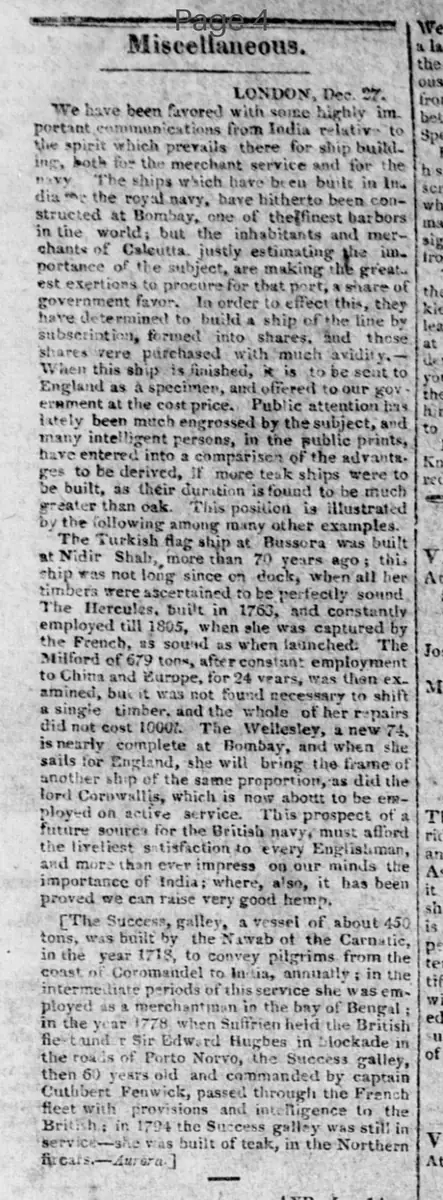
LONDON, Dec. 27.
We have been favored with some highly important communications from India relative to the spirit which prevails there for ship building, both for the merchant service and for the navy. The ships which have been built in India for the royal navy, have hitherto been constructed at Bombay, one of the finest harbors in the world; but the inhabitants and merchants of Calcutta, justly estimating the importance of the subject, are making the greatest exertions to procure for that port, a share of government favor. In order to effect this, they have determined to build a ship of the line by subscription, formed into shares, and these shares were purchased with much avidity. When this ship is finished, it is to be sent to England as a specimen, and offered to our government at the cost price. Public attention has lately been much engrossed by the subject, and many intelligent persons, in the public prints, have entered into a comparison of the advantages to be derived, if more teak ships were to be built, as their duration is found to be much greater than oak. This position is illustrated by the following among many other examples.
The Turkish flag ship at Bussora was built at Nidir Shal, more than 70 years ago; this ship was not long since on dock, when all her timbers were ascertained to be perfectly sound. The Hercules, built in 1763, and constantly employed till 1805, when she was captured by the French, as sound as when launched. The Milford of 679 tons, after constant employment to China and Europe, for 24 years, was then examined, but it was not found necessary to shift a single timber, and the whole of her repairs did not cost 100l. The Wellesley, a new 74 is nearly complete at Bombay, and when she sails for England, she will bring the frame of another ship of the same proportion, as did the Lord Cornwallis, which is now about to be employed on active service. This prospect of a future source for the British navy, must afford the liveliest satisfaction to every Englishman, and more than ever impress on our minds the importance of India; where, also, it has been proved we can raise very good hemp.
The Success, galley, a vessel of about 450 tons, was built by the Nawab of the Carnatic, in the year 1718, to convey pilgrims from the coast of Coromandel to India, annually: in the intermediate periods of this service she was employed as a merchantman in the bay of Bengal; in the year 1778 when Suffrein held the British fleet under Sir Edward Hughes in blockade in the roads of Porto Novo, the Success galley, then 60 years old and commanded by captain Cuthbert Fenwick, passed through the French fleet with provisions and intelligence to the British: in 1794 the Success galley was still in service--she was built of teak, in the Northern Circars.--Aurora--
What sub-type of article is it?
What keywords are associated?
What entities or persons were involved?
Where did it happen?
Foreign News Details
Primary Location
India
Key Persons
Outcome
teak ships demonstrate superior durability; calcutta to build and offer ship of the line to british government at cost; wellesley nearly complete at bombay.
Event Details
Communications from India show strong interest in shipbuilding for merchant and naval use, primarily at Bombay but now efforts in Calcutta to gain government favor by subscribing to build a ship of the line to send to England as specimen. Public discussion favors teak over oak for longevity, illustrated by examples like Turkish ship at Bussora (over 70 years sound), Hercules (1763-1805 sound when captured), Milford (24 years service, minimal repairs), Wellesley nearly complete, and Success galley (built 1718, served until at least 1794, aided British in 1778). India also source for good hemp.