Thank you for visiting SNEWPapers!

Sign up free
Page thumbnail for Southern Christian Advocate
Foreign News October 22, 1847

Southern Christian Advocate

Charleston, Charleston County, South Carolina

What is this article about?

Dr. Pusey denies advising Rev. E. G. K. Browne to convert to the Roman Catholic Church, amid reports of his influence on apostacies from the Church of England. Browne and an eyewitness claim Pusey's advice supported his decision to join Rome if he doubted Anglican apostolic succession. Pusey disavows non-natural interpretations of Anglican articles, distancing from Newman and Ward.

Clipping
OCR Quality

98% Excellent

Full Text

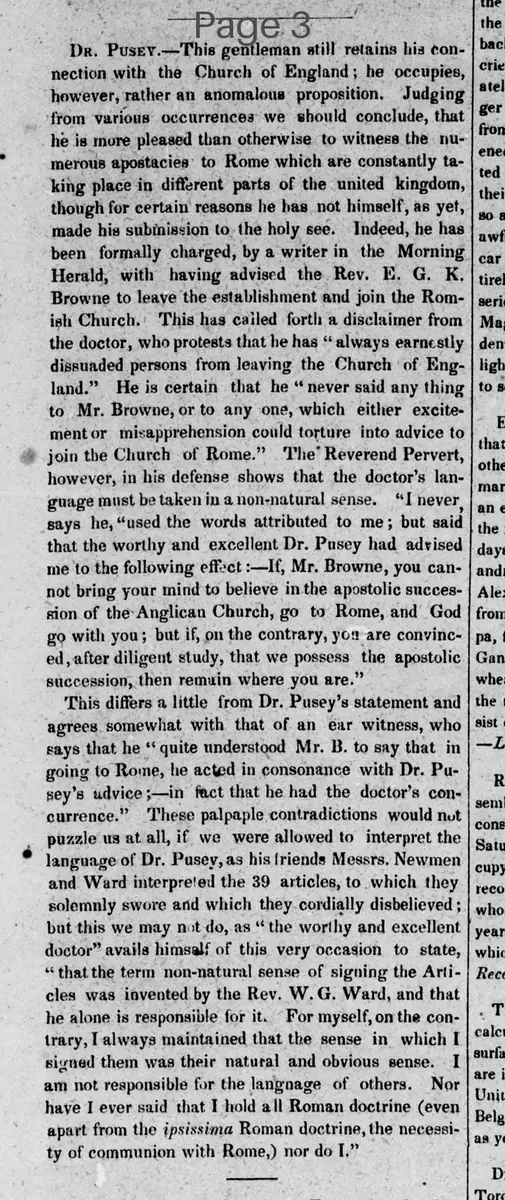
DR. Pusey. This gentleman still retains his connection with the Church of England; he occupies, however, rather an anomalous position. Judging from various occurrences we should conclude, that he is more pleased than otherwise to witness the numerous apostacies to Rome which are constantly taking place in different parts of the united kingdom, though for certain reasons he has not himself, as yet, made his submission to the holy see. Indeed, he has been formally charged, by a writer in the Morning Herald, with having advised the Rev. E. G. K. Browne to leave the establishment and join the Romish Church. This has called forth a disclaimer from the doctor, who protests that he has "always earnestly dissuaded persons from leaving the Church of England." He is certain that he "never said any thing to Mr. Browne, or to any one, which either excitement or misapprehension could torture into advice to join the Church of Rome." The Reverend Pervert, however, in his defense shows that the doctor's language must be taken in a non-natural sense. "I never," says he, "used the words attributed to me; but said that the worthy and excellent Dr. Pusey had advised me to the following effect: If, Mr. Browne, you cannot bring your mind to believe in the apostolic succession of the Anglican Church, go to Rome, and God go with you; but if, on the contrary, you are convinced, after diligent study, that we possess the apostolic succession, then remain where you are." This differs a little from Dr. Pusey's statement and agrees somewhat with that of an ear witness, who says that he "quite understood Mr. B. to say that in going to Rome, he acted in consonance with Dr. Pusey's advice; in fact that he had the doctor's concurrence." These palpable contradictions would not puzzle us at all, if we were allowed to interpret the language of Dr. Pusey, as his friends Messrs. Newman and Ward interpreted the 39 articles, to which they solemnly swore and which they cordially disbelieved; but this we may not do, as "the worthy and excellent doctor" avails himself of this very occasion to state, "that the term non-natural sense of signing the Articles was invented by the Rev. W. G. Ward, and that he alone is responsible for it. For myself, on the contrary, I always maintained that the sense in which I signed them was their natural and obvious sense. I am not responsible for the language of others. Nor have I ever said that I hold all Roman doctrine (even apart from the ipsissima Roman doctrine, the necessity of communion with Rome,) nor do I."

What sub-type of article is it?

Religious Affairs

What keywords are associated?

Dr Pusey Church Of England Conversion To Rome Apostolic Succession 39 Articles Religious Disclaimer

What entities or persons were involved?

Dr. Pusey Rev. E. G. K. Browne Rev. W. G. Ward Messrs. Newman

Where did it happen?

United Kingdom

Foreign News Details

Primary Location

United Kingdom

Key Persons

Dr. Pusey Rev. E. G. K. Browne Rev. W. G. Ward Messrs. Newman

Outcome

dr. pusey issues disclaimer denying advice to convert; contradictions in accounts of his statements; pusey maintains natural interpretation of 39 articles and rejects full roman doctrine.

Event Details

Dr. Pusey retains Church of England connection but faces charges of advising Rev. E. G. K. Browne to join Rome. Pusey protests he always dissuaded leaving Anglican Church and never advised Browne to convert. Browne defends that Pusey's words implied going to Rome if doubting Anglican apostolic succession. Eyewitness supports Browne's interpretation. Pusey rejects non-natural sense of signing Articles, attributing it to Ward, and states he signed in natural sense without holding all Roman doctrine.

Are you sure?