Thank you for visiting SNEWPapers!
Sign up free
Wilmington Daily Gazette
Wilmington, New Castle County, Delaware
What is this article about?
Article from Wilmington discusses public interest in cheaper, better gas, referencing a Reading committee report recommending city-owned works to supply gas at $2 per 1000 feet with 17-candle power, criticizing current Reading gas as inferior (10-11 candles) and overpriced at $3, compared to Philadelphia, Boston, and New York.
Clipping
OCR Quality
Full Text
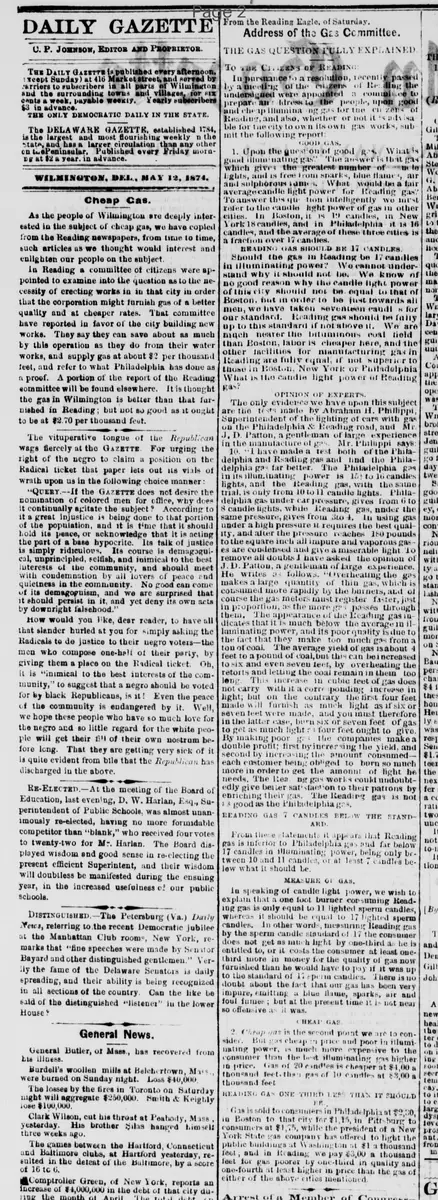
As the people of Wilmington are deeply interested in the subject of cheap gas, we have copied from the Reading newspapers, from time to time, such articles as we thought would interest and enlighten our people on the subject. In Reading a committee of citizens were appointed to examine into the question as to the necessity of erecting works in that city in order that the corporation might furnish gas of a better quality and at cheaper rates. That committee have reported in favor of the city building new works. They say they can save about as much by this operation as they do from their water works, and supply gas at about $2 per thousand feet, and refer to what Philadelphia has done as a proof. A portion of the report of the Reading committee will be found elsewhere. It is thought the gas in Wilmington is better than that furnished in Reading; but not so good as it ought to be at $2.70 per thousand feet.
From the Reading Times, of Saturday.
Address of the Gas Committee.
THE GAS QUESTION FULLY EXPLAINED TO THE CITIZENS OF READING.
In pursuance to a resolution, recently passed by a meeting of the citizens of Reading the undersigned were appointed a committee to prepare an address to the people, upon good and cheap illuminating gas for the citizens of Reading, and also, whether or not it's advisable for the city to own its own gas works, submit the following report:
GOOD GAS.
1. Upon the question of good gas. What is good illuminating gas? The answer is that gas which gives the greatest number of candle lights, and is free from sparks, blue flame, air and sulphurous fumes. What would be a fair average candle light power for Reading gas?
To answer this question intelligently we must refer to the candle light power of gas in other cities. In Boston, it is 19 candles, in New York 18 candles, and in Philadelphia it is 16 candles, and the average of these three cities is a fraction over 17 candles.
READING GAS SHOULD BE 17 CANDLES.
Should the gas in Reading be 17 candles in illuminating power? We cannot understand why it should not be. We know of no good reason why the candle light power of this city should not be equal to that of Boston, but in order to be just towards all men, we have taken seventeen candles for our standard. Reading gas should be fully up to this standard if not above it. We are much nearer the bituminous coal field than Boston, labor is cheaper here, and the other facilities for manufacturing gas in Reading are fully equal, if not superior to those in Boston, New York or Philadelphia.
What is the candle light power of Reading gas?
OPINION OF EXPERTS.
The only evidence we have upon this subject are the tests made by Abraham H. Phillippi, Superintendent of the lighting of cars with gas on the Philadelphia & Reading road, and Mr. J. D. Patton, a gentleman of large experience in the manufacture of gas. Mr. Phillippi says: "I have made a test both of the Philadelphia and Reading gas and find the Philadelphia gas far better. The Philadelphia gas in its illuminating power is 15 to 16 candle lights, and the Reading gas, with the same trial, is only from 10 to 11 candle lights. Philadelphia gas under car pressure, gives from 6 to 8 candle lights, while Reading gas, under the same pressure, gives from 3 to 4. In using gas under a high pressure it requires the best quality, and after the pressure reaches 150 pounds to the square inch all impure and vaporous gases are condensed and give a miserable light. To remove all doubts I have asked the opinion of J. D. Patton, a gentleman of large experience."
He writes as follows. "Overheating the gas makes a large quantity of thin gas, which is consumed more rapidly by the burners, and of course the gas meters must register faster, just in proportion, as the more gas passes through them." The appearance of the Reading gas indicates that it is much below the average in illuminating power, and its poor quality is due to the fact that they make too much gas from a ton of coal. The average yield of gas is about 4 feet to a pound of coal, but this can be increased to six and even seven feet, by overheating the retorts and letting the coal remain in them too long. This increase in cubic feet of gas does not carry with it a corresponding increase in light; but on the contrary the first four feet made will furnish as much light as if six or seven feet were made, and you must therefore in the latter case, burn six or seven feet of gas to get as much light as four feet ought to give.
By making poor gas the companies make a double profit; first by increasing the yield, and second by increasing the amount consumed—each customer being obliged to burn so much more in order to get the amount of light he needs. The Reading gas works could undoubtedly give better satisfaction to their patrons by enriching their gas. The Reading gas is not as good as the Philadelphia gas.
READING GAS 7 CANDLES BELOW THE STANDARD.
From these statements it appears that Reading gas is inferior to Philadelphia gas and far below 17 candles in illuminating power, being only between 10 and 11 candles, or at least 7 candles below what it should be.
MEASURE OF GAS.
In speaking of candle light power, we wish to explain that a one foot burner consuming Reading gas is only equal to 11 lighted sperm candles, whereas it should be equal to 17 lighted sperm candles. In other words, measuring Reading gas by the sperm candle standard of 17 the consumer does not get as much light by one-third as he is entitled to, or it costs the consumer at least one-third more in money for the quality of gas now furnished than he would have to pay if it was up to the standard of 17 sperm candles. There is no doubt about the fact that our gas has been very impure, emitting a blue flame, sparks, air and foul fumes; but at the present time it is not near so offensive as it was.
CHEAP GAS.
2. Cheap gas is the second point we are to consider. But gas cheap in price and poor in illuminating power, is much more expensive to the consumer than the best illuminating gas higher in price. Gas of 20 candles is cheaper at $4.00 a thousand feet than gas of 10 candles at $3.00 a thousand feet.
READING GAS ONE THIRD LESS THAN IT SHOULD BE.
Gas is sold to consumers in Philadelphia at $2.50, in Boston to that city for $1.15, in Pittsburg to consumers at $1.75, while the president of a New York State gas company has offered to light the public buildings at Washington at $1 a thousand feet, and in Reading we pay $3.00 a thousand feet for gas poorer by one-third in quality and one-fourth at least higher in price than the gas of either of the above cities mentioned.
What sub-type of article is it?
What themes does it cover?
What keywords are associated?
What entities or persons were involved?
Where did it happen?
Story Details
Key Persons
Location
Reading, Pennsylvania; Wilmington
Story Details
A committee in Reading reports on the need for city-owned gas works to provide better quality gas (17 candle power) at cheaper rates ($2 per 1000 feet), criticizing current private supply as inferior (10-11 candles) and overpriced ($3), due to deceptive manufacturing practices increasing volume but reducing light, compared to other cities like Philadelphia.