Thank you for visiting SNEWPapers!
Sign up free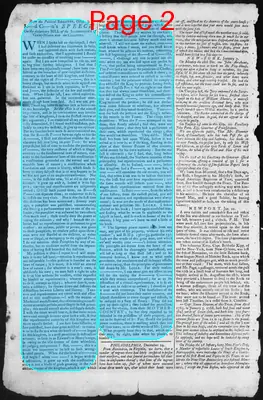
The New Hampshire Gazette And Historical Chronicle
Portsmouth, Greenland, Rockingham County, New Hampshire
What is this article about?
Lord Camden's speech in the House of Lords argues against the Declaratory Bill asserting British sovereignty to tax the American colonies without representation, citing historical precedents, natural law, and John Locke's principles as inseparable rights.
Clipping
OCR Quality
Full Text
Lord Camden's Speech
On the Declaratory Bill of the Sovereignty of Great-Britain over the Colonies.
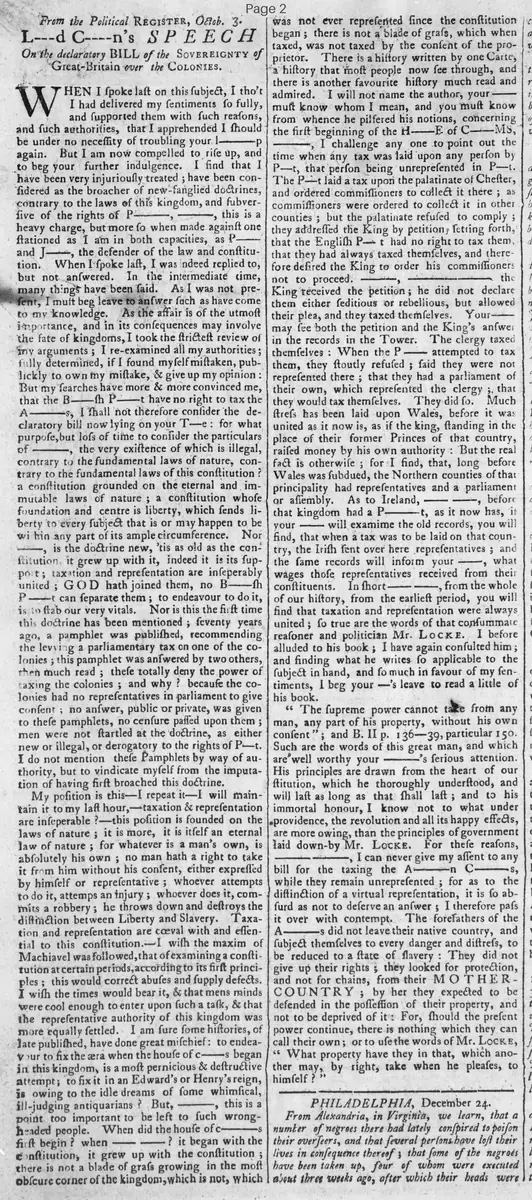
When I spoke last on this subject, I thought and supported them with such reasons, I had delivered my sentiments so fully, and such authorities, that I apprehended I should be under no necessity of troubling your lordships again. But I am now compelled to rise up, and to beg your further indulgence. I find that I have been very injuriously treated; have been considered as the broacher of new-fangled doctrines, contrary to the laws of this kingdom, and subversive of the rights of Parliament. This is a heavy charge, but more so when made against one stationed as I am in both capacities, as Privy Councillor and Judge, the defender of the law and constitution. When I spoke last, I was indeed replied to, but not answered. In the intermediate time, many things have been said. As I was not present, I must beg leave to answer such as have come to my knowledge. As the affair is of the utmost importance, and in its consequences may involve the fate of kingdoms, I took the strictest review of my arguments; I re-examined all my authorities; fully determined, if I found myself mistaken, publicly to own my mistake, & give up my opinion: But my searches have more & more convinced me, that the British Parliament have no right to tax the Americans. I shall not therefore consider the declaratory bill now lying on your table: for what purpose, but loss of time to consider the particulars of an act, the very existence of which is illegal, contrary to the fundamental laws of nature, contrary to the fundamental laws of this constitution? A constitution grounded on the eternal and immutable laws of nature; a constitution whose foundation and centre is liberty, which ends liberty to every subject that is or may happen to be within any part of its ample circumference. Nor, is the doctrine new, 'tis as old as the constitution, it grew up with it, indeed it is its support; taxation and representation are inseparably united; GOD hath joined them, no British Parliament can separate them; to endeavour to do it, is to stab our very vitals. Nor is this the first time this doctrine has been mentioned; seventy years ago, a pamphlet was published, recommending the levying a parliamentary tax on one of the colonies; this pamphlet was answered by two others, then much read; these totally deny the power of taxing the colonies; and why? because the colonies had no representatives in parliament to give consent: no answer, public or private, was given to these pamphlets, no censure passed upon them; men were not startled at the doctrine, as either new or illegal, or derogatory to the rights of Parliament. I do not mention these Pamphlets by way of authority, but to vindicate myself from the imputation of having first broached this doctrine. My position is this--I repeat it--I will maintain it to my last hour,--taxation & representation are inseparable?--this position is founded on the laws of nature; it is more, it is itself an eternal law of nature; for whatever is a man's own, is absolutely his own; no man hath a right to take it from him without his consent, either expressed by himself or representative; whoever attempts to do it, attempts an injury; whoever does it, commits a robbery; he throws down and destroys the distinction between Liberty and Slavery. Taxation and representation are coeval with and essential to this constitution.--I wish the maxim of Machiavel was followed, that of examining a constitution at certain periods, according to its first principles; this would correct abuses and supply defects. I wish the times would bear it, & that mens minds were cool enough to enter upon such a task, & that the representative authority of this kingdom was more equally settled. I am sure some histories, of late published, have done great mischief: to endeavour to fix the era when the house of commons began in this kingdom, is a most pernicious & destructive attempt; to fix it in an Edward's or Henry's reign, is owing to the idle dreams of some whimsical, ill-judging antiquarians? But, --, this is a point too important to be left to such wrong-headed people. When did the house of commons first begin? when — --? it began with the constitution, it grew up with the constitution: there is not a blade of grass growing in the most obscure corner of the kingdom, which was not ever represented since the constitution began; there is not a blade of grass, which when taxed, was not taxed by the consent of the proprietor. There is a history written by one Carte, a history that most people now see through, and there is another favourite history much read and admired. I will not name the author, your lordships must know whom I mean, and you must know from whence he pilfered his notions, concerning the first beginning of the HOUSE OF COMMONS, I challenge any one to point out the time when any tax was laid upon any person by Parliament, that person being unrepresented in Parliament. The Parliament laid a tax upon the palatinate of Chester, and ordered commissioners to collect it there; as commissioners were ordered to collect it in other counties; but the palatinate refused to comply: they addressed the King by petition, setting forth, that the English Parliament had no right to tax them, that they had always taxed themselves, and therefore desired the King to order his commissioners not to proceed. The King received the petition; he did not declare them either seditious or rebellious, but allowed their plea, and they taxed themselves. Your lordships may see both the petition and the King's answer in the records in the Tower. The clergy taxed themselves: When the Parliament attempted to tax them, they stoutly refused; said they were not represented there; that they had a parliament of their own, which represented the clergy; that they would tax themselves. They did so. Much stress has been laid upon Wales, before it was united as it now is, as if the king, standing in the place of their former Princes of that country, raised money by his own authority: But the real fact is otherwise: for I find, that, long before Wales was Subdued, the Northern counties of that principality had representatives and a parliament or assembly. As to Ireland, before that kingdom had a Parliament, as it now has, if your lordships will examine the old records, you will find, that when a tax was to be laid on that country, the Irish sent over here representatives; and the same records will inform your lordships, what wages those representatives received from their constituents. In short--.- -, from the whole of our history, from the earliest period, you will find that taxation and representation were always united: so true are the words of that consummate reasoner and politician Mr. Locke. I before alluded to his book; I have again consulted him; and finding what he writes so applicable to the subject in hand, and so much in favour of my sentiments, I beg your lordships' leave to read a little of his book. "The supreme power cannot take from any man, any part of his property, without his own consent"; and B. II p. 136--39, particular 150. Such are the words of this great man, and which are well worthy your lordships' serious attention. His principles are drawn from the heart of our constitution, which he thoroughly understood, and will last as long as that shall last; and to his immortal honour, I know not to what under providence, the revolution and all its happy effects, are more owing, than the principles of government laid down by Mr. Locke. For these reasons, I can never give my assent to any bill for the taxing the American Colonies, while they remain unrepresented; for as to the distinction of a virtual representation, it is so absurd as not to deserve an answer: I therefore pass it over with contempt. The forefathers of the Americans did not leave their native country, and subject themselves to every danger and distress, to be reduced to a state of slavery: They did not give up their rights; they looked for protection, and not for chains, from their MOTHER-COUNTRY: by her they expected to be defended in the possession of their property, and not to be deprived of it: For, should the present power continue, there is nothing which they can call their own; or to use the words of Mr. Locke, "What property have they in that, which another may, by right, take when he pleases, to himself?"
What sub-type of article is it?
What keywords are associated?
What entities or persons were involved?
Where did it happen?
Foreign News Details
Primary Location
The Colonies
Event Date
Oct. 3
Key Persons
Outcome
lord camden maintains that the british parliament has no right to tax the americans without representation and refuses assent to the declaratory bill.
Event Details
In his speech, Lord Camden defends his prior statements against the Declaratory Bill, arguing that taxation without representation violates natural law, the British constitution, and historical precedents from Chester, clergy, Wales, and Ireland. He cites pamphlets from seventy years ago, historians like Carte, Machiavelli, and quotes John Locke to support that taxation and representation are inseparable.