Thank you for visiting SNEWPapers!
Sign up free
The Louisiana Democrat
Alexandria, Rapides County, Louisiana
What is this article about?
The New York News reports on Judge J.S. Black's argument in the Supreme Court case of Ex parte Milligan, where civilians tried by military commission during the Civil War for conspiracy were deemed to lack jurisdiction for such tribunals. The Court ordered Milligan's discharge, invalidating many wartime military judgments and emphasizing civil justice.
Clipping
OCR Quality
Full Text
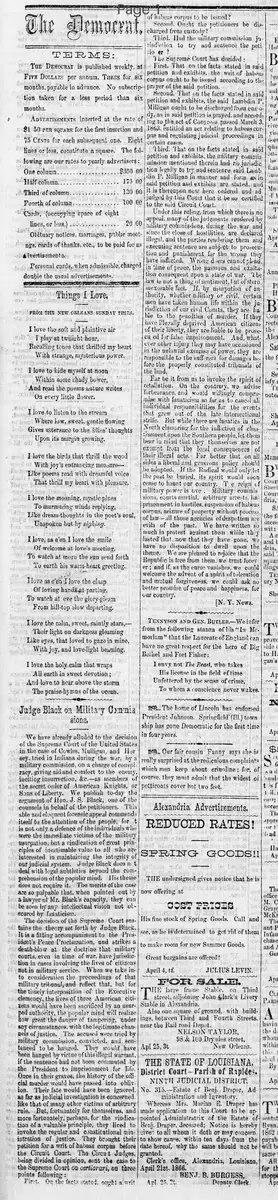
We have already alluded to the decision of the Supreme Court of the United States in the case of Cowles, Milligan, and Horsey, tried in Indiana during the war, by a military commission, on a charge of conspiracy, giving aid and comfort to the enemy, inciting insurrection, &c.-as members of the secret order of American Knights, or Sons of Liberty. We publish to-day the argument of Hon. J. S. Black, one of the counsels in behalf of the petitioners. This able and eloquent forensic appeal commends itself to the attention of the people:- for it is not only a defence of the individuals who were the immediate victims of the military usurpation; but a vindication of great principles of inestimable value to all who are interested in maintaining the integrity of our judicial system. Judge Black does not deal with legal subtleties beyond the comprehension of the popular mind. His theme does not require it. The merits of the case are so palpable that, when pointed out by a lawyer of Mr. Black's capacity, they can be seen by any intellectual vision not obscured by fanaticism.
The decision of the Supreme Court sustains the theory set forth by Judge Black. It is a fitting accompaniment to the President's Peace Proclamation, and strikes a death-blow at the doctrine that military courts, even in time of war, have jurisdiction in cases involving the lives of citizens not in military service. When we take into consideration the proceedings of that military tribunal, and reflect that, but for the timely interposition of the Executive clemency, the lives of three American citizens would have been sacrificed by an usurped authority, the popular mind will realize how great the danger of tampering, under any circumstances, with the legitimate channels of justice. The accused were tried by military commission, convicted, and, sentenced to be hanged. They would have been hanged by virtue of this illegal warrant, if the sentence had not been commuted by the President to imprisonment for life. Once in their graves, the history of the official murder would have passed into oblivion. Their fate would have been ignored, as far as judicial investigation is concerned, like that of many other victims of arbitrary rule. But, fortunately for themselves, and more fortunately, perhaps, for the vindication of a valuable principle, they lived to invoke the regular and constitutional administration of justice. They brought their petition for a writ of habeas corpus before the Circuit Court. The Circuit Judges, being divided in opinion, sent the case to the Supreme Court on certiorari, on three points following:
First. On the facts stated, ought a writ of habeas corpus to be issued?
Second. Ought the petitioners be discharged from custody?
Third. Had the military commission jurisdiction to try and sentence the petitioners?
The Supreme Court has decided:
First. That on the facts stated in said petition and exhibits, the writ of habeas corpus ought to be issued according to the prayer of the said petition.
Second. That on the facts stated in said petition and exhibits, the said Lambdin P. Milligan ought to be discharged from custody, as in said petition is prayed, and according to the act of Congress passed March 3, 1863, entitled an act relating to habeas corpus and regulating judicial proceedings in certain cases.
Third. That on the facts stated in said petition and exhibits, the military commission mentioned therein had no jurisdiction legally to try and sentence said Lambdin P. Milligan in manner and form as in said petition and exhibits are stated, and it is thereupon now here ordered and adjudged by this Court that it be so certified to the said Circuit Court.
Under this ruling, from which there is no appeal, many of the judgments rendered by military commissions, during the war and since the close of hostilities, are declared illegal, and the parties rendering them and executing sentence are subject to prosecution and punishment for the wrong they have inflicted. Wrong doers cannot plead, in time of peace, the passions and exaltation consequent upon a state of war. The law is not a thing of sentiment, but of stern, inexorable fact. If, by usurpation of authority, whether military or civil, certain men have taken human life within the jurisdiction of our civil Courts, they are liable to the penalties of murder. If they have illegally deprived American citizens of their liberty, they are liable to be prosecuted for false imprisonment. And, whatever other injury they may have occasioned in the unlawful exercise of power, they are responsible to the sufferers for damages before the properly constituted tribunals of the land.
Far be it from us to invoke the spirit of retaliation. On the contrary, we advise forbearance, and would willingly compromise with fanaticism so far as to cancel all individual responsibilities for the events that grew out of the late intersectional strife. But while there are fanatics in the North clamoring for the infliction of chastisement upon the Southern people, let them bear in mind that they themselves are not exempt from the legal consequences of their illegal acts. Far better that on all sides a liberal and generous policy should be adopted. If the Radical would only let the past be buried, its spirit would soon cease to haunt our country. The reign of military power is over. Military commissions, courts martial, arbitrary arrests, imprisonment in bastiles, suspension of habeas corpus, seizure of property without process of law--all those agencies of despotism are evils of the past. We have written so much in protest against them while they lasted that, now that they have gone, we have no disposition to dwell upon the theme. We are pleased to rejoice that the Republic is free from them, we trust forever; and if, as the curse vanishes, we could welcome the advent of a spirit of toleration and mutual forgiveness, we could ask no better promise of peace and happiness, for our country.
N. Y. News.
What sub-type of article is it?
What keywords are associated?
What entities or persons were involved?
Where did it happen?
Domestic News Details
Primary Location
Indiana
Event Date
During The War
Key Persons
Outcome
supreme court ruled military commission lacked jurisdiction; milligan discharged from custody; sentences commuted from death to life imprisonment by president; many wartime military judgments declared illegal.
Event Details
Civilians Cowles, Milligan, and Horsey tried by military commission in Indiana for conspiracy, aiding the enemy, and inciting insurrection as members of Sons of Liberty. Convicted and sentenced to hang, but commuted to life imprisonment. Petitioned for habeas corpus; Supreme Court decided writ should issue, petitioners discharged, and military commission had no jurisdiction over civilians not in military service.