Thank you for visiting SNEWPapers!
Sign up free
The Princeton Union
Princeton, Mille Lacs County, Minnesota
What is this article about?
A journalist praises Duluth, Minnesota, as a booming seaport and third-largest city in the state, highlighting its wholesale trade success, magnificent lyceum building, residential developments, newspapers, and potential Republican congressional candidates.
Merged-components note: These components form a continuous narrative story about Duluth, split due to initial parsing; merged into single logical unit focused on the city's development and politics.
Clipping
OCR Quality
Full Text
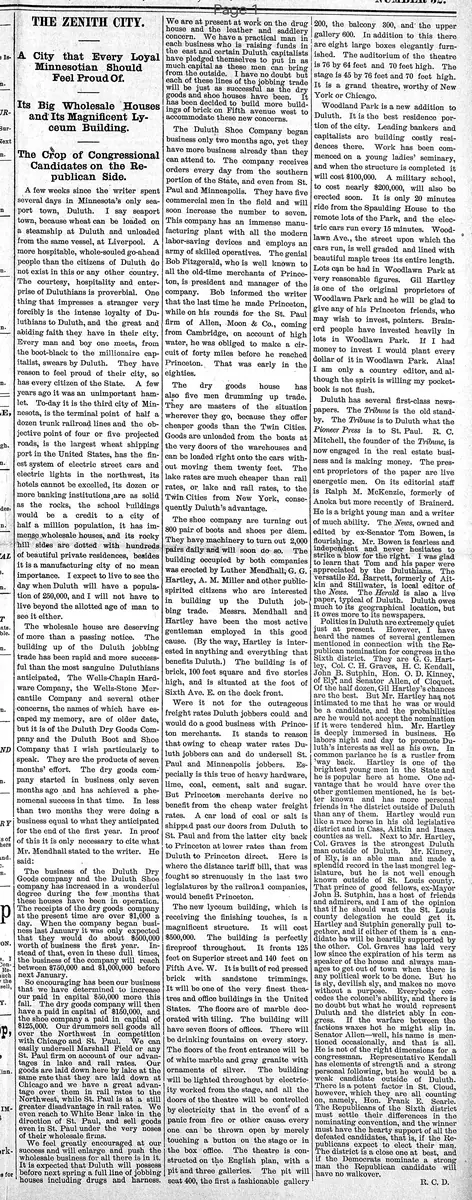
A City that Every Loyal Minnesotian Should Feel Proud Of.
Its Big Wholesale Houses and Its Magnificent Lyceum Building.
The Crop of Congressional Candidates on the Republican Side.
A few weeks since the writer spent several days in Minnesota's only seaport town, Duluth. I say seaport town, because wheat can be loaded on a steamship at Duluth and unloaded from the same vessel, at Liverpool. A more hospitable, whole-souled go-ahead people than the citizens of Duluth do not exist in this or any other country. The courtesy, hospitality and enterprise of Duluthians is proverbial. One thing that impresses a stranger very forcibly is the intense loyalty of Duluthians to Duluth, and the great and abiding faith they have in their city. Every man and boy one meets, from the boot-black to the millionaire capitalist, swears by Duluth. They have reason to feel proud of their city, so has every citizen of the State. A few years ago it was an unimportant hamlet. To-day it is the third city of Minnesota, is the terminal point of half a dozen trunk railroad lines and the objective point of four or five projected roads, is the largest wheat shipping port in the United States, has the finest system of electric street cars and electric lights in the northwest. its hotels cannot be excelled. its dozen or more banking institutions are as solid as the rocks, the school buildings would be a credit to a city of half a million population, it has immense wholesale houses, and its rocky hill sides are dotted with hundreds of beautiful private residences, besides it is a manufacturing city of no mean importance. I expect to live to see the day when Duluth will have a population of 250,000, and I will not have to live beyond the allotted age of man to see it either.
The wholesale house are deserving of more than a passing notice. The building up of the Duluth jobbing trade has been rapid and more successful than the most sanguine Duluthians anticipated, The Wells-Chapin Hardware Company, the Wells-Stone Mercantile Company and several other concerns, the names of which have escaped my memory, are of older date, but it is of the Duluth Dry Goods Company and the Duluth Boot and Shoe Company that I wish particularly to speak. They are the products of seven months' effort. The dry goods company started in business only seven months ago and has achieved a phenomenal success in that time. In less than two months they were doing a business equal to what they anticipated for the end of the first year. In proof of this it is only necessary to cite what Mr. Mendhall stated to the writer. He said:
The business of the Duluth Dry Goods company and the Duluth Shoe company has increased in a wonderful degree during the few months that these houses have been in operation. The receipts of the dry goods company at the present time are over $1,000 a day. When the company began business last January it was only expected that they would do about $500,000 worth of business the first year. Instead of that, even in these dull times. the business of the company will reach between $750,000 and $1,000,000 before next January.
So encouraging has been our business that we have determined to increase our paid in capital $50,000 more this fall. The dry goods company will then have a paid in capital of $150,000, and the shoe company a paid in capital of $125,000. Our drummers sell goods all over the Northwest in competition with Chicago and St. Paul. We can easily undersell Marshall Field or any St. Paul firm on account of our advantages in lake and rail rates. Our goods are laid down here by lake at the same rate that they are laid down at Chicago and we have a great advantage over them in rail rates to the Northwest, while St. Paul is at a still greater disadvantage in rail rates. We even reach to White Bear lake in the direction of St. Paul. and sell goods even in St. Paul under the very noses of their wholesale firms.
We feel greatly encouraged at our success and will enlarge and push the wholesale business for all there is in it. It is expected that Duluth will possess before next spring a full line of jobbing houses including drugs and harness. We are at present at work on the drug house and the leather and saddlery concern. We have a practical man in each business who is raising funds in the east and certain Duluth capitalists have pledged themselves to put in as much capital as these men can bring from the outside. I have no doubt but each of these lines of the jobbing trade will be just as successful as the dry goods and shoe houses have been. It has been decided to build more buildings of brick on Fifth avenue west to accommodate these new concerns.
The Duluth Shoe Company began business only two months ago, yet they have more business already than they can attend to. The company receives orders every day from the southern portion of the State, and even from St. Paul and Minneapolis. They have five commercial men in the field and will soon increase the number to seven.
This company has an immense manufacturing plant with all the modern labor-saving devices and employs an army of skilled operatives. The genial Bob Fitzgerald, who is well known to all the old-time merchants of Princeton, is president and manager of the company. Bob informed the writer that the last time he made Princeton, while on his rounds for the St. Paul firm of Allen, Moon & Co., coming from Cambridge, on account of high water, he was obliged to make a circuit of forty miles before he reached Princeton. That was early in the eighties.
The dry goods house −has also five men drumming up trade. They are masters of the situation wherever they go, because they offer cheaper goods than the Twin Cities. Goods are unloaded from the boats at the very doors of the warehouses and can be loaded right onto the cars without moving them twenty feet. The lake rates are much cheaper than rail rates, or lake and rail rates, to the Twin Cities from New York, consequently Duluth's advantage.
The shoe company are turning out 800 pair of boots and shoes per diem. They have machinery to turn out 2,000 pairs daily and will soon do so, The building occupied by both companies was erected by Luther Mendhall, G. G. Hartley, A. M. Miller and other public spirited citizens who are interested in building up the Duluth jobbing trade. Messrs. Mendhall and Hartley have been the most active gentleman employed in this good cause. (By the way, Hartley is interested in anything and everything that benefits Duluth.) The building is of brick, 100 feet square and five stories high, and is situated at the foot of Sixth Ave. E. on the dock front
Were it not for the outrageous freight rates Duluth jobbers could and would do a good business with Princeton merchants. It stands to reason that owing to cheap water rates Duluth jobbers can and do undersell St. Paul and Minneapolis jobbers. Especially is this true of heavy hardware, lime, coal, cement, salt and sugar. But Princeton merchants derive no benefit from the cheap water freight rates. A car load of coal or salt is shipped past our doors from Duluth to St. Paul and from the latter city back to Princeton at lower rates than from Duluth to Princeton direct. Here is where the distance tariff bill, that was fought so strenuously in the last two legislatures by the railroal companies. would benefit Princeton.
The new lyceum building. which is receiving the finishing touches, is a magnificent structure. It will cost $500,000. The building is perfectly fireproof throughout. It fronts 125 feet on Superior street and 140 feet on Fifth Ave. W. It is built of red pressed brick with sandstone trimmings.
It will be one of the very finest theatres and office buildings in the United States. The floors are of marble decorated with tiling. The building will have seven floors of offices. There will be drinking fountains on every story. The floors of the front entrance will be of white marble and gray granite with ornaments of silver. The building will be lighted throughout by electricity worked from the stage, and all the doors of the theatre will be controlled by electricity that in the event of a panic from fire or other cause every one can 'be thrown open by merely touching a button on the stage or in the box office. The theatre is constructed on the English plan, with a pit and three galleries. The pit will seat 400, the first a fashionable gallery 200, the balcony 300, and the upper gallery 600. In addition to this there are eight large boxes elegantly furnished. The auditorium of the theatre is 76 by 64 feet and 70 feet high. The stage is 45 by 76 feet and 70 feet high. It is a grand theatre, worthy of New York or Chicago.
Woodland Park is a new addition to Duluth. It is the best residence portion of the city. Leading bankers and capitalists are building costly residences there. Work has been commenced on a young ladies' seminary, and when the structure is completed it will cost $100,000. A military school, to cost nearly $200,000, will also be erected soon. It is only 20 minutes ride from the Spaulding House to the remote lots of the Park, and the electric cars run every 15 minutes. Woodlawn Ave., the street upon which the cars run. is well graded and lined with beautiful maple trees its entire length,
Lots can be had in Woodlawn Park at very reasonable figures. Gil Hartley is one of the original proprietors of Woodlawn Park and he will be glad to give any of his Princeton friends, who may wish to invest, pointers. Brainerd people have invested heavily in lots in Woodlawn Park. If I had money to invest I would plant every dollar of it in Woodlawn Park. Alas! I am only a country editor, and although the spirit is willing my pocketbook is not flush.
Duluth has several first-class newspapers. The Tribune is the old stand-by. The Tribune is to Duluth what the Pioneer Press is to St. Paul. R. C. Mitchell, the founder of the Tribune, is now engaged in the real estate business and is making money. The present proprietors of the paper are live energetic men. On its editorial staff is Ralph M. McKenzie, formerly of Anoka but more recently of Brainerd. He is a bright young man and a writer of much ability. The News, owned and edited by ex-Senator Tom Bowen, is flourishing. Mr. Bowen is fearless and independent and never hesitates to strike a blow for the right. I was glad to learn that Tom and his paper were appreciated by the Duluthians. The versatile Ed. Barrett, formerly of Aitkin and Stillwater. is local editor of the News. The Herald is also a live paper, typical of Duluth. Duluth owes much to its geographical location, but it owes more to its newspapers.
Politics in Duluth are extremely quiet just at present. However, I have heard the names of several gentlemen mentioned in connection with the Republican nomination for congress in the Sixth district. They are G. G. Hartley, Col. C. H. Graves, H. C. Kendall, John B. Sutphin, Hon. O. D. Kinney, of Ely, and Senator Allen, of Cloquet. Of the half dozen, Gil Hartley's chances are the best. But Mr. Hartley has not intimated to me that he was or would be a candidate, and the probabilities are he would not accept the nomination if it were tendered him. Mr. Hartley is deeply immersed in business. He labors night and day to promote Duluth's interests as well as his own. In common parlance he is a rustler from 'way back. Hartley is one of the brightest young men in the State and he is popular here at home. One advantage that he would have over the other gentlemen mentioned, he is better known and has more personal friends in the district outside of Duluth than any of them. Hartley would run like a race horse in his old legislative district and in Cass, Aitkin and Itasca counties as well. Next to Mr. Hartley, Col. Graves is the strongest Duluth man outside of Duluth. Mr. Kinney, of Ely, is an able man and made a splendid record in the last mongrel legislature, but he is not well enough known outside of St. Louis county. That prince of good fellows, ex-Mayor John B. Sutphin, has a host of friends and admirers, and I am of the opinion that if he should want the St. Louis county delegation he could get it. Hartley and Sutphin generally pull together, and if either of them is a candidate he will be heartily supported by the other. Col. Graves has laid very low since the expiration of his term as speaker of the house and always manages to get out of town when there is any political work to be done. But he is sly, devilish sly, and makes no move without a purpose. Everybody concedes the colonel's ability, and there is no doubt but what he would represent Duluth and the district ably in congress. If the warfare between the factions waxes hot he might slip in. Senator Allen-well, his name is mentioned occasionally, and that is all. He is not of the right dimensions for a congressman. Representative Kendall has elements of strength and a strong personal following, but he would be a weak candidate outside of Duluth.
There is a potent factor in St. Cloud, however, which they are all counting on, namely, Hon. Frank E. Searle. The Republicans of the Sixth district must settle their differences in the nominating convention, and the winner must have the hearty support of all the defeated candidates, that is, if the Republicans expect to elect their man. The district is a close one at best, and if the Democrats nominate a strong man the Republican candidate will have no walkover.
R. C.:
What sub-type of article is it?
What themes does it cover?
What keywords are associated?
What entities or persons were involved?
Where did it happen?
Story Details
Key Persons
Location
Duluth, Minnesota
Story Details
The writer visits Duluth, describing its rapid growth from hamlet to major seaport and commercial hub, successful wholesale companies like Duluth Dry Goods and Shoe Company, the grand new lyceum building, Woodland Park development, newspapers, and potential Republican congressional candidates led by G. G. Hartley.