Thank you for visiting SNEWPapers!
Sign up free
Letter to Editor
September 23, 1795
Gazette Of The United States
Philadelphia, Philadelphia County, Pennsylvania
What is this article about?
A pseudonymous letter from 'Belisarius' criticizes President Washington for hastily ratifying the British treaty (Jay Treaty) on August 14, 1795, despite widespread public opposition via town meetings in major cities, accusing him of contradiction, precipitancy, and cabinet influence.
Clipping
OCR Quality
98%
Excellent
Full Text
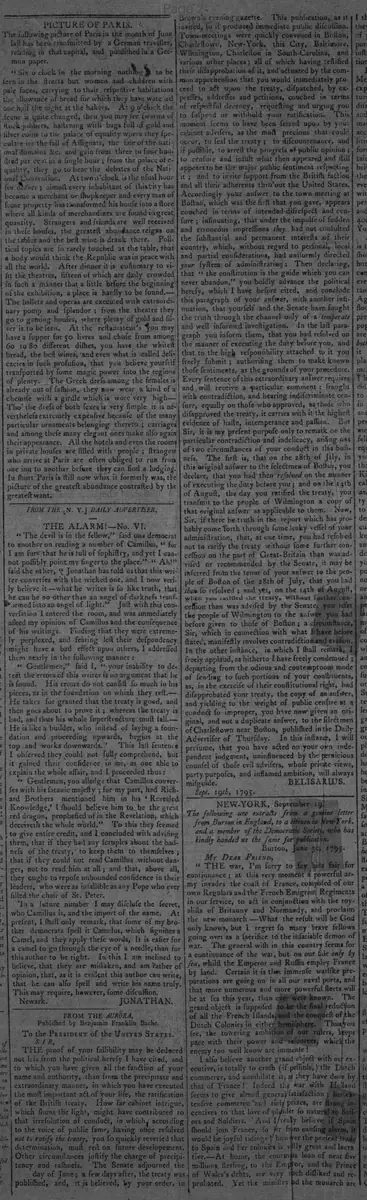
FROM THE AURORA.
Published by Benjamin Franklin Bache.
To the President of the United States.
SIR,
THE proof of your fallibility may be deduced not less from the political heresy I have cited, and to which you have given all the sanction of your name and authority, than from the precipitate and extraordinary manner, in which you have executed the most important act of your life, the ratification of the British treaty. How far cabinet intrigue, which shuns the light, might have contributed to that irresolution of conduct, in which, according to the voice of public fame, having once resolved not to ratify the treaty, you so quickly reversed that determination, must rest on future development.
Other circumstances justify the charge of precipitancy and rashness. The Senate adjourned the day of June; a few days after, the treaty was published, and, it is believed, by your order, in Brown's evening gazette. This publication, as it invited, so it produced immediate public discussion. Town-meetings were quickly convened in Boston, Charlestown, New-York, this City, Baltimore, Wilmington, Charleston in South-Carolina, and various other places; all of which having testified their disapprobation of it, and actuated by the common apprehension that you would immediately proceed to act upon the treaty, dispatched, by express, addresses and petitions, couched in terms of respectful decency, requesting and urging you to suspend or withhold your ratification. This moment seems to have been seized upon by you and your cabinet advisers, as the most precious that could occur, to seal the treaty; to discountenance, and if possible, to arrest the progress of public opinion; to censure and insult what then appeared and still appears to be the major public sentiment respecting it; and to invite support from the British faction and all their adherents thro'out the United States.
Accordingly your answer to the town-meeting at Boston, which was the first that you gave, appears couched in terms of intended disrespect and censure; insinuating, that under the impulse of sudden and erroneous impressions they had not consulted the substantial and permanent interests of their country, which, without regard to personal, local and partial considerations, had uniformly directed your system of administration: Then declaring, that "the constitution is the guide which you can never abandon," you boldly advance the political heresy, which I have before cited, and conclude this paragraph of your answer, with another insinuation, that yourself and the Senate have sought the truth through the channel only of a temperate and well informed investigation. In the last paragraph you inform them, that you had resolved on the manner of executing the duty before you, and that to the high responsibility attached to it you freely submit; authorizing them to make known those sentiments, as the grounds of your procedure.
Every sentence of this extraordinary answer requires and will receive a particular comment: fraught with contradiction, and bearing indiscriminate censure, equally on those who approved, as those who disapproved the treaty, it carries with it the highest evidence of haste, intemperance and passion. But Sir, it is my present purpose only to remark on the particular contradiction and indelicacy, arising out of two circumstances of your conduct in this business. The first is, that on the 28th of July, in this original answer to the selectmen of Boston, you declare, that you had then resolved on the manner of executing the duty before you; and on the 14th of August, the day you ratified the treaty, you transmit to the people of Wilmington a copy of that original answer as applicable to them. Now, Sir, if there be truth in the report which has probably come forth through some leaky vessel of your administration, that, at one time, you had resolved not to ratify the treaty without some further concession on the part of Great-Britain than was advised or recommended by the Senate, it may be inferred from the tenor of your answer to the people of Boston of the 28th of July, that you had then so resolved; and yet, on the 14th of August, when you ratified the treaty, without further concession than was advised by the Senate, you refer the people of Wilmington to the answer you had before given to those of Boston; a circumstance, Sir, which in connection with what I have before stated, manifestly involves contradiction and evasion.
In the other instance, in which I shall remark, I freely applaud, as hitherto I have freely condemned; departing from the odious and contemptuous mode of sending to such portions of your constituents, as, in the exercise of their constitutional right, had disapprobated your treaty, the copy of an answer, and yielding to the weight of public censure at a conduct so improper, you have now given an original, and not a duplicate answer, to the selectmen of Charlestown near Boston, published in the Daily Advertiser of Thursday. In this instance, I will presume, that you have acted on your own independent judgment, uninfluenced by the pernicious counsel of those evil advisers, whose private views, party purposes, and inflamed ambition, will always misguide.
BELISARIUS.
Sept. 19th, 1795.
Published by Benjamin Franklin Bache.
To the President of the United States.
SIR,
THE proof of your fallibility may be deduced not less from the political heresy I have cited, and to which you have given all the sanction of your name and authority, than from the precipitate and extraordinary manner, in which you have executed the most important act of your life, the ratification of the British treaty. How far cabinet intrigue, which shuns the light, might have contributed to that irresolution of conduct, in which, according to the voice of public fame, having once resolved not to ratify the treaty, you so quickly reversed that determination, must rest on future development.
Other circumstances justify the charge of precipitancy and rashness. The Senate adjourned the day of June; a few days after, the treaty was published, and, it is believed, by your order, in Brown's evening gazette. This publication, as it invited, so it produced immediate public discussion. Town-meetings were quickly convened in Boston, Charlestown, New-York, this City, Baltimore, Wilmington, Charleston in South-Carolina, and various other places; all of which having testified their disapprobation of it, and actuated by the common apprehension that you would immediately proceed to act upon the treaty, dispatched, by express, addresses and petitions, couched in terms of respectful decency, requesting and urging you to suspend or withhold your ratification. This moment seems to have been seized upon by you and your cabinet advisers, as the most precious that could occur, to seal the treaty; to discountenance, and if possible, to arrest the progress of public opinion; to censure and insult what then appeared and still appears to be the major public sentiment respecting it; and to invite support from the British faction and all their adherents thro'out the United States.
Accordingly your answer to the town-meeting at Boston, which was the first that you gave, appears couched in terms of intended disrespect and censure; insinuating, that under the impulse of sudden and erroneous impressions they had not consulted the substantial and permanent interests of their country, which, without regard to personal, local and partial considerations, had uniformly directed your system of administration: Then declaring, that "the constitution is the guide which you can never abandon," you boldly advance the political heresy, which I have before cited, and conclude this paragraph of your answer, with another insinuation, that yourself and the Senate have sought the truth through the channel only of a temperate and well informed investigation. In the last paragraph you inform them, that you had resolved on the manner of executing the duty before you, and that to the high responsibility attached to it you freely submit; authorizing them to make known those sentiments, as the grounds of your procedure.
Every sentence of this extraordinary answer requires and will receive a particular comment: fraught with contradiction, and bearing indiscriminate censure, equally on those who approved, as those who disapproved the treaty, it carries with it the highest evidence of haste, intemperance and passion. But Sir, it is my present purpose only to remark on the particular contradiction and indelicacy, arising out of two circumstances of your conduct in this business. The first is, that on the 28th of July, in this original answer to the selectmen of Boston, you declare, that you had then resolved on the manner of executing the duty before you; and on the 14th of August, the day you ratified the treaty, you transmit to the people of Wilmington a copy of that original answer as applicable to them. Now, Sir, if there be truth in the report which has probably come forth through some leaky vessel of your administration, that, at one time, you had resolved not to ratify the treaty without some further concession on the part of Great-Britain than was advised or recommended by the Senate, it may be inferred from the tenor of your answer to the people of Boston of the 28th of July, that you had then so resolved; and yet, on the 14th of August, when you ratified the treaty, without further concession than was advised by the Senate, you refer the people of Wilmington to the answer you had before given to those of Boston; a circumstance, Sir, which in connection with what I have before stated, manifestly involves contradiction and evasion.
In the other instance, in which I shall remark, I freely applaud, as hitherto I have freely condemned; departing from the odious and contemptuous mode of sending to such portions of your constituents, as, in the exercise of their constitutional right, had disapprobated your treaty, the copy of an answer, and yielding to the weight of public censure at a conduct so improper, you have now given an original, and not a duplicate answer, to the selectmen of Charlestown near Boston, published in the Daily Advertiser of Thursday. In this instance, I will presume, that you have acted on your own independent judgment, uninfluenced by the pernicious counsel of those evil advisers, whose private views, party purposes, and inflamed ambition, will always misguide.
BELISARIUS.
Sept. 19th, 1795.
What sub-type of article is it?
Persuasive
Political
Provocative
What themes does it cover?
Politics
Constitutional Rights
Economic Policy
What keywords are associated?
British Treaty
Jay Treaty Ratification
Public Opposition
Town Meetings
Cabinet Intrigue
Washington Criticism
Constitutional Duty
What entities or persons were involved?
Belisarius
The President Of The United States
Letter to Editor Details
Author
Belisarius
Recipient
The President Of The United States
Main Argument
the president hastily ratified the british treaty against public opinion, contradicting his prior resolutions and responses to petitions, influenced by cabinet intrigue and aimed at suppressing dissent.
Notable Details
Town Meetings In Boston, Charlestown, New York, Philadelphia, Baltimore, Wilmington, Charleston Disapproving The Treaty
Publication Of Treaty In Brown's Evening Gazette
President's Answer To Boston On July 28, 1795
Ratification On August 14, 1795
Reference To Political Heresy Regarding The Constitution
Applause For Original Answer To Charlestown Selectmen