Thank you for visiting SNEWPapers!
Sign up free
Literary
January 31, 1804
The New Hampshire Gazette
Portsmouth, Rockingham County, New Hampshire
What is this article about?
Historical account of early church penitents and rigorous penances in the 3rd-4th centuries, evolving into commutations via alms, masses, and money by the 8th century due to impractical durations. Examples include substituting psalter repetitions and whippings for years of penance, with reflections on corruption in Christianity.
Clipping
OCR Quality
95%
Excellent
Full Text
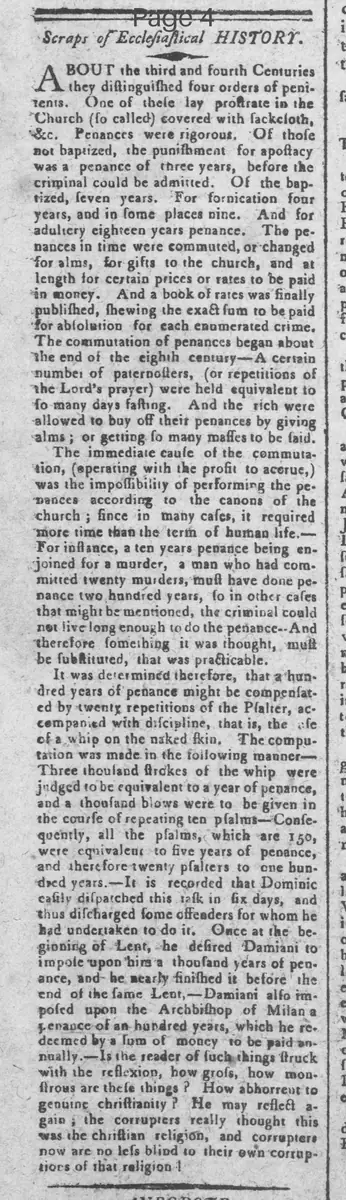
Scraps of Ecclesiastical HISTORY.
ABOUT the third and fourth Centuries they distinguished four orders of penitents. One of these lay prostrate in the Church (so called) covered with sackcloth, &c. Penances were rigorous. Of those not baptized, the punishment for apostasy was a penance of three years, before the criminal could be admitted. Of the baptized, seven years. For fornication four years, and in some places nine. And for adultery eighteen years penance. The penances in time were commuted, or changed for alms, for gifts to the church, and at length for certain prices or rates to be paid in money. And a book of rates was finally published, showing the exact sum to be paid for absolution for each enumerated crime.
The commutation of penances began about the end of the eighth century-A certain number of paternosters, (or repetitions of the Lord's prayer) were held equivalent to so many days fasting. And the rich were allowed to buy off their penances by giving alms ; or getting so many masses to be said.
The immediate cause of the commutation, (operating with the profit to accrue,) was the impossibility of performing the penances according to the canons of the church ; since in many cases, it required more time than the term of human life.-- For instance, a ten years penance being enjoined for a murder, a man who had committed twenty murders, must have done penance two hundred years, so in other cases that might be mentioned, the criminal could not live long enough to do the penance-- And therefore something it was thought, must be substituted, that was practicable.
It was determined therefore, that a hundred years of penance might be compensated by twenty repetitions of the Psalter, accompanied with discipline, that is, the use of a whip on the naked skin. The computation was made in the following manner-- Three thousand strokes of the whip were judged to be equivalent to a year of penance, and a thousand blows were to be given in the course of repeating ten psalms-Consequently, all the psalms, which are 150, were equivalent to five years of penance, and therefore twenty psalters to one hundred years.-It is recorded that Dominic daily dispatched this task in six days, and thus discharged some offenders for whom he had undertaken to do it. Once at the beginning of Lent, he desired Damiani to impose upon him a thousand years of penance, and-he nearly finished it before the end of the same Lent,-Damiani also imposed upon the Archbishop of Milan a penance of an hundred years, which he redeemed by a sum of money to be paid annually.-Is the reader of such things struck with the reflection, how gross, how monstrous are these things ? How abhorrent to genuine christianity ? He may reflect again; the corrupters really thought this was the christian religion, and corrupters now are no less blind to their own corruptions of that religion !
ABOUT the third and fourth Centuries they distinguished four orders of penitents. One of these lay prostrate in the Church (so called) covered with sackcloth, &c. Penances were rigorous. Of those not baptized, the punishment for apostasy was a penance of three years, before the criminal could be admitted. Of the baptized, seven years. For fornication four years, and in some places nine. And for adultery eighteen years penance. The penances in time were commuted, or changed for alms, for gifts to the church, and at length for certain prices or rates to be paid in money. And a book of rates was finally published, showing the exact sum to be paid for absolution for each enumerated crime.
The commutation of penances began about the end of the eighth century-A certain number of paternosters, (or repetitions of the Lord's prayer) were held equivalent to so many days fasting. And the rich were allowed to buy off their penances by giving alms ; or getting so many masses to be said.
The immediate cause of the commutation, (operating with the profit to accrue,) was the impossibility of performing the penances according to the canons of the church ; since in many cases, it required more time than the term of human life.-- For instance, a ten years penance being enjoined for a murder, a man who had committed twenty murders, must have done penance two hundred years, so in other cases that might be mentioned, the criminal could not live long enough to do the penance-- And therefore something it was thought, must be substituted, that was practicable.
It was determined therefore, that a hundred years of penance might be compensated by twenty repetitions of the Psalter, accompanied with discipline, that is, the use of a whip on the naked skin. The computation was made in the following manner-- Three thousand strokes of the whip were judged to be equivalent to a year of penance, and a thousand blows were to be given in the course of repeating ten psalms-Consequently, all the psalms, which are 150, were equivalent to five years of penance, and therefore twenty psalters to one hundred years.-It is recorded that Dominic daily dispatched this task in six days, and thus discharged some offenders for whom he had undertaken to do it. Once at the beginning of Lent, he desired Damiani to impose upon him a thousand years of penance, and-he nearly finished it before the end of the same Lent,-Damiani also imposed upon the Archbishop of Milan a penance of an hundred years, which he redeemed by a sum of money to be paid annually.-Is the reader of such things struck with the reflection, how gross, how monstrous are these things ? How abhorrent to genuine christianity ? He may reflect again; the corrupters really thought this was the christian religion, and corrupters now are no less blind to their own corruptions of that religion !
What sub-type of article is it?
Essay
What themes does it cover?
Religious
Moral Virtue
What keywords are associated?
Ecclesiastical History
Penitents
Penances
Commutation
Church Corruption
Psalter Discipline
Literary Details
Title
Scraps Of Ecclesiastical History.
Key Lines
Is The Reader Of Such Things Struck With The Reflection, How Gross, How Monstrous Are These Things ? How Abhorrent To Genuine Christianity ?
He May Reflect Again; The Corrupters Really Thought This Was The Christian Religion, And Corrupters Now Are No Less Blind To Their Own Corruptions Of That Religion !