Thank you for visiting SNEWPapers!
Sign up free
Story
July 23, 1951
The Nome Nugget
Nome, Nome County, Alaska
What is this article about?
Interior Department studies, supervised by Reclamation Bureau, highlight Alaska's vast hydroelectric potential, idle land for production, water needs, flood control, mineral deposits, and major dam projects, promising a multi-billion-dollar future for the territory.
Clipping
OCR Quality
95%
Excellent
Full Text
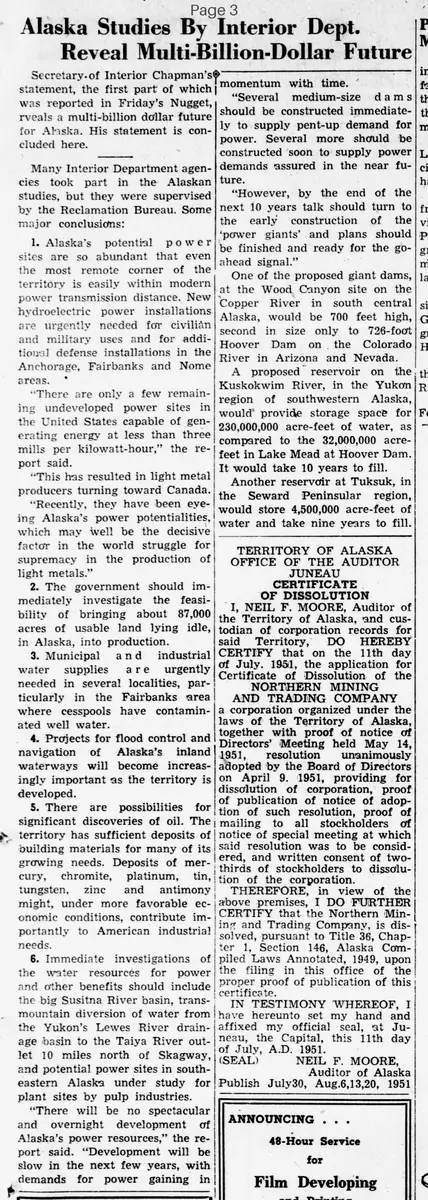
Alaska Studies By Interior Dept.
Reveal Multi-Billion-Dollar Future
Secretary of Interior Chapman's statement, the first part of which was reported in Friday's Nugget, reveals a multi-billion dollar future for Alaska. His statement is concluded here.
Many Interior Department agencies took part in the Alaskan studies, but they were supervised by the Reclamation Bureau. Some major conclusions:
1. Alaska's potential power sites are so abundant that even the most remote corner of the territory is easily within modern power transmission distance. New hydroelectric power installations are urgently needed for civilian and military uses and for additional defense installations in the Anchorage, Fairbanks and Nome areas.
"There are only a few remaining undeveloped power sites in the United States capable of generating energy at less than three mills per kilowatt-hour," the report said.
"This has resulted in light metal producers turning toward Canada.
"Recently, they have been eyeing Alaska's power potentialities, which may well be the decisive factor in the world struggle for supremacy in the production of light metals."
2. The government should immediately investigate the feasibility of bringing about 87,000 acres of usable land lying idle in Alaska into production.
3. Municipal and industrial water supplies are urgently needed in several localities, particularly in the Fairbanks area where cesspools have contaminated wellwater.
4. Projects for flood control and navigation of Alaska's inland waterways will become increasingly important as the territory is developed.
5. There are possibilities for significant discoveries of oil. The territory has sufficient deposits of building materials for many of its growing needs. Deposits of mercury, chromite, platinum, tin, tungsten, zinc and antimony might, under more favorable economic conditions, contribute importantly to American industrial needs.
6. Immediate investigations of the water resources for power and other benefits should include the big Susitna River basin, trans-mountain diversion of water from the Yukon's Lewes River drainage basin to the Taiya River outlet 10 miles north of Skagway, and potential power sites in southeastern Alaska under study for plant sites by pulp industries.
"There will be no spectacular and overnight development of Alaska's power resources," the report said. "Development will be slow in the next few years, with demands for power gaining in momentum with time.
"Several medium-size dams should be constructed immediately to supply pent-up demand for power. Several more should be constructed soon to supply power demands assured in the near future.
"However, by the end of the next 10 years talk should turn to the early construction of the 'power giants' and plans should be finished and ready for the go-ahead signal."
One of the proposed giant dams, at the Wood Canyon site on the Copper River in south central Alaska, would be 700 feet high, second in size only to 726-foot Hoover Dam on the Colorado River in Arizona and Nevada.
A proposed reservoir on the Kuskokwim River in the Yukon region of southwestern Alaska would provide storage space for 230,000,000 acre-feet of water, as compared to the 32,000,000 acre-feet in Lake Mead at Hoover Dam. It would take 10 years to fill.
Another reservoir at Tuksuk, in the Seward Peninsular region, would store 4,500,000 acre-feet of water and take nine years to fill.
Reveal Multi-Billion-Dollar Future
Secretary of Interior Chapman's statement, the first part of which was reported in Friday's Nugget, reveals a multi-billion dollar future for Alaska. His statement is concluded here.
Many Interior Department agencies took part in the Alaskan studies, but they were supervised by the Reclamation Bureau. Some major conclusions:
1. Alaska's potential power sites are so abundant that even the most remote corner of the territory is easily within modern power transmission distance. New hydroelectric power installations are urgently needed for civilian and military uses and for additional defense installations in the Anchorage, Fairbanks and Nome areas.
"There are only a few remaining undeveloped power sites in the United States capable of generating energy at less than three mills per kilowatt-hour," the report said.
"This has resulted in light metal producers turning toward Canada.
"Recently, they have been eyeing Alaska's power potentialities, which may well be the decisive factor in the world struggle for supremacy in the production of light metals."
2. The government should immediately investigate the feasibility of bringing about 87,000 acres of usable land lying idle in Alaska into production.
3. Municipal and industrial water supplies are urgently needed in several localities, particularly in the Fairbanks area where cesspools have contaminated wellwater.
4. Projects for flood control and navigation of Alaska's inland waterways will become increasingly important as the territory is developed.
5. There are possibilities for significant discoveries of oil. The territory has sufficient deposits of building materials for many of its growing needs. Deposits of mercury, chromite, platinum, tin, tungsten, zinc and antimony might, under more favorable economic conditions, contribute importantly to American industrial needs.
6. Immediate investigations of the water resources for power and other benefits should include the big Susitna River basin, trans-mountain diversion of water from the Yukon's Lewes River drainage basin to the Taiya River outlet 10 miles north of Skagway, and potential power sites in southeastern Alaska under study for plant sites by pulp industries.
"There will be no spectacular and overnight development of Alaska's power resources," the report said. "Development will be slow in the next few years, with demands for power gaining in momentum with time.
"Several medium-size dams should be constructed immediately to supply pent-up demand for power. Several more should be constructed soon to supply power demands assured in the near future.
"However, by the end of the next 10 years talk should turn to the early construction of the 'power giants' and plans should be finished and ready for the go-ahead signal."
One of the proposed giant dams, at the Wood Canyon site on the Copper River in south central Alaska, would be 700 feet high, second in size only to 726-foot Hoover Dam on the Colorado River in Arizona and Nevada.
A proposed reservoir on the Kuskokwim River in the Yukon region of southwestern Alaska would provide storage space for 230,000,000 acre-feet of water, as compared to the 32,000,000 acre-feet in Lake Mead at Hoover Dam. It would take 10 years to fill.
Another reservoir at Tuksuk, in the Seward Peninsular region, would store 4,500,000 acre-feet of water and take nine years to fill.
What sub-type of article is it?
Government Report
Resource Assessment
What themes does it cover?
Exploration
Triumph
Fortune Reversal
What keywords are associated?
Alaska Development
Hydroelectric Power
Mineral Deposits
Interior Department
Reclamation Bureau
Dam Projects
Resource Potential
What entities or persons were involved?
Secretary Of Interior Chapman
Where did it happen?
Alaska
Story Details
Key Persons
Secretary Of Interior Chapman
Location
Alaska
Story Details
Interior Department studies reveal Alaska's abundant hydroelectric sites, need for land development, water supplies, flood control, mineral potential, and major dam projects for future growth.