Thank you for visiting SNEWPapers!
Sign up free
Editorial
March 17, 1840
The Caledonian
Saint Johnsbury, Caledonia County, Vermont
What is this article about?
Satirical dialogue from Connecticut Courant between a laborer and ex-senator critiquing Democratic policies on labor wage reductions, the Sub-Treasury system, and John C. Calhoun's speech, highlighting economic hardships and partisan divides.
Clipping
OCR Quality
95%
Excellent
Full Text
From the Connecticut Courant.
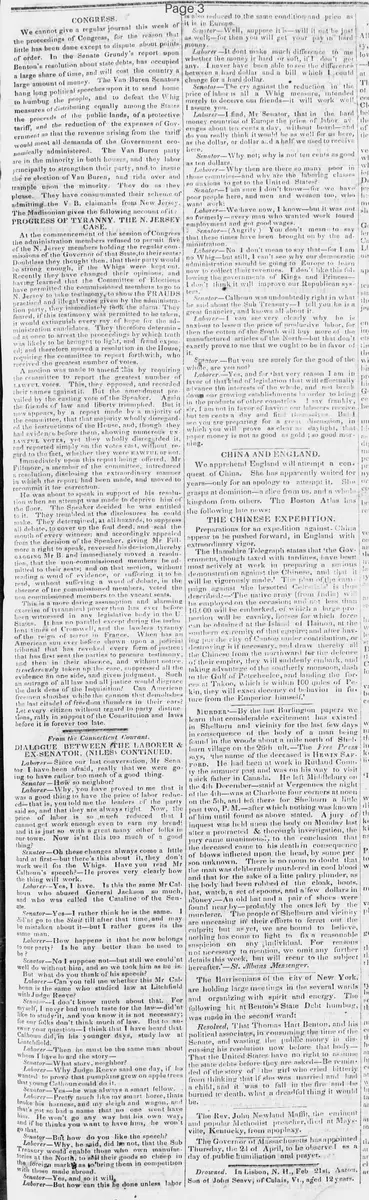
DIALOGUE BETWEEN A LABORER & EX-SENATOR. (CONTINUED.)
Laborer—Since our last conversation, Mr Senator I have been afraid, really that we were going to have rather too much of a good thing.
Senator—How so neighbor?
Laborer—Why, you have proved to me that it was a good thing to have the price of labor reduced—that is, you told me the leaders of the party said so, and that they are always right Now, the price of labor is so much reduced that I cannot get work enough even to earn my bread and it is just so with a great many other folks in our town. Now isn't this too much of a good thing?
Senator—Oh these changes always come a little hard at first but there's this about it, they don't work well for the Whigs. Have you read Mr Calhoun's speech?—He proves very clearly how the thing will work.
Laborer—Yes. I have. Is this the same Mr Calhoun who abused General Jackson so much, and who was called the Cataline of the Senate?
Senator—Yes—I rather think he is the same. I didn't go to the Senate till after that time, and may be mistaken about it but I rather guess its the same man.
Laborer—How happens it that he now belongs to our party? Is he any better than he used to be?
Senator—No I suppose not—but still we couldn't well do without him, and so we took him as he is. But what do you think of his speech?
Laborer—Can you tell me whether this Mr Calhoun is the same who studied law at Litchfield with Judge Reeve?
Senator—I don't know much about that. For myself, I never had much taste for the law—didn't like to study it, and you know it is not necessary; for our folks don't think much of law. But to answer your question—I think that I have heard that Calhoun did, in his younger days, study law at Litchfield.
Laborer—Then he must be the same man about whom I have heard the story—
Senator—What story, neighbor?
Laborer—Why Judge Reeve said one day, if he wanted to prove that pumpkins grew on apple trees that young Calhoun could do it.
Senator—Yes—he was always a smart fellow.
Laborer—Pretty much like my smart horse, that's broke his harness and my sleigh and wagon and that's got so bad a name that no one won't have him and if he thinks you want to have him, he won't go that.
Senator—But how do you like the speech?
Laborer—Why, he said, did he not, that the Sub Treasury would enable those who own manufactories at the North to sell their goods so cheap in the foreign market as to bring them in competition with those made abroad.
Senator—Yes, and so it will.
Laborer—But how can this be done unless labor is also reduced to the same condition and price as it is in Europe.
Senator—Well, suppose it is—will it not be just as well;—for then you will get your pay in hard money.
Laborer—It dont make much difference to me whether the money is hard or soft, if I don't get any. I never have been able to see the difference between a hard dollar and a bill which I could change for a hard dollar.
Senator—The cry against the reduction in the price of labor is all a Whig measure, intended merely to deceive our friends—it will work well I assure you.
Laborer—I find, Mr Senator, that in the hard money countries of Europe the price of labor averages about ten cents a day, without board—and do you really think it would be as well for us here, as the dollar, or dollar and a half we used to receive here.
Senator—Why not; why is not ten cents as good as ten dollars.
Laborer—Why then are there so many poor in those countries—and why are the laboring classes so anxious to get to the United States?
Senator—I am sure I don't know—for we have poor people here, and men and women too, who want work:
Laborer—We have now, I know—but it was not so formerly—every man who wanted work found employment and got good wages.
Senator—(Angrily) You don't mean to say that these times have been brought on by the administration.
Laborer—No I don't mean to say that—for I am no Whig—but still, I can't see why our democratic administration should be going to Europe to learn how to collect their revenues. I don't like this following the governments of Kings and Princes—I don't think it will improve our Republican system.
Senator—Calhoun was undoubtedly right in what he said about the Sub Treasury—I tell you he is a great financier, and knows all about it.
Laborer—I can see very clearly why he is anxious to lessen the price of productive labor, for then the cotton of the South will buy more of the manufactured articles of the North—but that don't exactly prove to me that we ought to be in favor of it.
Senator—But you are surely for the good of the whole, are you not?
Laborer—Yes, and for that very reason I am in favor of that kind of legislation that will effectually advance the interests of the whole, and not break down our growing establishments in order to bring in the products of other countries I say, frankly, sir. I am not in favor of having our laborers receive but ten cents a day and find themselves. But I see you are preparing for a great discussion, in which you will prove as clear as daylight, that paper money is not as good as gold; so good morning.
DIALOGUE BETWEEN A LABORER & EX-SENATOR. (CONTINUED.)
Laborer—Since our last conversation, Mr Senator I have been afraid, really that we were going to have rather too much of a good thing.
Senator—How so neighbor?
Laborer—Why, you have proved to me that it was a good thing to have the price of labor reduced—that is, you told me the leaders of the party said so, and that they are always right Now, the price of labor is so much reduced that I cannot get work enough even to earn my bread and it is just so with a great many other folks in our town. Now isn't this too much of a good thing?
Senator—Oh these changes always come a little hard at first but there's this about it, they don't work well for the Whigs. Have you read Mr Calhoun's speech?—He proves very clearly how the thing will work.
Laborer—Yes. I have. Is this the same Mr Calhoun who abused General Jackson so much, and who was called the Cataline of the Senate?
Senator—Yes—I rather think he is the same. I didn't go to the Senate till after that time, and may be mistaken about it but I rather guess its the same man.
Laborer—How happens it that he now belongs to our party? Is he any better than he used to be?
Senator—No I suppose not—but still we couldn't well do without him, and so we took him as he is. But what do you think of his speech?
Laborer—Can you tell me whether this Mr Calhoun is the same who studied law at Litchfield with Judge Reeve?
Senator—I don't know much about that. For myself, I never had much taste for the law—didn't like to study it, and you know it is not necessary; for our folks don't think much of law. But to answer your question—I think that I have heard that Calhoun did, in his younger days, study law at Litchfield.
Laborer—Then he must be the same man about whom I have heard the story—
Senator—What story, neighbor?
Laborer—Why Judge Reeve said one day, if he wanted to prove that pumpkins grew on apple trees that young Calhoun could do it.
Senator—Yes—he was always a smart fellow.
Laborer—Pretty much like my smart horse, that's broke his harness and my sleigh and wagon and that's got so bad a name that no one won't have him and if he thinks you want to have him, he won't go that.
Senator—But how do you like the speech?
Laborer—Why, he said, did he not, that the Sub Treasury would enable those who own manufactories at the North to sell their goods so cheap in the foreign market as to bring them in competition with those made abroad.
Senator—Yes, and so it will.
Laborer—But how can this be done unless labor is also reduced to the same condition and price as it is in Europe.
Senator—Well, suppose it is—will it not be just as well;—for then you will get your pay in hard money.
Laborer—It dont make much difference to me whether the money is hard or soft, if I don't get any. I never have been able to see the difference between a hard dollar and a bill which I could change for a hard dollar.
Senator—The cry against the reduction in the price of labor is all a Whig measure, intended merely to deceive our friends—it will work well I assure you.
Laborer—I find, Mr Senator, that in the hard money countries of Europe the price of labor averages about ten cents a day, without board—and do you really think it would be as well for us here, as the dollar, or dollar and a half we used to receive here.
Senator—Why not; why is not ten cents as good as ten dollars.
Laborer—Why then are there so many poor in those countries—and why are the laboring classes so anxious to get to the United States?
Senator—I am sure I don't know—for we have poor people here, and men and women too, who want work:
Laborer—We have now, I know—but it was not so formerly—every man who wanted work found employment and got good wages.
Senator—(Angrily) You don't mean to say that these times have been brought on by the administration.
Laborer—No I don't mean to say that—for I am no Whig—but still, I can't see why our democratic administration should be going to Europe to learn how to collect their revenues. I don't like this following the governments of Kings and Princes—I don't think it will improve our Republican system.
Senator—Calhoun was undoubtedly right in what he said about the Sub Treasury—I tell you he is a great financier, and knows all about it.
Laborer—I can see very clearly why he is anxious to lessen the price of productive labor, for then the cotton of the South will buy more of the manufactured articles of the North—but that don't exactly prove to me that we ought to be in favor of it.
Senator—But you are surely for the good of the whole, are you not?
Laborer—Yes, and for that very reason I am in favor of that kind of legislation that will effectually advance the interests of the whole, and not break down our growing establishments in order to bring in the products of other countries I say, frankly, sir. I am not in favor of having our laborers receive but ten cents a day and find themselves. But I see you are preparing for a great discussion, in which you will prove as clear as daylight, that paper money is not as good as gold; so good morning.
What sub-type of article is it?
Economic Policy
Labor
Partisan Politics
What keywords are associated?
Labor Wages
Sub Treasury
Calhoun Speech
Economic Policy
Partisan Debate
Wage Reduction
Manufacturing Competition
What entities or persons were involved?
Mr Calhoun
General Jackson
Judge Reeve
Whigs
Democrats
Sub Treasury
Editorial Details
Primary Topic
Critique Of Labor Wage Reductions And Sub Treasury Policy
Stance / Tone
Satirical Mockery Of Democratic Economic Arguments
Key Figures
Mr Calhoun
General Jackson
Judge Reeve
Whigs
Democrats
Sub Treasury
Key Arguments
Reduction In Labor Prices Harms Workers And Leads To Unemployment
Calhoun's Speech Supports Sub Treasury To Compete In Foreign Markets By Lowering Costs
European Labor Wages Are Only Ten Cents A Day, Undesirable For Us
Partisan Defense Of Policies Despite Past Criticisms Of Calhoun
Preference For Protecting Domestic Manufacturing Over Cheap Foreign Imports
Hard Money Vs Paper Money Irrelevant Without Employment