Thank you for visiting SNEWPapers!
Sign up free
Alexandria Gazette
Alexandria, Alexandria County, District Of Columbia
What is this article about?
The tax bill has passed both houses of the Virginia General Assembly, maintaining the 50 cents per $100 property tax rate and introducing changes to exemptions, assessments on vehicles, debts, businesses, licenses for merchants, liquor retailers, professionals, and more.
Clipping
OCR Quality
Full Text
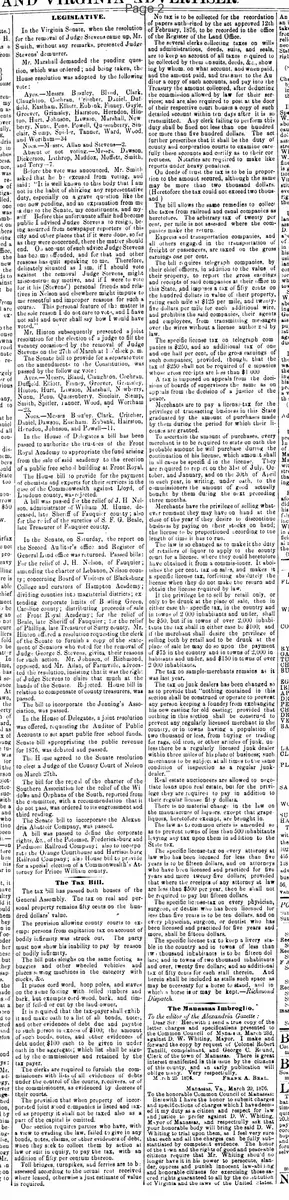
The tax bill has passed both houses of the General Assembly. The tax on real and personal property remains fifty cents on the hundred dollars' value.
The provision allowing county courts to exempt persons from capitation tax on account of bodily infirmity was struck out. The party must now show his inability to pay by reason of bodily infirmity.
The bill puts sleighs on the same footing as buggies and other wheeled vehicles, and places sewing machines in the category with clocks, &c.
It places cord wood, hoop poles, and staves on the same footing with felled timbers and bark, but exempts cord-wood, bark, and timber if felled or cut by the land-owner.
It is required that the tax-payer shall exhibit and make oath to a list of all bonds, notes, and other evidences of debt due and payable to such person in excess of $100; the amount of such bonds, notes, and other evidences of debt under $100 each to be given in under oath in the aggregate; which list shall be signed by the commissioner and retained by the tax payer.
The clerks are required to furnish the commissioners with lists of all evidences of debts under the control of the courts, receivers, or of the commissioners, as evidenced by decrees of their courts.
The provision that when property of incorporated joint stock companies is listed and taxed as property it shall not be taxed also as a part of the capital is omitted.
One section requires parties who have, with a view to evading the law, failed to give in any bonds, notes, claims, or other evidences of debt, when they seek to collect them by action at law or suit in equity, to pay the tax, with an addition of fifty per centum thereon.
Toll bridges, turnpikes, and ferries are to be assessed according to the actual rent received where leased, otherwise a just estimate of value is required.
No tax is to be collected for the recordation of papers authorized by the act approved 12th of February, 1876, to be recorded in the office of the Register of the Land Office.
The several clerks collecting taxes on wills and administrations, deeds, suits, and seals, are to keep an account of all taxes required to be collected by them on suits, deeds, &c., showing by whom, on what account, and when paid, and the amount paid, and transmit to the Auditor a copy of such accounts, and pay into the Treasury the amount collected, after deducting the commission allowed by law for their services; and are also required to post at the door of their respective court houses a copy of such detailed account within ten days after it is so transmitted. Any clerk failing to perform this duty shall be fined not less than one hundred nor more than five hundred dollars. The act further prescribes that it shall be the duty of county and corporation courts to examine carefully these accounts and certify as to their correctness. Notaries are required to make like reports under heavy penalties.
On deeds of trust the tax is to be in proportion to the amount secured, although the same may be more than two thousand dollars (Heretofore the tax could not exceed two thousand).
The bill allows the same remedies to collect the taxes from railroad and canal companies as heretofore. The arbitrary tax of twenty per cent. per mile is not assessed where the companies make the return.
Express and transportation companies, and all others engaged in the transportation of freight or passengers, are taxed on the gross earnings one per cent.
The bill requires telegraph companies, by their chief officers, in addition to the value of their property, to report the gross earnings and receipts of said companies at their office in this State, and imposes a tax of fifty cents on the hundred dollars in value of their property, rating each mile at $125 per mile, and twenty-five dollars per mile for each additional wire, and prohibits the said companies, their agents and employees, from transmitting messages over the wires without a license authorized by law.
The specific license tax on telegraph companies is $250, and an additional tax of one and one half per cent. of the gross earnings of such companies; provided, though, that the tax of $250 shall not be required of companies whose gross receipts are less than $1,000.
A tax is imposed on appeals from the decisions of boards of supervisors the same as on appeals from the decision of a justice of the peace.
Merchants are to pay a license-tax for the privilege of transacting business in this State graduated by the amount of purchases made by them during the period for which their licenses are granted.
To ascertain the amount of purchases, every merchant is to be required to state on oath the probable amount he will purchase during the continuation of his license, which amount shall in all cases be specified in the license. They are required to report on the 31st of July, October, and January, and on the 30th of April in each year, in writing, under oath, to the commissioners the amount of goods actually bought by them during the next preceding three months.
Merchants have the privilege of selling whatever remnant they may have on hand at the close of the year if they desire to discontinue business by paying on their stocks on hand: the license to be proportioned according to the length of time it has to run.
The law is so changed as to make it the duty of retailers of liquor to apply to the county court for a license, where they could heretofore have obtained it from a commissioner. It abolishes the per cent. tax on sales, and makes it a specific license tax, forfeiting absolutely the license when they do not make the return and obtain the license required by law.
If the privilege be to sell by retail only, or only to be drunk at the place of sale, then in either case the specific tax, in the country and in towns of 2,000 inhabitants and under, shall be $50, but if in towns of over 2,000 inhabitants the tax shall in either case be $100; and if the merchant shall desire the privilege of selling both by retail and to be drunk at the place of sale he may do so upon the payment of $75 in the country and in towns of 2,000 inhabitants and under, and $150 in towns of over 2,000 inhabitants.
The tax on sample-merchants remains as it was last year.
The tax on junk dealers has been changed so as to provide that "nothing contained in this section shall be construed or operate to prevent any person keeping a foundry from exchanging his new castings for old castings: provided that nothing in this section shall be construed to prevent any regularly licensed merchant in the country, or in towns having a population of two thousand or less, from buying or trading for rags, old iron, or other articles of junk, unless there be a regularly licensed junk dealer within three miles of his place of business; such merchants to be subject at all times to the same condition of inspection as a regular junk-dealer."
Real estate auctioneers are allowed to negotiate loans upon real estate, but for the privilege they are required to pay in addition to their regular license fifty dollars.
There is no material change in the law on the manufacture of liquors, except that grape liquors, heretofore exempt, are brought in.
The law as to common criers is amended so as to prevent towns of less than 500 inhabitants levying any tax upon them in addition to the State tax.
The specific license-tax on every attorney at law who has been licensed for less than five years is to be fifteen dollars, and on attorneys who have been licensed and practiced for five years and more twenty-five dollars; provided that where the receipts of any attorney at law are less than $500 per year, then he shall not be required to pay but fifteen dollars.
The specific license-tax on every physician, surgeon, or dentist who has been licensed for less than five years is to be ten dollars, and on every physician, surgeon, or dentist who has been licensed and practiced for five years and more, shall be fifteen dollars.
The specific license tax to keep a livery stable in the country and in towns of less than two thousand inhabitants is to be fifteen dollars; and in towns of two thousand inhabitants and over, twenty five dollars; and an additional tax of fifty cents for each stall therein, And herein shall be included as stalls such space as may be necessary for a horse to stand, and in which a horse is or may be kept.-Richmond Dispatch
What sub-type of article is it?
What keywords are associated?
Where did it happen?
Domestic News Details
Primary Location
Virginia
Outcome
the bill passed both houses of the general assembly, implementing various tax adjustments and license requirements without reported casualties.
Event Details
The tax bill passed both houses of the General Assembly, retaining the 50 cents per $100 tax on real and personal property, removing certain exemptions, adjusting assessments on vehicles, debts, businesses, tolls, and imposing specific license taxes on merchants, liquor retailers, professionals, telegraph companies, and others, with reporting and penalty provisions.