Thank you for visiting SNEWPapers!
Sign up free
The New Hampshire Gazette
Portsmouth, Rockingham County, New Hampshire
What is this article about?
An anonymous correspondent defends the unnamed critic of Rev. Mr. Parsons's religious discourses against personal attacks in a prior letter, urging readers to judge the work on its merits via Scripture and reason, without prejudice from anonymity. Dated May 10, 1757, in the New Hampshire Gazette.
Merged-components note: These components are a continuous letter to the editor critiquing religious discourses, with sequential reading order and matching topic.
Clipping
OCR Quality
Full Text
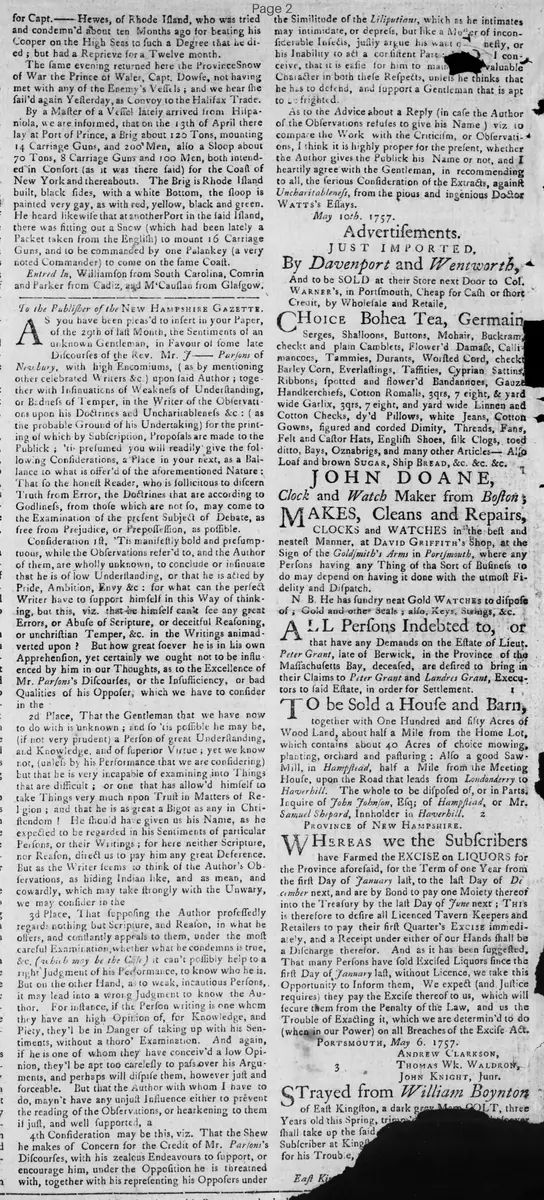
Sir, you have been pleas'd to insert in your Paper, of the 29th of last Month, the Sentiments of an unknown Gentleman, in Favour of some late Discourses of the Rev. Mr. F--- Parsons of Newbury, with high Encomiums, (as by mentioning other celebrated Writers &c.) upon said Author; together with Insinuations of Weakness of Understanding, or Badness of Temper, in the Writer of the Observations upon his Doctrines and Uncharitableness &c: (as the probable Ground of his Undertaking) for the printing of which by Subscription, Proposals are made to the Publick; 'tis presum'd you will readily give the following Considerations, a Place in your next, as a Balance to what is offer'd of the aforementioned Nature:
That to the honest Reader, who is solicitous to discern Truth from Error, the Doctrines that are according to Godliness, from those which are not so, may come to the Examination of the present Subject of Debate, as free from Prejudice, or Prepossession, as possible.
Consideration 1st, 'Tis manifestly bold and presumptuous, while the Observations refer'd to, and the Author of them, are wholly unknown, to conclude or insinuate that he is of low Understanding, or that he is acted by Pride, Ambition, Envy &c: for what can the perfect Writer have to support himself in this Way of thinking, but this, viz. that since himself can't see any great Errors, or Abuse of Scripture, or deceitful Reasoning, or unchristian Temper, &c. in the Writings animadverted upon? But how great soever he is in his own Apprehension, yet certainly we ought not to be influenced by him in our Thoughts, as to the Excellence of Mr. Parsons's Discourses, or the Insufficiency, or bad Qualities of his Opposer, which we have to consider in the
2d Place. That the Gentleman that we have now to do with is unknown; and so 'tis possible he may be, (if not very prudent) a Person of great Understanding, and Knowledge, and of superior Virtue; yet we know not, (unless by his Performance that we are considering) but that he is very incapable of examining into Things that are difficult; or one that has allow'd himself to take Things very much upon Trust in Matters of Religion; and that he is as great a Bigot as any in Christendom! He should have given us his Name, as he expects to be regarded in his Sentiments of particular Persons, or their Writings; for here neither Scripture, nor Reason, direct us to pay him any great Deference.
But as the Writer seems to think of the Author's Observations, as hiding Indian like, and as mean, and cowardly, which may take strongly with the Unwary, we may consider in the
3d Place, That Supposing the Author professedly regards nothing but Scripture, and Reason, in what he offers, and constantly appeals to them, under the most careful Examination whether what he condemns is true, &c, (which may be the Case) it can't possibly help to a right Judgment of his Performance, to know who he is.
But on the Other Hand, as to weak, incautious Persons, it may lead into a wrong Judgment to know the Author. For instance, if the Person writing is one whom they have an high Opinion of, for Knowledge, and Piety, they'll be in Danger of taking up with his Sentiments, without a thorough Examination. And again, if he is one of whom they have conceiv'd a low Opinion, they'll be apt too carelessly to pass over his Arguments, and perhaps will despise them, however just and forcible. But that the Author with whom I have to do, mayn't have any unjust Influence either to prevent the reading of the Observations, or hearkening to them if just, and well supported, a
4th Consideration may be this, viz. That the Shew he makes of Concern for the Credit of Mr. Parsons's Discourses, with his zealous Endeavours to support, or encourage him, under the Opposition he is threatned with, together with his representing his Opposers under
the Similitude of the Lilliputians, which as he intimates may intimidate, or depress, but like a Master of incon-siderable Insects, justly argue his want of
Courage, or his Inability to act a consistent Part:
I conceive, that it is easy for him to maintain a
valuable Character in both these Respects, unless he thinks that he has to defend, and support a Gentleman that is apt to be frighted.
As to the Advice about a Reply (in case the Author of the Observations refuses to give his Name) viz. to compare the Work with the Criticism, or Observations, I think it is highly proper for the present, whether the Author gives the Publick his Name or not. and I heartily agree with the Gentleman, in recommending to all, the serious Consideration of the Extracts, against Uncharitableness, from the pious and ingenious Doctor Watts's Essays.
May 10th. 1757.
What sub-type of article is it?
What themes does it cover?
What keywords are associated?
What entities or persons were involved?
Letter to Editor Details
Recipient
Publisher Of The New Hampshire Gazette
Main Argument
the critic of rev. mr. parsons's discourses should be evaluated on the substance of his observations using scripture and reason, without personal attacks or bias from anonymity, to allow unbiased discernment of truth in religious doctrines.
Notable Details