Thank you for visiting SNEWPapers!
Sign up free
The Daily Advertiser
New York, New York County, New York
What is this article about?
Extract from Abbe de Commerell's Memoires detailing the cultivation, planting, harvesting, preservation, and uses of the Diette or Scarcity Root for human and animal food, emphasizing its resilience, productivity, and benefits for farming and livestock.
Merged-components note: This is a single continuous literary article on the Diette or Scarcity Root spanning multiple columns on page 2 and continuing onto page 3. The second part was incorrectly labeled as 'story' and is merged with the first part under 'literary'.
Clippings
1 of 2
OCR Quality
Full Text
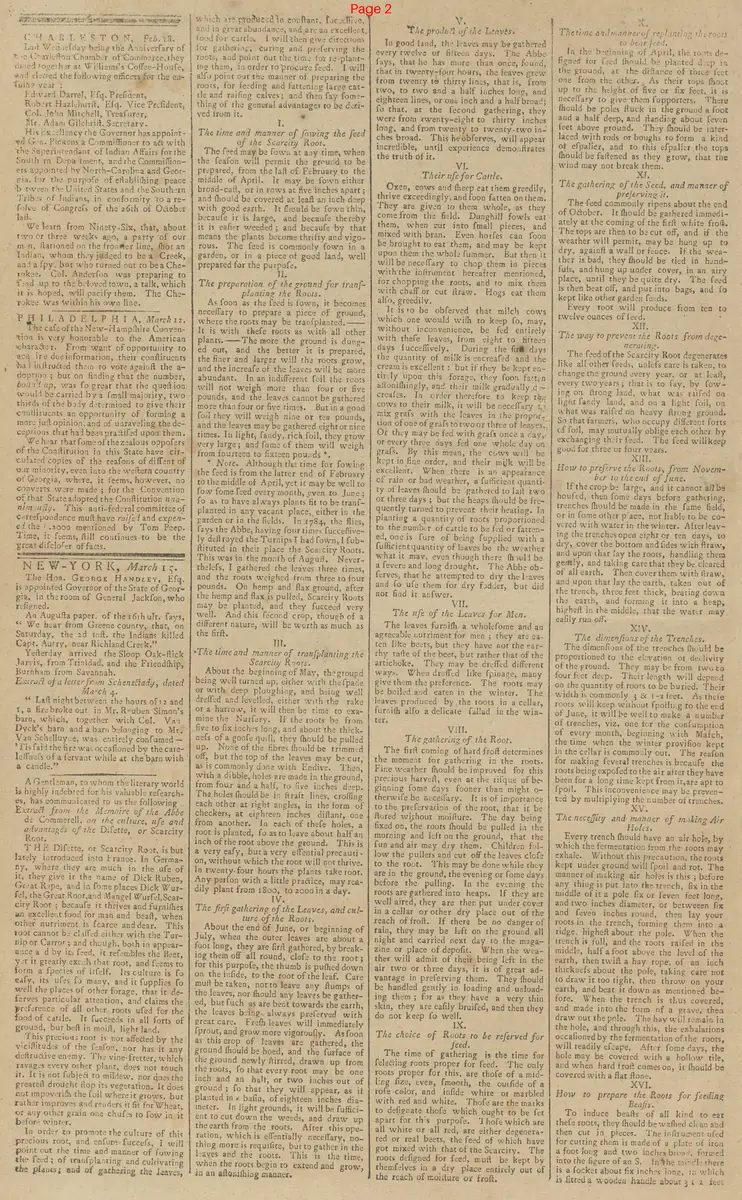
THE Diette, or Scarcity Root, is but lately introduced into France. In Germany, where they are much in the use of it, they give it the name of Dick Ruben, Great Rape, and in some places Dick Wurfel, the Great Root, and Mangel Wurfel, Scarcity Root; because it thrives and furnishes an excellent food for man and beast, when other nutriment is scarce and dear. This root cannot be classed either with the Turnip or Carrot; and though, both in appearance and by its seed, it resembles the Beet, yet it greatly excels that root, and seems to form a species of itself. Its culture is so easy, its uses so many, and it supplies so well the places of other forage, that it deserves particular attention, and claims the preference of all other roots used for the food of cattle. It succeeds in all sorts of ground, but best in moist, light land.
This precious root is not affected by the vicissitudes of the season, nor has it any destructive enemy. The vine-fretter, which ravages every other plant, does not touch it. It is not subject to mildew, nor does the greatest drought stop its vegetation. It does not impoverish the soil where it grows, but rather improves and renders it fit for Wheat, or any other grain one chooses to sow in it before winter.
In order to promote the culture of this precious root, and ensure success, I will point out the time and manner of sowing the seed; of transplanting and cultivating the plants; and of gathering the leaves, which are produced in constant, successive, and in great abundance, and are an excellent food for cattle. I will then give directions for gathering, curing and preserving the roots, and point out the time for re-planting them, in order to procure seed. I will also point out the manner of preparing the roots, or feeding and fattening large cattle and raising calves; and then say something of the general advantages to be derived from it.
I.
The time and manner of sowing the seed of the Scarcity Root.
The seed may be sown at any time, when the season will permit the ground to be prepared, from the last of February to the middle of April. It may be sown either broad-cast, or in rows at five inches apart; and should be covered at least an inch deep with good earth. It should be sown thin, because it is large, and because thereby it is easier weeded; and because by that means the plants become thrifty and vigorous. The seed is commonly sown in a garden, or in a piece of good land, well prepared for the purpose.
II.
The preparation of the ground for transplanting the Roots.
As soon as the seed is sown, it becomes necessary to prepare a piece of ground, where the roots may be transplanted.— It is with these roots as with all other plants. The more the ground is dunged out, and the better it is prepared, the finer and larger will the roots grow, and the increase of the leaves will be more abundant. In an indifferent soil the roots will not weigh more than four or five pounds, and the leaves cannot be gathered more than four or five times. But in a good soil they will weigh nine or ten pounds, and the leaves may be gathered eight or nine times. In light, sandy, rich soil, they grow very large; and some of them will weigh from fourteen to sixteen pounds *.
* Note. Although the time for sowing the seed is from the latter end of February to the middle of April, yet it may be well to sow some seed every month, even to June: so as to have always plants fit to be transplanted in any vacant place, either in the garden or in the fields. In 1784, the flies, says the Abbe, having four times successively destroyed the Turnips I had sown, I substituted in their place the Scarcity Roots. This was in the month of August. Nevertheless, I gathered the leaves three times, and the roots weighed from three to four pounds. On hemp and flax ground, after the hemp and flax is pulled, Scarcity Roots may be planted, and they succeed very well. And this second crop, though of a different nature, will be worth as much as the first.
III.
The time and manner of transplanting the Scarcity Roots.
About the beginning of May, the ground being well turned up, either with the spade or with deep ploughing, and being well dressed and levelled, either with the rake or a harrow, it will then be time to examine the Nursery. If the roots be from five to six inches long, and about the thickness of a goose quill, they should be pulled up. None of the fibres should be trimmed off, but the top of the leaves may be cut, as is commonly done with Endive. Then, with a dibble, holes are made in the ground, from four and a half, to five inches deep. The holes should be in straight lines, crossing each other at right angles, in the form of checkers, at eighteen inches distant, one from another. In each of these holes, a root is planted, so as to leave about half an inch of the root above the ground. This is a very easy, but a very essential precaution, without which the root will not thrive. In twenty-four hours the plants take root. Any person with a little practice, may readily plant from 1800, to 2000 in a day.
IV.
The first gathering of the Leaves, and culture of the Roots.
About the end of June, or beginning of July, when the outer leaves are about a foot long, they are first gathered, by breaking them off all round, close to the root; for this purpose, the thumb is pushed down on the inside, to the root of the leaf. Care must be taken, not to leave any stumps of the leaves, nor should any leaves be gathered, but such as are bent towards the earth, the leaves being always preserved with great care. Fresh leaves will immediately sprout, and grow more vigorously. As soon as this crop of leaves are gathered, the ground should be hoed, and the surface of the ground newly stirred, drawn up from the roots, so that every root may be one inch and a half, or two inches out of ground; so that they will appear, as if planted in a basin, of eighteen inches diameter. In light grounds, it will be sufficient to cut down the weeds, and draw up the earth from the roots. After this operation, which is essentially necessary, nothing more is requisite, but to gather the leaves and the roots. This is the time, when the roots begin to extend and grow, in an astonishing manner.
V.
The product of the Leaves.
In good land, the leaves may be gathered every twelve or fifteen days. The Abbe says, that he has more than once, found, that in twenty-four hours, the leaves grew from twenty to thirty lines, that is, from two, to two and a half inches long, and eighteen lines, or one inch and a half broad; so that, at the second gathering, they were from twenty-eight to thirty inches long, and from twenty to twenty-two inches broad. This he observes, will appear incredible, until experience demonstrates the truth of it.
VI.
Their use for Cattle.
Oxen, cows and sheep eat them greedily, thrive exceedingly, and soon fatten on them. They are given to them whole, as they come from the field. Dunghill fowls eat them, when cut into small pieces, and mixed with bran. Even horses can soon be brought to eat them, and may be kept upon them the whole summer. But then it will be necessary to chop them in pieces with the instrument hereafter mentioned, for chopping the roots, and to mix them with chaff or cut straw. Hogs eat them also, greedily.
It is to be observed that milch cows which one would wish to keep so, may, without inconvenience, be fed entirely with these leaves, from eight to fifteen days successively. During the first days the quantity of milk is increased and the cream is excellent: but if they be kept entirely upon this forage, they soon fatten astonishingly, and their milk gradually decreases. In order therefore to keep the cows to their milk, it will be necessary to mix grass with the leaves in the proportion of one of grass to two or three of leaves. Or they may be fed with grass once a day, or every three days fed one whole day on grass. By this means, the cows will be kept in fine order, and their milk will be excellent. When there is an appearance of rain or bad weather, a sufficient quantity of leaves should be gathered to last two or three days; but the heaps should be frequently turned to prevent their heating. In planting a quantity of roots proportioned to the number of cattle to be fed or fattened, one is sure of being supplied with a sufficient quantity of leaves be the weather what it may, even though there should be a severe and long drought. The Abbe observes, that he attempted to dry the leaves and so use them for dry fodder, but did not find it answer.
VII.
The use of the Leaves for Men.
The leaves furnish a wholesome and an agreeable nutriment for men; they are eaten like beets, but they have not the earthy taste of the beet, but rather that of the artichoke. They may be dressed different ways. When dressed like spinach, many give them the preference. The roots may be boiled and eaten in the winter. The leaves produced by the roots in a cellar, furnish also a delicate salad in the winter.
VIII.
The gathering of the Root.
The first coming of hard frost determines the moment for gathering in the roots. Fine weather should be improved for this precious harvest, even at the risque of beginning some days sooner than might otherwise be necessary. It is of importance to the preservation of the root, that it be stored without moisture. The day being fixed on, the roots should be pulled in the morning and left on the ground, that the sun and air may dry them. Children follow the pullers and cut off the leaves close to the root. This may be done while they are in the ground, the evening or some days before the pulling. In the evening the roots are gathered into heaps. If they are well aired, they are then put under cover in a cellar or other dry place out of the reach of frost. If there be no danger of rain, they may be left on the ground all night and carried next day to the magazine or place of deposit. When the weather will admit of their being left in the air two or three days, it is of great advantage in preserving them. They should be handled gently in loading and unloading them; for as they have a very thin skin, they are easily bruised, and then they do not keep so well.
IX.
The choice of Roots to be reserved for seed.
The time of gathering is the time for electing roots proper for seed. The only roots proper for this, are those of a middle size, even, smooth, the outside of a rose color, and inside white or marbled with red and white. Those are the marks to designate those which ought to be set apart for this purpose. Those which are all white or all red, are either degenerated or real beets, the seed of which have got mixed with that of the Scarcity. The roots designed for seed, must be kept by themselves in a dry place entirely out of the reach of moisture or frost.
X.
The time and manner of replanting the roots to bear seed.
In the beginning of April, the roots designed for seed should be planted deep in the ground, at the distance of three feet one from the other. As their tops shoot up to the height of five or six feet, it is necessary to give them supporters. There should be poles stuck in the ground a foot and a half deep, and standing about seven feet above ground. They should be interlaced with rods or boughs to form a kind of espalier, and to this espalier the tops should be fastened as they grow, that the wind may not break them.
XI.
The gathering of the Seed, and manner of preserving it.
The seed commonly ripens about the end of October. It should be gathered immediately at the coming of the first white frost. The tops are then to be cut off, and if the weather will permit, may be hung up to dry, against a wall or fence. If the weather is bad, they should be tied in handfuls, and hung up under cover, in an airy place, until they be quite dry. The seed is then beat off, and put into bags, and so kept like other garden seeds.
Every root will produce from ten to twelve ounces of seed.
XII.
The way to prevent the Roots from degenerating.
The seed of the Scarcity Root degenerates like all other seeds, unless care is taken, to change the ground every year, or at least, every two years; that is to say, by sowing on strong land, what was raised on light sandy land, and on a light soil, on what was raised on heavy strong ground. So that farmers, who occupy different sorts of soil, may mutually oblige each other by exchanging their seed. The seed will keep good for three or four years.
XIII.
How to preserve the Roots, from November to the end of June.
If the crop be large, and it cannot all be housed, then some days before gathering, trenches should be made in the same field, or in some other place, not liable to be covered with water in the winter. After leaving the trenches open eight or ten days, to dry, cover the bottom and sides with straw, and upon that lay the roots, handling them gently, and taking care that they be cleared of all earth. Then cover them with straw, and upon that lay the earth, taken out of the trench, three feet thick, beating down the earth, and forming it into a heap, highest in the middle, that the water may easily run off.
XIV.
The dimensions of the Trenches.
The dimensions of the trenches should be proportioned to the elevation or declivity of the ground. They may be from two to four feet deep. Their length will depend on the quantity of roots to be buried. Their width is commonly 3 1/2 feet. As these roots will keep without spoiling to the end of June, it will be well to make a number of trenches, viz. one for the consumption of every month, beginning with March, the time when the winter provision kept in the cellar is commonly out. The reason for making several trenches is because the roots being exposed to the air after they have been for a long time kept from it, are apt to spoil. This inconvenience may be prevented by multiplying the number of trenches.
XV.
The necessity and manner of making Air Holes.
Every trench should have an air hole, by which the fermentation from the roots may exhale. Without this precaution, the roots kept under ground will spoil and rot. The manner of making air holes is this; before any thing is put into the trench, fix in the middle of it a pole six or seven feet long, and two inches diameter, or between six and seven inches round, then lay your roots in the trench, forming them into a ridge, highest about the pole. When the trench is full, and the roots raised in the middle, half a foot above the level of the earth, then twist a hay rope, of an inch thickness about the pole, taking care not to draw it too tight, then throw on your earth, and beat it down as mentioned before. When the trench is thus covered, and made into the form of a grave, then draw out the pole. The hay will remain in the hole, and through this, the exhalations occasioned by the fermentation of the roots, will readily escape. After some days, the hole may be covered with a hollow tile, and when hard frost comes on, it should be covered with a flat stone.
XVI.
How to prepare the Roots for feeding Beasts.
To induce beasts of all kind to eat these roots, they should be washed clean and then cut in pieces. The instrument used for cutting them is made of a plate of iron a foot long and two inches broad, formed into the figure of an S. In the middle where is a socket about six inches long, in which is fitted a wooden handle about 3 1/2 feet
XVI.
For chopping the Roots.
With this instrument the roots are easily cut in a trough kept for the purpose. A man can, in an hour, chop as many as will serve twelve oxen a whole day. Before the roots are thrown into a trough they should be split and cut in quarters. It is of advantage to cut the roots very small, cattle thereby receive more benefit from them.
XVII.
For feeding horned Cattle.
Prepared in the manner above directed, the roots may be given without any mixture to horned cattle and sheep, especially if they are for fattening. But if it be necessary to use economy in the consumption of the roots, then a quarter or more of chopped hay or cut straw may be mixed with them. It will be well to do this for the three or four first weeks for a lean beast which is put up for fattening; clover, sain-foin, lucerne, &c. are the best for this purpose. The Dutch cutting boxes will render this work light and easy.
XVIII.
For Horses.
Horses may be kept the whole winter on these roots by mixing them half and half with cut straw or hay. Fed in this manner they will be fat, vigorous and sleek. But when put to continual hard labor, they should have at times some grain. Hogs will also eat the roots mixed with the wash commonly given them. They fatten on them as well if not better than on potatoes.
XIX.
The daily allowance for different Beasts.
The quantity of roots given to different beasts will depend on the quantity of dry forage given them in addition; for they should every day have a little dry forage before they are watered. The quantity must be proportioned to the size and largeness of the beast. It should also be proportioned according to what the beast is designed for. Those which are for keeping, should have less than those put up for fattening. As the size of the root is greater or smaller, according to the goodness of the soil where they grew, the quantity cannot be determined by the number. Weight would be more certain, but every one has not conveniences for weighing. The Abbe then proceeds to say, that from 16,000 roots planted in May, 1785, on two arpents of land, Heidelberg measure, which is about one English acre, he fed seven cows and three calves constantly with the leaves from the beginning of July to the 15th of November; and with the roots from the 20th of November to the summer following. The cows were fed twice a day, at each feeding, with 16 or 18 pounds of roots mixed with one quarter as much cut straw or hay. Their milk was as good and as plentiful as in summer, and they were kept in excellent condition.
XX.
How to fatten Beeves.
I put up (says the Abbe) four very lean oxen to fatten. They were fed twice a day each, with 20 pounds of roots mixed with 5 pounds of cut hay of the first or second crop. In about a month, by the advice of a sensible farmer, I withdrew the hay, and substituted 5 pounds of roots instead of it. They were then fed two months with roots only, and then were sufficiently fat to be sold. They always eat their food greedily because it is tender. I found it best to feed both oxen and cows two or three times a day; that they fatten the faster for it, and that nothing is wasted or lost, which is not the case when they have it all at once. From this it is easy to calculate how many roots are necessary to keep a cow or fatten an ox. It commonly requires four months to fatten an ox on other food, but with these roots or with the leaves they will fatten in three.
XXI.
The quantity that may be raised from an acre.
An English acre contains 160 perches, each perch 16 1/2 feet square, and each foot 12 inches square, may be divided into 18,600 squares of 18 inches diameter. However making abatement, let us suppose 16, or even 15 thousand, if the land be even of an indifferent quality; it is easy to conceive what an immense quantity of wholesome nutriment may be raised off an acre, and much more if the soil be suitable and a little manure added.
XXII.
Advantages of this Culture.
Besides the advantages already mentioned, the Scarcity Root has this in its favor, that it is a sure crop, not subject to the uncertainties of the season, it supplies plenty of food for horses and cattle which are housed, and thereby provides a plentiful supply of dung, which is indispensably necessary in agriculture; it will keep down the price of other forage, and enable the farmer to increase his stock, and thereby increase the profits of a farm.
XXIII.
How to raise Calves weaned at 12 days old.
The scarcity of forage often obliging farmers to kill their calves, it is important for them to be informed that by the use of this Root they may wean their calves at ten or twelve days old, and with a little care and trouble rear them in the following manner:
When the calves are three days old, they should be presented every day with a little milk, luke warm, in a wooden vessel; no matter whether they drink it at first or not, it is sufficient if they wet their lips with it. In eight or ten days they will come to drink it; they should then be weaned, but the whole milk of the dam should be given to each calf, morning and evening, for three or four days: at noon, instead of milk, they should be presented with luke-warm water, sprinkled with a little flour. When they are twelve days old, they should not any more have pure milk night and morning, but only luke warm water mixed with bran and a little milk. This should be continued for four or five days, proceeding as follows: On the fourth day present to each calf, from time to time, a little bran; when it begins to lick it, then put before it a handful of bran, and continue this for twelve days, by which time it will learn to eat. The food should be put in a proper place, which should be cleaned well every time fresh food is put in. After these twelve days, give them every day, three times a day, Scarcity Leaves, chopped, and mixed with one-third bran, and twice a day whitened water to drink. If it be winter the roots will supply the place of leaves. When the calf is 4 or 5 weeks old, the bran may be withdrawn, and cut hay or straw substituted in its stead, mixed with an equal quantity of roots or leaves. Whatever the calf leaves should be removed, and it should always be served with fresh provender to prevent disgust. In this manner, the Abbe says, he has found by experience that calves may be very well raised.
What sub-type of article is it?
What themes does it cover?
What keywords are associated?
What entities or persons were involved?
Literary Details
Title
Extract From The Memoires Of The Abbe De Commerell, On The Culture, Use And Advantages Of The Diette, Or Scarcity Root
Author
Abbe De Commerell
Subject
On The Culture, Use And Advantages Of The Diette, Or Scarcity Root
Form / Style
Instructional Prose On Root Cultivation And Livestock Feeding
Key Lines