Thank you for visiting SNEWPapers!
Sign up free
Fowle's New Hampshire Gazette And General Advertiser
Portsmouth, Rockingham County, New Hampshire
What is this article about?
Bryan Edwards argues in this essay for the continuation of trade between British West Indies and the United States post-independence, highlighting its necessity for provisioning islands with food and lumber, exporting staples like rum and sugar, and overall benefits to British commerce, critiquing restrictive proclamations.
Merged-components note: This is the continuation of the serialized literary essay 'THOUGHTS on the Trade between America and the West-India Islands' from page 1 to page 2, as indicated by the text flow and '(Continued from our last)' and '(To be continued)' markers.
Clippings
1 of 2
OCR Quality
Full Text
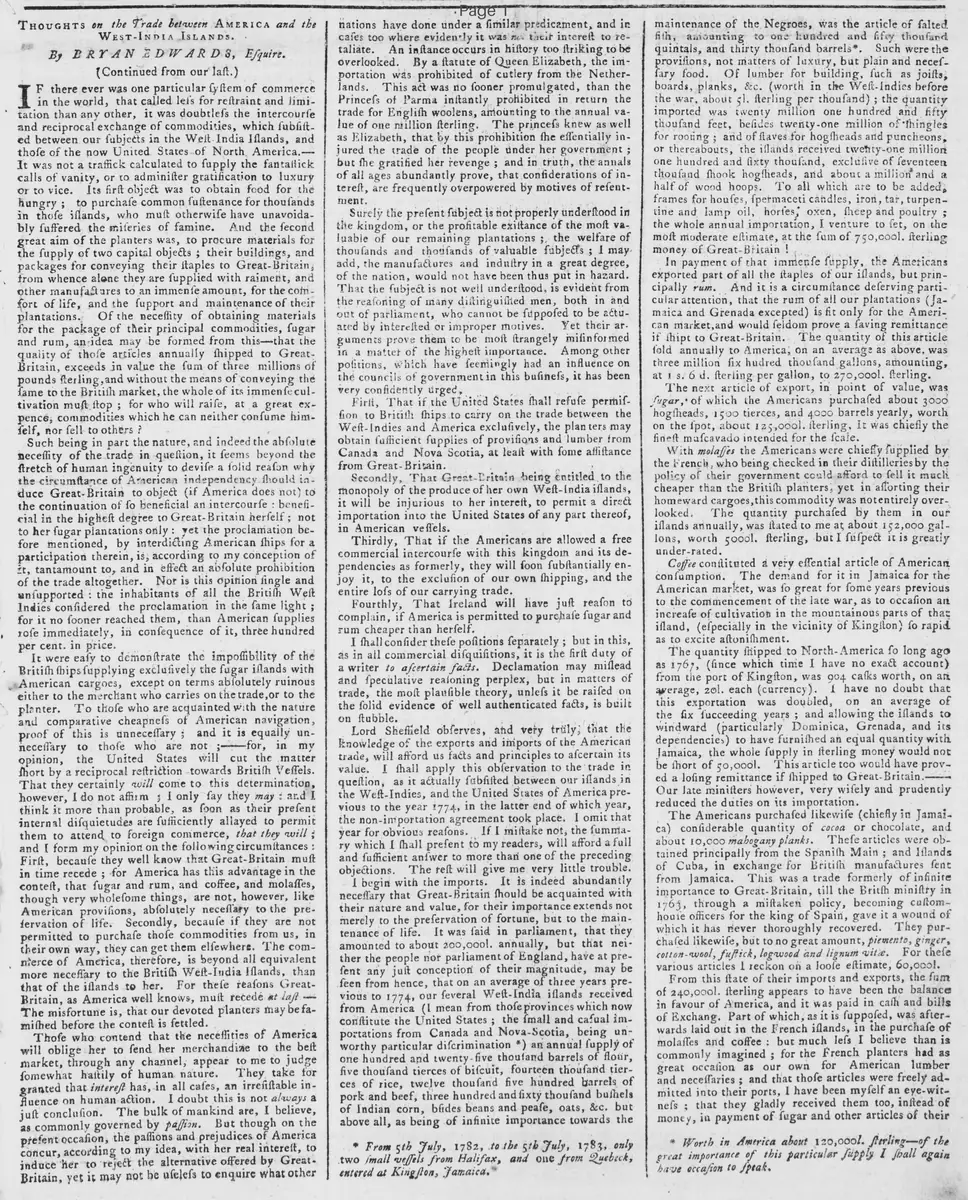
By BRYAN EDWARDS, Esquire.
(Continued from our last.)
If there ever was one particular system of commerce in the world, that called less for restraint and limitation than any other, it was doubtless the intercourse and reciprocal exchange of commodities, which subsisted between our subjects in the West-India Islands, and those of the now United States of North America.
It was not a traffic calculated to supply the fantastick calls of vanity, or to administer gratification to luxury or to vice. Its first object was to obtain food for the hungry; to purchase common sustenance for thousands in those islands, who must otherwise have unavoidably suffered the miseries of famine. And the second great aim of the planters was, to procure materials for the supply of two capital objects; their buildings, and packages for conveying their staples to Great-Britain, from whence alone they are supplied with raiment, and other manufactures to an immense amount, for the comfort of life, and the support and maintenance of their plantations. Of the necessity of obtaining materials for the package of their principal commodities, sugar and rum, an idea may be formed from this—that the quantity of those articles annually shipped to Great-Britain, exceeds in value the sum of three millions of pounds sterling, and without the means of conveying the same to the British market, the whole of its immense cultivation must stop; for who will raise, at a great expense, commodities which he can neither consume himself, nor sell to others?
Such being in part the nature, and indeed the absolute necessity of the trade in question, it seems beyond the stretch of human ingenuity to devise a solid reason why the circumstance of American independency should induce Great-Britain to object (if America does not) to the continuation of so beneficial an intercourse: beneficial in the highest degree to Great-Britain herself: not to her sugar plantations only: yet the proclamation before mentioned, by interdicting American ships from a participation therein, is, according to my conception of it, tantamount to, and in effect an absolute prohibition of the trade altogether. Nor is this opinion single and unsupported: the inhabitants of all the British West Indies considered the proclamation in the same light; for it no sooner reached them, than American supplies rose immediately, in consequence of it, three hundred per cent. in price.
It were easy to demonstrate the impossibility of the British ships supplying exclusively the sugar islands with American cargoes, except on terms absolutely ruinous either to the merchant who carries on the trade, or to the planter. To those who are acquainted with the nature and comparative cheapness of American navigation, proof of this is unnecessary; and it is equally unnecessary to those who are not—for, in my opinion, the United States will cut the matter short by a reciprocal restriction towards British Vessels.
That they certainly will come to this determination, however, I do not affirm; I only say they may: and I think it more than probable, as soon as their present internal disquietudes are sufficiently allayed to permit them to attend to foreign commerce, that they will: and I form my opinion on the following circumstances:
First, because they well know that Great-Britain must in time recede; for America has this advantage in the contest, that sugar and rum, and coffee, and molasses, though very wholesome things, are not, however, like American provisions, absolutely necessary to the preservation of life. Secondly, because if they are not permitted to purchase those commodities from us, in their own way, they can get them elsewhere. The commerce of America, therefore, is beyond all equivalent more necessary to the British West-India Islands, than that of the islands to her. For these reasons Great-Britain, as America well knows, must recede at last.
The misfortune is, that our devoted planters may be famished before the contest is settled.
Those who contend that the necessities of America will oblige her to send her merchandize to the best market, through any channel, appear to me to judge somewhat hastily of human nature. They take for granted that interest has, in all cases, an irresistible influence on human action. I doubt this is not always a just conclusion. The bulk of mankind are, I believe, as commonly governed by passion. But though on the present occasion, the passions and prejudices of America concur, according to my idea, with her real interest, to induce her to reject the alternative offered by Great-Britain, yet it may not be useless to enquire what other nations have done under a similar predicament, and in cases too where evidently it was not their interest to retaliate. An instance occurs in history too striking to be overlooked. By a statute of Queen Elizabeth, the importation was prohibited of cutlery from the Netherlands. This act was no sooner promulgated, than the Princes of Parma instantly prohibited in return the trade for English woolens, amounting to the annual value of one million sterling. The princes knew as well as Elizabeth, that by this prohibition she essentially injured the trade of the people under her government; but she gratified her revenge; and in truth, the annals of all ages abundantly prove, that considerations of interest, are frequently overpowered by motives of resentment.
Surely the present subject is not properly understood in the kingdom, or the profitable existence of the most valuable of our remaining plantations; the welfare of thousands and thousands of valuable subjects; I may add, the manufactures and industry in a great degree, of the nation, would not have been thus put in hazard. That the subject is not well understood, is evident from the reasoning of many distinguished men, both in and out of parliament, who cannot be supposed to be actuated by interested or improper motives. Yet their arguments prove them to be most strangely misinformed in a matter of the highest importance. Among other positions, which have seemingly had an influence on the councils of government in this business, it has been very confidently urged,
First, That if the United States shall refuse permission to British ships to carry on the trade between the West-Indies and America exclusively, the planters may obtain sufficient supplies of provisions and lumber from Canada and Nova Scotia, at least with some assistance from Great-Britain.
Secondly, That Great-Britain being entitled to the monopoly of the produce of her own West-India islands, it will be injurious to her interest, to permit a direct importation into the United States of any part thereof, in American vessels.
Thirdly, That if the Americans are allowed a free commercial intercourse with this kingdom and its dependencies as formerly, they will soon substantially enjoy it, to the exclusion of our own shipping, and the entire loss of our carrying trade.
Fourthly, That Ireland will have just reason to complain, if America is permitted to purchase sugar and rum cheaper than herself.
I shall consider these positions separately; but in this, as in all commercial disquisitions, it is the first duty of a writer to ascertain facts. Declamation may mislead and speculative reasoning perplex, but in matters of trade, the most plausible theory, unless it be raised on the solid evidence of well authenticated facts, is built on stubble.
Lord Sheffield observes, and very truly, that the knowledge of the exports and imports of the American trade, will afford us facts and principles to ascertain its value. I shall apply this observation to the trade in question, as it actually subsisted between our islands in the West-Indies, and the United States of America previous to the year 1774, in the latter end of which year, the non-importation agreement took place. I omit that year for obvious reasons. If I mistake not, the summary which I shall present to my readers, will afford a full and sufficient answer to more than one of the preceding objections. The rest will give me very little trouble.
I begin with the imports. It is indeed abundantly necessary that Great-Britain should be acquainted with their nature and value, for their importance extends not merely to the preservation of fortune, but to the maintenance of life. It was said in parliament, that they amounted to about 200,000l. annually, but that neither the people nor parliament of England, have at present any just conception of their magnitude, may be seen from hence, that on an average of three years previous to 1774, our several West-India islands received from America (I mean from those provinces which now constitute the United States; the small and casual importations from Canada and Nova-Scotia, being unworthy particular discrimination *) an annual supply of one hundred and twenty-five thousand barrels of flour, five thousand tierces of biscuit, fourteen thousand tierces of rice, twelve thousand five hundred barrels of pork and beef, three hundred and sixty thousand bushels of Indian corn, besides beans and pease, oats, &c. but above all, as being of infinite importance towards the maintenance of the Negroes, was the article of salted fish, amounting to one hundred and fifty thousand quintals, and thirty thousand barrels*. Such were the provisions, not matters of luxury, but plain and necessary food. Of lumber for building, such as joists, boards, planks, &c. (worth in the West-Indies before the war, about 5l. sterling per thousand); the quantity imported was twenty million one hundred and fifty thousand feet, besides twenty-one million of shingles for roofing; and of staves for hogheads and puncheons, or thereabouts, the islands received twenty-one million one hundred and sixty thousand, exclusive of seventeen thousand shook hogheads, and about a million and a half of wood hoops. To all which are to be added, frames for houses, spermaceti candles, iron, tar, turpentine and lamp oil, horses, oxen, sheep and poultry; the whole annual importation, I venture to set, on the most moderate estimate, at the sum of 750,000l. sterling money of Great-Britain!
In payment of that immense supply, the Americans exported part of all the staples of our islands, but principally rum. And it is a circumstance deserving particular attention, that the rum of all our plantations (Jamaica and Grenada excepted) is fit only for the American market, and would seldom prove a saving remittance if shipped to Great-Britain. The quantity of this article sold annually to America, on an average as above, was three million six hundred thousand gallons, amounting, at 1s. 6d. sterling per gallon, to 270,000l. sterling.
The next article of export, in point of value, was sugar, of which the Americans purchased about 3000 hogheads, 1500 tierces, and 4000 barrels yearly, worth on the spot, about 125,000l. sterling. It was chiefly the finest muscavado intended for the cake.
With molasses the Americans were chiefly supplied by the French, who being checked in their distilleries by the policy of their government could afford to sell it much cheaper than the British planters, yet in assorting their homeward cargoes, this commodity was not entirely overlooked. The quantity purchased by them in our islands annually, was stated to me at about 152,000 gallons, worth 20,000l. sterling, but I suspect it is greatly under-rated.
Coffee constituted a very essential article of American consumption. The demand for it in Jamaica for the American market, was so great for some years previous to the commencement of the late war, as to occasion an increase of cultivation in the mountainous parts of that island, (especially in the vicinity of Kingston) so rapid as to excite astonishment.
The quantity shipped to North-America so long ago as 1767, (since which time I have no exact account) from the port of Kingston, was 904 casks worth, on an average, 20l. each (currency). I have no doubt that this exportation was doubled, on an average of the six succeeding years; and allowing the islands to windward (particularly Dominica, Grenada, and its dependencies) to have furnished an equal quantity with Jamaica, the whole supply in sterling money would not be short of 20,000l. This article too would have proved a losing remittance if shipped to Great-Britain. Our late ministers however, very wisely and prudently reduced the duties on its importation.
The Americans purchased likewise (chiefly in Jamaica) considerable quantity of cocoa or chocolate, and about 10,000 mahogany planks. These articles were obtained principally from the Spanish Main; and Islands of Cuba, in exchange for British manufactures sent from Jamaica. This was a trade formerly of infinite importance to Great-Britain, till the British ministry in 1763, through a mistaken policy, becoming custom-house officers for the king of Spain, gave it a wound of which it has never thoroughly recovered. They purchased likewise, but to no great amount, pimento, ginger, cotton-wool, fustick, logwood and lignum vitae. For these various articles I reckon on a loose estimate, 60,000l.
From this state of their imports and exports, the sum of 240,000l. sterling appears to have been the balance in favour of America, and it was paid in cash and bills of Exchange. Part of which, as it is supposed, was afterwards laid out in the French islands, in the purchase of molasses and coffee: but much less I believe than is commonly imagined; for the French planters had as great occasion as our own for American lumber and necessaries; and that those articles were freely admitted into their ports, I have been myself an eye-witness; that they gladly received them too, instead of money, in payment of sugar and other articles of their worth in America about 120,000l. sterling—of the great importance of this particular supply I shall again have occasion to speak.
produce, which were afterwards conveyed (whether illegally or not) into the ports of North-America, there is no reason to doubt. It is therefore more than probable, that the whole, or the greatest part of the balance due and received from the planters in our own islands, was remitted by the Americans to Great-Britain, in reduction of their debts to the British merchants. And such were once the happy effects of colonial navigation and commerce! Though spreading through a variety of distant channels, their profits all returned to, and ultimately centered in Great-Britain, like rivers to the ocean, which, as philosophers tell us, supplies by unobserved operations, and through a thousand secret recesses, the springs and fountains of the earth: but these, after giving fertility and life to the remotest corners of the globe, return back with collective and augmented force, and freighted with golden treasures, to the bosom of their general parent.
In the preceding enumerations of the exports from the British West-Indies to North America, I am not clear that my statement conforms to official documents. The Custom House books in the West Indies, out of which those documents are formed, afford no certainty of information; for many of the bays, creeks, and shipping places in the islands (particularly in Jamaica) being remote from the ports of entry, it was formerly usual with the masters of American vessels loading at such places in order to prevent delay, to make out their manifests, and take out their clearances before they were fully laden, receiving afterwards on board, notwithstanding the risks they incurred by the practice, much greater quantities of goods than they had reported. Governor Lyttleton, in a representation to the Lords of Trade, in 1764, now before me, observes that there was not at that time one half of the produce entered for exportation in the Custom-House books at Jamaica, which was actually shipped. Perhaps, therefore, I may have over-rated the balance in favour of America.
(To be continued.)
What sub-type of article is it?
What themes does it cover?
What keywords are associated?
What entities or persons were involved?
Literary Details
Title
Thoughts On The Trade Between America And The West India Islands.
Author
By Bryan Edwards, Esquire.
Subject
On The Trade Between British West Indies And United States Post American Independence
Key Lines