Thank you for visiting SNEWPapers!
Sign up free
Story
February 15, 1928
The Arkansas Farmer
Little Rock, Pulaski County, Arkansas
What is this article about?
A discussion on profit sharing in farming partnerships, particularly sheep farming with Mr. Turner, advocating equal division among capital, labor, and management, with adjustments based on contributions.
Clipping
OCR Quality
85%
Good
Full Text
PRACTICAL FARM TALKS.
(Continued From Page 6.)
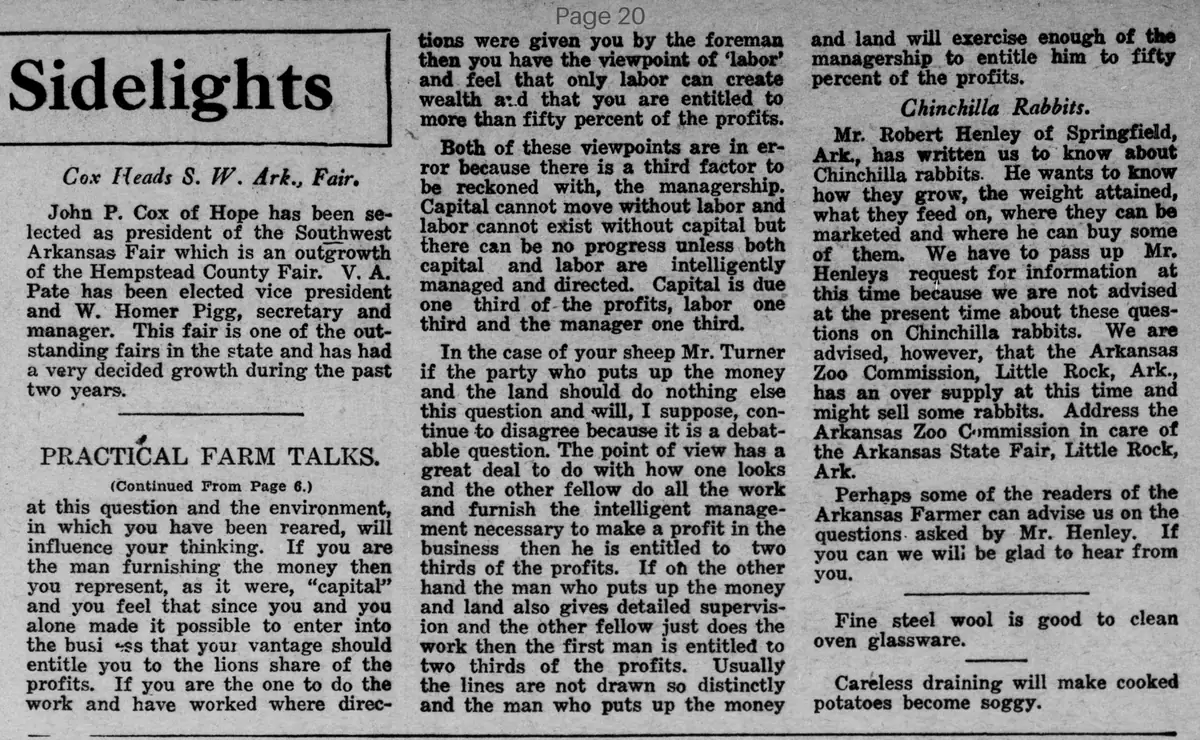
at this question and the environment, in which you have been reared, will influence your thinking. If you are the man furnishing the money then you represent, as it were, "capital" and you feel that since you and you alone made it possible to enter into the business that your vantage should entitle you to the lion's share of the profits. If you are the one to do the work and have worked where directions were given you by the foreman then you have the viewpoint of labor and feel that only labor can create wealth and that you are entitled to more than fifty percent of the profits. Both of these viewpoints are in error because there is a third factor to be reckoned with, the managership. Capital cannot move without labor and labor cannot exist without capital but there can be no progress unless both capital and labor are intelligently managed and directed. Capital is due one third of the profits, labor one third and the manager one third. In the case of your sheep Mr. Turner if the party who puts up the money and the land should do nothing else this question and will, I suppose, continue to disagree because it is a debatable question. The point of view has a great deal to do with how one looks and the other fellow do all the work and furnish the intelligent management necessary to make a profit in the business then he is entitled to two thirds of the profits. If on the other hand the man who puts up the money and land also gives detailed supervision and the other fellow just does the work then the first man is entitled to two thirds of the profits. Usually the lines are not drawn so distinctly and the man who puts up the money and land will exercise enough of the managership to entitle him to fifty percent of the profits.
(Continued From Page 6.)
at this question and the environment, in which you have been reared, will influence your thinking. If you are the man furnishing the money then you represent, as it were, "capital" and you feel that since you and you alone made it possible to enter into the business that your vantage should entitle you to the lion's share of the profits. If you are the one to do the work and have worked where directions were given you by the foreman then you have the viewpoint of labor and feel that only labor can create wealth and that you are entitled to more than fifty percent of the profits. Both of these viewpoints are in error because there is a third factor to be reckoned with, the managership. Capital cannot move without labor and labor cannot exist without capital but there can be no progress unless both capital and labor are intelligently managed and directed. Capital is due one third of the profits, labor one third and the manager one third. In the case of your sheep Mr. Turner if the party who puts up the money and the land should do nothing else this question and will, I suppose, continue to disagree because it is a debatable question. The point of view has a great deal to do with how one looks and the other fellow do all the work and furnish the intelligent management necessary to make a profit in the business then he is entitled to two thirds of the profits. If on the other hand the man who puts up the money and land also gives detailed supervision and the other fellow just does the work then the first man is entitled to two thirds of the profits. Usually the lines are not drawn so distinctly and the man who puts up the money and land will exercise enough of the managership to entitle him to fifty percent of the profits.
What sub-type of article is it?
Practical Advice
Business Discussion
What themes does it cover?
Moral Virtue
Justice
What keywords are associated?
Farm Profits
Capital Labor
Management Share
Sheep Farming
Partnership Advice
What entities or persons were involved?
Mr. Turner
Story Details
Key Persons
Mr. Turner
Story Details
Debate on profit sharing in sheep farming: capital, labor, and management each deserve one-third, with variations based on additional contributions like supervision.