Thank you for visiting SNEWPapers!
Sign up free
Kentucky Gazette And General Advertiser
Lexington, Fayette County, Kentucky
What is this article about?
Official account of Louisiana's boundaries, historical cessions, provincial divisions, settlements along the Mississippi, population estimates, resources like salt springs and mines, and geographical features, communicated to U.S. Congress around 1803.
Merged-components note: Merged continuation of the 'Account of Louisiana' article across pages; relabeled from literary to story as it is a full narrative factual report on the territory.
Clippings
1 of 2
OCR Quality
Full Text
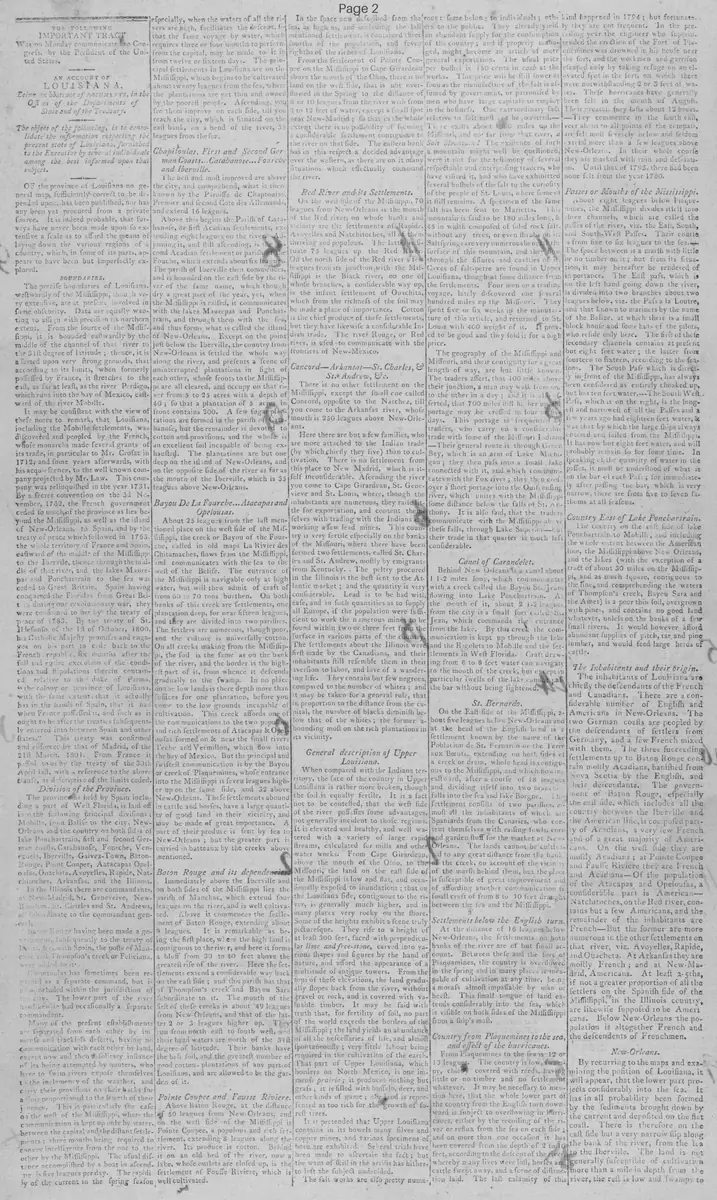
AN ACCOUNT OF LOUISIANA.
Being in abstract of documents in the offices of the Departments of State and of the Treasury.
The object of the following is to consolidate the information respecting the present state of Louisiana, furnished to the Executive by several individuals among the best informed upon that subject.
Of the province of Louisiana no general map, sufficiently correct to be depended upon, has been published, nor has any been yet procured from a private source. It is indeed probable that surveys have never been made upon so extensive a scale as to afford the means of laying down the various regions of a country, which, in some of its parts, appears to have been but imperfectly explored.
BOUNDARIES.
The precise boundaries of Louisiana, westwardly of the Mississippi, though very extensive, are at present involved in some obscurity. Data are equally wanting to assign with precision its northern extent. From the source of the Mississippi, it is bounded eastwardly by the middle of the channel of that river to the 31st degree of latitude; thence, it is asserted upon very strong grounds, that according to its limits, when formerly possessed by France, it stretches to the east, as far at least, as the river Perdido, which runs into the bay of Mexico, eastward of the river Mobile.
It may be consistent with the view of these notes to remark, that Louisiana, including the Mobile settlements, was discovered and peopled by the French, whose monarchs made several grants of its trade, in particular to Mr. Crozat in 1712, and some years afterwards, with his acquiescence, to the well known company projected by Mr. Law. This company was relinquished in the year 1731. By a secret convention on the 3d November, 1762, the French government ceded so much of the province as lies beyond the Mississippi, as well as the island of New-Orleans, to Spain, and by the treaty of peace which followed in 1763, the whole territory of France and Spain, eastward of the middle of the Mississippi to the Iberville, thence through the middle of that river, and the lakes Maurepas and Pontchartrain to the sea was ceded to Great Britain. Spain having conquered the Floridas from Great Britain during our revolutionary war, they were confirmed to her by the treaty of peace of 1783. By the treaty of St. Ildefonso of the 1st of October, 1800, his Catholic Majesty promises and engages on his part to cede back to the French republic, six months after the full and entire execution of the conditions and stipulations therein contained relative to the duke of Parma, "the colony or province of Louisiana, with the same extent that it actually has in the hands of Spain, that it had when France possessed it, and such as it ought to be after the treaties subsequently entered into between Spain and other states." This treaty was confirmed and enforced by that of Madrid, of the 21st March, 1801. From France it passed to us by the treaty of the 30th April last, with a reference to the above clause, as descriptive of the limits ceded.
Division of the Province.
The province as held by Spain including a part of West Florida, is laid off into the following principal divisions: Mobile, from Balize to the city, New-Orleans and the country on both sides of lake Pontchartrain, first and second German coasts, Catabanoce, Fourche, Iberville, Galvez-Town, Baton-Rouge, Point Coupee, Attacapas, Opelousas, Onachuta, Avoyelles, Rapide, Natchitoches, Arkansas, and the Illinois.
In the Illinois there are commandants, at New Madrid, St. Genevieve, New Bourbon, St. Charles and St. Andrews, all subordinate to the commandant general. Baton Rouge having been made a government, subsequently to the treaty of limits, &c. with Spain, the posts of Manchac and Thompson's creek or Feliciana, were added to it. Opelousas has sometimes been regarded as a separate command, but is included within the jurisdiction of the city. The lower part of the river has likewise had occasionally a separate commandant.
Many of the present establishments are separated from each other by immense and trackless deserts, having no communication with each other by land, except now and then a solitary instance of its being attempted by hunters, who have to swim rivers, expose themselves to the inclemency of the weather, and carry their provisions on their backs for a time proportioned to the length of their journey. This is particularly the case on the west of the Mississippi, where the communication is kept up only by water, between the capital and the distant settlements: three months being required to convey intelligence from the one to the other by the Mississippi. The usual distance accomplished by a boat in ascending is five leagues per day. The rapidity of the current in the spring season especially, when the waters of all the rivers are high, facilitates the descent, so that the same voyage by water, which requires three or four months to perform from the capital, may be made to it in from twelve or sixteen days. The principal settlements in Louisiana are on the Mississippi, which begins to be cultivated about twenty leagues from the sea, where the plantations are yet thin and owned by the poorest people. Ascending, you see them improve on each side, till you reach the city, which is situated on the east bank, on a bend of the river, 36 leagues from the sea.
Chapitoulas, First and Second German Coasts, Galvez-Town, Catabanoce, Fourche and Iberville,
The best and most improved are above the city, and comprehend, what is there known by the Parish of Chapitoulas, Premier and second Cote des Allemands, and extend 16 leagues. Above this begins the Parish of Catabanoce, or first Acadian settlements, extending eight leagues on the river. Adjoining it, and still ascending, is the second Acadian settlement or parish of the Fourche, which extends about six leagues. The parish of Iberville then commences, and is bounded on the east side by the river of the same name, which though dry a great part of the year, yet, when the Mississippi is raised, it communicates with the lakes Maurepas and Pontchartrain, and through them with the sea, and thus forms what is called the island of New-Orleans. Except on the point just below the Iberville, the country from New-Orleans is settled the whole way along the river, and presents a scene of uninterrupted plantations in sight of each other, whose fronts to the Mississippi are all cleared, and occupy on that river from 5 to 25 acres with a depth of 40; so that a plantation of 5 acres in front contains 200. A few sugar plantations are formed in the parish of Catabanoce, but the remainder is devoted to cotton and provisions, and the whole is an excellent soil incapable of being exhausted. The plantations are but one deep on the island of New-Orleans, and on the opposite side of the river as far as the mouth of the Iberville, which is 35 leagues above New-Orleans.
Bayou De La Fourche, Attacapas and Opelousas.
About 25 leagues from the last mentioned place on the west side of the Mississippi, the creek or Bayou of the Fourche, called in old maps La Rivier des Chitamaches, flows from the Mississippi and communicates with the sea to the west of the Balize. The entrance of the Mississippi is navigable only at high water, but will then admit of craft of from 60 to 70 tons burden. On both banks of this creek are settlements, one plantation deep, for near fifteen leagues, and they are divided into two parishes. The settlers are numerous, though poor, and the culture is universally cotton. On all creeks making from the Mississippi, the soil is the same as on the bank of the river, and the border is the highest part of it, from whence it descends gradually to the swamp. In no place on the low lands is there depth more than suffices for one plantation, before you come to the low grounds incapable of cultivation. This creek affords one of the communications to the two populous and rich settlements of Attacapas & Opelousas formed on & near the small rivers Teche and Vermillion, which flow into the bay of Mexico. But the principal and swiftest communication is by the Bayou or creek of Plaquemines, whose entrance into the Mississippi is seven leagues higher up on the same side, and 32 above New-Orleans. These settlements abound in cattle and horses, have a large quantity of good land in their vicinity, and may be made of great importance. A part of their produce is sent by sea to New-Orleans; but the greater part is carried in batteaux by the creeks above mentioned.
Baton Rouge and its dependencies
Immediately above the Iberville and on both sides of the Mississippi lies the parish of Manchac, which extends four leagues on the river, and is well cultivated. Above it commences the settlement of Baton Rouge, extending about 9 leagues. It is remarkable as being the first place, where the high land is contiguous to the river, and here it forms a bluff from 30 to 40 feet above the greatest rise of the river. Here the settlements extend a considerable way back on the east side; and this parish has that of Thompson's creek and Bayou Sara subordinate to it. The mouth of the first of these creeks is about 49 leagues from New Orleans, and that of the latter 2 or 3 leagues higher up. They run from north east to south west, and their head waters are north of the 31st degree of latitude. Their banks have the best soil, and the greatest number of good cotton plantations of any part of Louisiana, and are allowed to be the garden of it.
Pointe Coupee and Fausse Riviere.
Above Baton Rouge, at the distance of 50 leagues from New-Orleans, and on the west side of the Mississippi is Pointe Coupee, a populous and rich settlement, extending 8 leagues along the river. Its produce is cotton. Behind it on an old bed of the river, now a lake, whose outlets are closed up, is the settlement of Fausse Riviere, which is not well cultivated.
In the space now described from the sea, as high as, and including the last mentioned settlement, is contained three fourths of the population, and seven eighths of the riches of Louisiana. From the settlement of Pointe Coupee on the Mississippi to Cape Girardeau above the mouth of the Ohio, there is no land on the west side, that is not overflown in the Spring to the distance of 8 or 10 leagues from the river with from 2 to 12 feet of water, except a small spot near New-Madrid; so that in the whole extent there is no possibility of forming a considerable settlement contiguous to the river on that side. The eastern bank has in this respect a decided advantage over the western, as there are on it many situations which effectually command the river.
Red River and its Settlements.
On the west side of the Mississippi, 70 leagues from New-Orleans is the mouth of the Red river, on whose banks and vicinity are the settlements of Rapide, Avoyelles and Natchitoches, all of them thriving and populous. The latter is situate 75 leagues up the Red River. On the north side of the Red river a few leagues from its junction with the Mississippi is the Black river, on one of whose branches, a considerable way up, is the infant settlement of Ouachita, which from the richness of the soil may be made a place of importance. Cotton is the chief produce of these settlements, but they have likewise a considerable Indian trade. The river Rouge, or Red river, is used to communicate with the frontiers of New-Mexico.
Concord, Arkansas, St. Charles, & St. Andrew, &c.
There is no other settlement on the Mississippi, except the small one called Concord, opposite to the Natchez, till you come to the Arkansas river, whose mouth is 250 leagues above New-Orleans. Here there are but a few families, who are more attached to the Indian trade (by which chiefly they live) than to cultivation. There is no settlement from this place to New Madrid, which is itself inconsiderable. Ascending the river you come to Cape Girardeau, St. Genevieve and St. Louis, where, though the inhabitants are numerous, they raise little for exportation, and content themselves with trading with the Indians and working a few lead mines. This country is very fertile especially on the banks of the Missouri, where there have been formed two settlements, called St. Charles and St. Andrew, mostly by emigrants from Kentucky. The peltry procured in the Illinois is the best sent to the Atlantic market; and the quantity is very considerable. Lead is to be had with ease, and in such quantities as to supply all Europe, if the population were sufficient to work the numerous mines to be found within two or three feet from the surface in various parts of the country. The settlements about the Illinois were first made by the Canadians, and their inhabitants still resemble them in their aversion to labor, and love of a wandering life. They contain but few negroes compared to the number of whites; and it may be taken for a general rule, that in proportion to the distance from the capital, the number of blacks diminish below that of the whites; the former abounding most on the rich plantations in its vicinity.
General description of Upper Louisiana.
When compared with the Indiana territory, the face of the country in Upper Louisiana is rather more broken, though the soil is equally fertile. It is a fact not to be contested, that the west side of the river possesses some advantages, not generally incident to those regions. It is elevated and healthy, and well watered with a variety of large rapid streams, calculated for mills and other water works. From Cape Girardeau, above the mouth of the Ohio, to the Missouri, the land on the east side of the Mississippi is low and flat, and occasionally exposed to inundations; that on the Louisiana side, contiguous to the river, is generally much higher, and in many places very rocky on the shore. Some of the heights exhibit a scene truly picturesque. They rise to a height of at least 300 feet, faced with perpendicular lime and free-stone, carved into various shapes and figures by the hand of nature, and afford the appearance of a multitude of antique towers. From the tops of these elevations, the land gradually slopes back from the river, without gravel or rock, and is covered with valuable timber. It may be said with truth that, for fertility of soil, no part of the world exceeds the borders of the Mississippi; the land yields an abundance of all the necessaries of life, and almost spontaneously; very little labour being required in the cultivation of the earth. That part of Upper Louisiana, which borders on North Mexico, is one immense prairie; it produces nothing but grass; it is filled with buffalo, deer, and other kinds of game; the land is represented as too rich for the growth of forest trees.
It is pretended that Upper Louisiana contains in its bowels many silver and copper mines, and various specimens of both are exhibited. Several trials have been made to ascertain the fact; but the want of skill in the artists has hitherto left the subject undecided.
Salt springs are numerous: some belong to individuals: others to the public. They already yield an abundant supply for the consumption of the country; and if properly managed, might become an article of more general exportation. The usual price per bushel is 15 cents in cash at the works. This price will be still lower as soon as the manufacture of the salt is assumed by government, or patronised by men who have large capitals to employ in the business. One extraordinary fact relative to salt must be omitted. There exists about 100 miles up the Missouri, and not far from that river, a Salt Mountain! The existence of such a mountain might well be questioned, were it not for the testimony of several respectable and enterprising traders, who have visited it, and who have exhibited several bushels of the salt to the curiosity of the people of St. Louis, where some of it still remains. A specimen of the same salt has been sent to Marietta. This mountain is said to be 180 miles long, & 45 in width composed of solid rock salt, without any trees, or even shrubs on it. Salt springs are very numerous beneath the surface of this mountain, and there flow through the fissures and cavities of it.
Caves of salt-petre are found in Upper Louisiana, though at some distance from the settlements. Four men on a trading voyage, lately discovered one several hundred miles up the Missouri. They spent five or six weeks in the manufacture of this article, and returned to St. Louis with 400 weight of it. It proved to be good and they sold it for a high price.
The geography of the Mississippi and Missouri, and their contiguity for a great length of way, are but little known. The traders assert, that 100 miles above their junction, a man may walk from one to the other in a day; and it is also asserted, that 700 miles still higher up, the portage may be crossed in four or five days. This portage is frequented by traders, who carry on a considerable bit trade with some of the Missouri Indians. Their general route is through Green Bay, which is an arm of Lake Michigan; they then pass into a small lake connected with it, and which communicates with the Fox river; they then cross over a short portage into the Ouisconsing river, which unites with the Mississippi some distance below the falls of St. Anthony. It is also said, that the traders communicate with the Mississippi above these falls, through Lake Superior—but their trade in that quarter is much less considerable.
Canal of Carondelet.
Behind New Orleans is a Canal about 1 1-2 miles long, which communicates with a creek called the Bayou St. Jean, flowing into Lake Pontchartrain. At the mouth of it, about 2 1-2 leagues from the city is a small fort called St. Jean, which commands the entrance from the lake. By this creek the communication is kept up through the lake and the Rigolets to Mobile and the settlements in West Florida. Craft drawing from 6 to 8 feet water can navigate to the mouth of the creek, but except in particular swells of the lake cannot pass the bar without being lightened.
On the East side of the Mississippi, about five leagues below New-Orleans and at the head of the English bend is a settlement known by the name of the Poblacion de St. Bernards or the Terre aux Boeufs, extending on both sides of a creek or drain, whose head is contiguous to the Mississippi, and which flowing eastward, after a course of 18 leagues and dividing itself into two branches falls into the sea and lake Borgne. This settlement consists of two parishes, almost all the inhabitants of which are Spaniards from the Canaries, who content themselves with raising fowls, corn, and garden stuff for the market at New-Orleans. The lands cannot be cultivated to any great distance from the banks of the creek, on account of the vicinity of the marsh behind them, but the place is susceptible of great improvement and of affording another communication to small craft of from 8 to 10 feet draught between the sea and the Mississippi.
Settlements below the English turn.
At the distance of 16 leagues below New-Orleans, the settlements on both banks of the river are of but small account. Between these and the fort of Plaquemines, the country is overflowed in the spring and in many places is incapable of cultivation at any time, being a morass almost impassable by man or beast. This small tongue of land extends considerably into the sea, which is visible on both sides of the Mississippi from a ship's mast.
Country from Plaquemines to the sea, and effect of the hurricanes.
From Plaquemines to the sea is 12 or 13 leagues. The country is low, swampy, chiefly covered with reeds, having little or no timber and no settlement whatever. It may be necessary to mention here, that the whole lower part of the country from the English turn downward is subject to overflowing in hurricanes, either by the recoiling of the river or reflux from the sea on each side: and on more than one occasion it has been covered from the depth of 2 to 10 feet, according to the descent of the river, whereby many lives were lost, horses and cattle swept away, and a scene of destruction laid. The last calamity of this kind happened in 1794; but fortunately they are not frequent. In the preceding year the engineer who superintended the erection of the Fort of Plaquemines was drowned in his house near the fort, and the workmen and garrison escaped only by taking refuge on an elevated roof in the fort, on which there were notwithstanding 2 or 3 feet of water. These hurricanes have generally been felt in the month of August. Their greatest fury lasts about 12 hours. They commence in the south east, veer about to all points of the compass, are felt most severely below and seldom extend more than a few leagues above New-Orleans. In their whole course they are marked with ruin and desolation. Until that of 1793, there had been none felt from the year 1780.
Passes or Mouths of the Mississippi
About eight leagues below Plaquemines, the Mississippi divides itself into three channels, which are called the passes of the river, viz. the East, South, and South-West Passes. Their course is from five to six leagues to the sea. The space between is a marsh with little or no timber on it; but from its situation, it may hereafter be rendered of importance. The East pass, which is on the left hand going down the river, is divided into two branches about two leagues below, viz. the Pass a la Loutre, and that known to mariners by the name of the Balize, at which there is a small block house and some huts of the pilots, who reside only here. The first of these secondary channels contains at present but eight feet water; the latter from fourteen to sixteen, according to the seasons. The South Pass which is directly in front of the Mississippi, has always been considered as entirely choaked up, but has ten feet water. The South West Pass, which is on the right, is the longest and narrowest of all the Passes and a few years ago had eighteen feet water, & was that by which the large ships always entered and sailed from the Mississippi. It has now but eight feet water, and will probably remain so for some time. In speaking of the quantity of water in the passes, it must be understood of what is on the bar of each Pass; for immediately after passing the bar, which is very narrow, there are from five to seven fathoms at all seasons.
Country East of Lake Pontchartrain.
The country on the east side of lake Pontchartrain to Mobile, and including the whole extent between the American line, the Mississippi above New Orleans, and the lakes (with the exception of a tract of about 80 miles on the Mississippi, and as much square, contiguous to the line and comprehending the waters of Thompson's creek, Bayou Sara and the Amite) is a poor thin soil, overgrown with pines, and contains no good land whatever, unless on the banks of a few small rivers. It would however afford abundant supplies of pitch, tar and pine lumber, and would feed large herds of cattle.
The Inhabitants and their origin.
The inhabitants of Louisiana are chiefly the descendants of the French and Canadians. There are a considerable number of English and Americans in New-Orleans. The two German coasts are peopled by the descendants of settlers from Germany, and a few French mixed with them. The three succeeding settlements up to Baton Rouge contain mostly Acadians, banished from Nova Scotia by the English, and their descendants. The government of Baton Rouge, especially the east side, which includes all the country between the Iberville and the American line, is composed partly of Acadians, a very few French and of a great majority of Americans. On the west side they are mostly Acadians; at Pointe Coupee and Fausse Riviere they are French and Acadians. Of the population of the Attacapas and Opelousas, a considerable part is American. Natchitoches, on the Red river, contains but a few Americans, and the remainder of the inhabitants are French. But the former are more numerous in the other settlements on that river, viz. Avoyelles, Rapide, and Ouachita. At Arkansas they are mostly French; and at New-Madrid, Americans. At least 2-5ths, if not a greater proportion of all the settlers on the Spanish side of the Mississippi, in the Illinois country, are likewise supposed to be Americans. Below New-Orleans the population is altogether French and the descendants of Frenchmen.
New-Orleans.
By recurring to the maps and examining the position of Louisiana, it will appear, that the lower part projects considerably into the sea. It has in all probability been formed by the sediments brought down by the current and deposited on the flat coast. There is therefore on the east side but a very narrow strip along the bank of the river, from the sea to the Iberville. The land is not generally susceptible of cultivation more than a mile in depth from the river, the rest is low and swampy to the lakes and the sea, but in general abounds with cypress timber, which it is sawed by mills, which are worked in by artificial streams from the Mississippi, in the time of freshets. They a generally run five months in the year.
What has been said of the east equally applies to the west side of the river. The soil and situation are nearly the same. After leaving the bank of the river, there is an immense swamp, intersected by creeks and lakes, extending to the highlands of Atacapas, and occupying a space of thirty or forty leagues.
The city of New-Orleans, which is regularly laid out on the east side of the Mississippi, in lat. 30, N. and long. 90, W. extends nearly a mile along the river, from the gate of France on the south, to that of Chapitoulas above, and a little more than one third of a mile in breadth, from the river to the rampart; but it has an extensive suburb on the upper side. The houses in front of the town and for a square or two backwards, are mostly of brick, covered with slate or tile, and many of two stories. The remainder are of wood, covered with shingles. The streets cross each other at right angles, and are 32 French feet wide. The squares between the intersections of the streets have a front of 300 French feet. There is in the middle of the front of the city a place d'armes, facing which the church and town-house are built. There are from 1200 to 1400 houses in the city and suburbs. The population may be estimated at 10,000, including the seamen and garrison. It was fortified in 1793, but the works were originally defective, could not have been defended, and are now in ruins. The powder magazine is on the opposite bank of the river.
The public buildings and other public property in New-Orleans, are as follows:-
Two very extensive brick stores. from 160 to 180 feet in length, and about 30 in breadth. They are one story high and covered with shingles.
A government house, stables and garden, occupying a front of about 220 feet on the river, in the middle of the town, and extending 336 feet back to the next street.
A military hospital.
An ill built custom house of wood. almost in ruins, in the upper part of the city, near the river.
An extensive barrack in the lower part of the city, fronting on the river, and calculated to lodge 1200 or 1400 men.
A large lot adjoining the king's stores, with a few sheds in it. It serves as a park for artillery.
A prison, a town-house, market house, assembly room, some ground rents, and the common about the town.
A public school for the rudiments of the Spanish language.
A Cathedral church unfinished, & some houses belonging to it.
A charitable hospital, with some houses belonging to it, and a revenue of 1500 dollars annually, endowed by an individual lately deceased.
The canal de Carondelet has been already described.
Number of Inhabitants.
According to the annexed census. No. 2, of Louisiana, including Pensacola and the Natchez, as made in 1785, the whole number of inhabitants amounting to 32,062, of which 14,215 were free whites, 1,303 free people of colour, and 16,544 slaves
The statement No. 3, from the latest documents, makes the whole number 42,375-the free whites, 21,244--the free people of color, 1,768 and the slaves, 12,920.
A particular statement respecting the population, &c. of Upper Louisiana, and another containing the census of New-Orleans, in this year. are numbered 4 and 5, in the appendix.
These papers certainly exhibit a smaller number than the real population of the country. From an official document, made in July last, and received from Atacapas since the statement, No. 3, was formed, it appears that it contained 2,270 whites, 210 free people of color. 1,266 slaves, in all 3,746 souls, instead of 1,447, as therein stated. It is highly probable that the return for the neighboring district of Opelousas, is in the same proportion underrated.
A conjectural estimation made by a gentleman of great respectability and correct information, residing at Natchez, raises the number of whites in the island of New-Orleans, on the west side of the river, and some settlements on the east side, to 50,150. and the number of blacks to 39,820 His statement is also subjoined, No. 6
It is at all times difficult to obtain the full census of a country, and the impediments are increased in this from its scattered population. The actual enumeration may therefore fall short of the true numbers.
(To be Continued)
What sub-type of article is it?
What themes does it cover?
What keywords are associated?
Where did it happen?
Story Details
Location
Louisiana
Event Date
Treaty Of The 30th April Last
Story Details
Consolidated report on Louisiana's geography, boundaries from historical treaties, provincial divisions and settlements along the Mississippi River, population demographics, natural resources including salt springs and potential mines, and infrastructure like the Canal of Carondelet.