Thank you for visiting SNEWPapers!
Sign up free
Literary
November 10, 1790
Gazette Of The United States
New York, New York County, New York
What is this article about?
Continuation of historical discourse on French politics in 1560: King of Navarre demands removal of Guises and liberty of conscience for Huguenots in treaty with Queen Regent. Background on Calvinism's spread in Navarre. Queen promises concessions indirectly. Constable Montmorency is reinstated to mediate peace. Council appoints offices; Prince of Conde released. Year ends in fragile concord.
Merged-components note: Continuation of the serialized 'Discourses on Davila' historical narrative.
Clipping
OCR Quality
95%
Excellent
Full Text
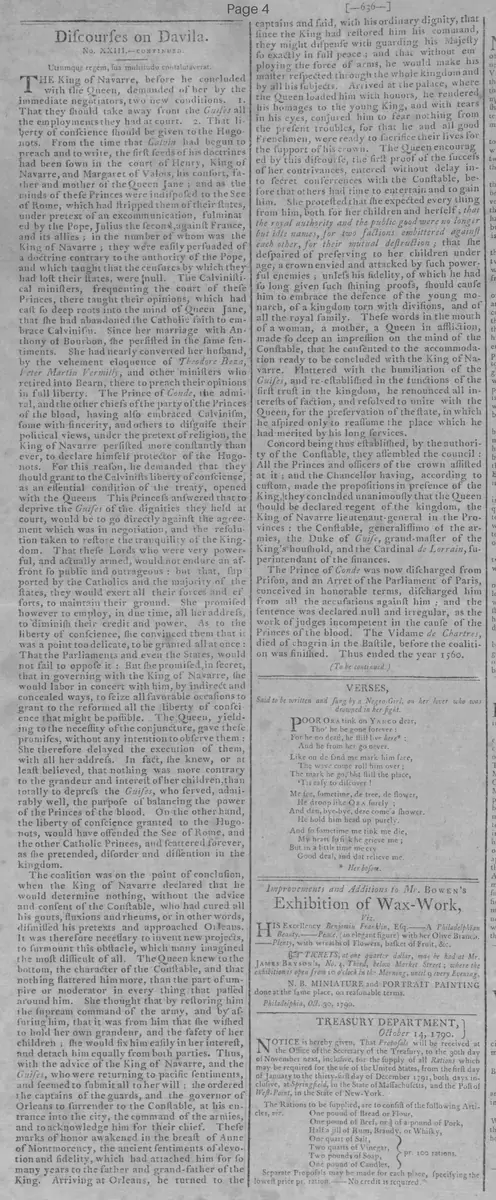
Discourses on Davila.
NO. XXIII-CONTINUED.
Quorumque regem, sua multitudo congratulaverat.
The King of Navarre, before he concluded
with the Queen, demanded of her by the
immediate negotiators, two new conditions. I.
That they should take away from the Guises all
the employments they had at court. 2. That li-
berty of conscience should be given to the Hugo-
nnots. From the time that Calvin had begun to
preach and to write, the first seeds of his doctrines
had been sown in the court of Henry, King of
Navarre, and Margaret of Valois, his consort, fa-
ther and mother of the Queen Jane; and as the
minds of these Princes were indisposed to the See
of Rome, which had stripped them of their states,
under pretext of an excommunication, fulminat-
ed by the Pope, Julius the second, against France,
and its allies; in the number of whom was the
King of Navarre; they were easily persuaded of
a doctrine contrary to the authority of the Pope,
and which taught that the censures by which they
had lost their states, were null. The Calvinisti-
cal ministers, frequenting the court of these
Princes, there taught their opinions, which had
cast so deep roots into the mind of Queen Jane,
that she had abandoned the Catholic faith to em-
brace Calvinism. Since her marriage with An-
thony of Bourbon, she persisted in the same sen-
timents. She had nearly converted her husband,
by the vehement eloquence of Theodore Beza,
Peter Martyr Vermily, and other ministers who
retired into Bearn, there to preach their opinions
in full liberty. The Prince of Conde, the admi-
ral, and the other chiefs of the party of the Princes
of the blood, having also embraced Calvinism,
some with sincerity, and others to disguise their
political views, under the pretext of religion, the
King of Navarre persisted more constantly than
ever, to declare himself protector of the Hugo-
nnots. For this reason, he demanded that they
should grant to the Calvinists liberty of conscience,
as an essential condition of the treaty, opened
with the Queens. This Princess answered that to
deprive the Guises of the dignities they held at
court, would be to go directly against the agree-
ments which was in negotiation, and the resolu-
tion taken to restore the tranquility of the King-
dom. That these Lords who were very power-
ful, and actually armed, would not endure an af-
front so public and outrageous: but that, up-
ported by the Catholics and the majority of the
states, they would exert all their forces and ef-
forts, to maintain their ground. She promised
however to employ, in due time, all her address,
to diminish their credit and power. As to the
liberty of conscience, she convinced them that it
was a point too delicate, to be granted all at once:
That the Parliaments and even the States, would
not fail to oppose it: But she promised, in secret,
that in governing with the King of Navarre, she
would labor in concert with him, by indirect and
concealed ways, to seize all favorable occasions to
grant to the reformed all the liberty of conci-
science that might be possible. The Queen, yield-
ing to the necessity of the conjuncture, gave these
promises, without any intention to observe them:
She therefore delayed the execution of them,
with all her address. In fact, she knew, or at
least believed, that nothing was more contrary
to the grandeur and interest of her children, than
totally to depress the Guises, who served, admi-
rably well, the purpose of balancing the power
of the Princes of the blood. On the other hand.
the liberty of conscience granted to the Hugo-
nnots, would have offended the See of Rome, and
the other Catholic Princes, and scattered forever,
as she pretended, disorder and dissension in the
kingdom.
The coalition was on the point of conclusion,
when the King of Navarre declared that he
would determine nothing, without the advice
and consent of the Constable, who had cured all
his gouts, fluxions and rheums, or in other words,
dismissed his pretexts and approached Orleans.
It was therefore necessary to invent new projects,
to surmount this obstacle, which many imagined
the most difficult of all. The Queen knew to the
bottom, the character of the Constable, and that
nothing flattered him more, than the part of um-
pire or moderator in every thing that passed
around him. She thought that by restoring him
the supreme command of the army, and by as-
suring him, that it was from him that she wished
to hold her own grandeur, and the safety of her
children; she would fix him easily in her interest,
and detach him equally from both parties. Thus,
with the advice of the King of Navarre, and the
Guises, who were returning to pacific sentiments,
and seemed to submit all to her will; she ordered
the captains of the guards, and the governor of
Orleans to surrender to the Constable, at his en-
trance into the city, the command of the armies,
and to acknowledge him for their chief. These
marks of honor awakened in the breast of Anne
of Montmorency, the ancient sentiments of devo-
tion and fidelity, which had attached him for so
many years to the father and grand-father of the
King. Arriving at Orleans, he turned to the
captains and said, with his ordinary dignity, that
since the King had restored him his command,
they might dispense with guarding his Majesty
so exactly in full peace.; and that without em-
ploying the force of arms, he would make his
master respected through the whole kingdom and
by all his subjects. Arrived at the palace, where
the Queen loaded him with honors, he rendered
his homages to the young King, and with tears
in his eyes, conjured him to fear nothing from
the present troubles, for that he and all good
Frenchmen, were ready to sacrifice their lives for
the support of his crown. The Queen encourag-
ed by this discourse, the first proof of the success
of her contrivances, entered without delay in-
to secret conferences with the Constable, be-
fore that others had time to entertain and to gain
him. She protested that she expected every thing
from him, both for her children and herself; that
the royal authority and the public good were no longer
but idle names, for two factions embittered against
each other, for their mutual destruction; that she
despair of preserving to her children under
age, a crown envied and attacked by such power-
ful enemies; unless his fidelity, of which he had
so long given such shining proofs, should cause
him to embrace the defence of the young mo-
narch, of a kingdom torn with divisions, and of
all the royal family. These words in the mouth
of a woman, a mother, a Queen in affliction,
made so deep an impression on the mind of the
Constable, that he consented to the accommoda-
tion ready to be concluded with the King of Na-
varre. Flattered with the humiliation of the
Guises, and re-established in the functions of the
first trust in the kingdom, he renounced all in-
terests of faction, and resolved to unite with the
Queen, for the preservation of the state, in which
he aspired only to reassume the place which he
had merited by his long services.
Concord being thus established, by the authori-
ty of the Constable, they assembled the council:
All the Princes and officers of the crown assisted
at it; and the Chancellor having, according to
custom, made the propositions in presence of the
King, they concluded unanimously that the Queen
should be declared regent of the kingdom, the
King of Navarre lieutenant-general in the Pro-
vinces: the Constable, generalissimo of the ar-
mies, the Duke of Guise, grand-master of the
King's household, and the Cardinal de Lorrain, su-
perintendant of the finances.
The Prince of Conde was now discharged from
Prison, and an Arret of the Parliament of Paris,
conceived in honorable terms, discharged him
from all the accusations against him; and the
sentence was declared null and irregular, as the
work of judges incompetent in the cause of the
Princes of the blood. The Vidame de Chartres,
died of chagrin in the Bastile, before the coaliti-
on was finished. Thus ended the year 1560.
(To be continued.)
NO. XXIII-CONTINUED.
Quorumque regem, sua multitudo congratulaverat.
The King of Navarre, before he concluded
with the Queen, demanded of her by the
immediate negotiators, two new conditions. I.
That they should take away from the Guises all
the employments they had at court. 2. That li-
berty of conscience should be given to the Hugo-
nnots. From the time that Calvin had begun to
preach and to write, the first seeds of his doctrines
had been sown in the court of Henry, King of
Navarre, and Margaret of Valois, his consort, fa-
ther and mother of the Queen Jane; and as the
minds of these Princes were indisposed to the See
of Rome, which had stripped them of their states,
under pretext of an excommunication, fulminat-
ed by the Pope, Julius the second, against France,
and its allies; in the number of whom was the
King of Navarre; they were easily persuaded of
a doctrine contrary to the authority of the Pope,
and which taught that the censures by which they
had lost their states, were null. The Calvinisti-
cal ministers, frequenting the court of these
Princes, there taught their opinions, which had
cast so deep roots into the mind of Queen Jane,
that she had abandoned the Catholic faith to em-
brace Calvinism. Since her marriage with An-
thony of Bourbon, she persisted in the same sen-
timents. She had nearly converted her husband,
by the vehement eloquence of Theodore Beza,
Peter Martyr Vermily, and other ministers who
retired into Bearn, there to preach their opinions
in full liberty. The Prince of Conde, the admi-
ral, and the other chiefs of the party of the Princes
of the blood, having also embraced Calvinism,
some with sincerity, and others to disguise their
political views, under the pretext of religion, the
King of Navarre persisted more constantly than
ever, to declare himself protector of the Hugo-
nnots. For this reason, he demanded that they
should grant to the Calvinists liberty of conscience,
as an essential condition of the treaty, opened
with the Queens. This Princess answered that to
deprive the Guises of the dignities they held at
court, would be to go directly against the agree-
ments which was in negotiation, and the resolu-
tion taken to restore the tranquility of the King-
dom. That these Lords who were very power-
ful, and actually armed, would not endure an af-
front so public and outrageous: but that, up-
ported by the Catholics and the majority of the
states, they would exert all their forces and ef-
forts, to maintain their ground. She promised
however to employ, in due time, all her address,
to diminish their credit and power. As to the
liberty of conscience, she convinced them that it
was a point too delicate, to be granted all at once:
That the Parliaments and even the States, would
not fail to oppose it: But she promised, in secret,
that in governing with the King of Navarre, she
would labor in concert with him, by indirect and
concealed ways, to seize all favorable occasions to
grant to the reformed all the liberty of conci-
science that might be possible. The Queen, yield-
ing to the necessity of the conjuncture, gave these
promises, without any intention to observe them:
She therefore delayed the execution of them,
with all her address. In fact, she knew, or at
least believed, that nothing was more contrary
to the grandeur and interest of her children, than
totally to depress the Guises, who served, admi-
rably well, the purpose of balancing the power
of the Princes of the blood. On the other hand.
the liberty of conscience granted to the Hugo-
nnots, would have offended the See of Rome, and
the other Catholic Princes, and scattered forever,
as she pretended, disorder and dissension in the
kingdom.
The coalition was on the point of conclusion,
when the King of Navarre declared that he
would determine nothing, without the advice
and consent of the Constable, who had cured all
his gouts, fluxions and rheums, or in other words,
dismissed his pretexts and approached Orleans.
It was therefore necessary to invent new projects,
to surmount this obstacle, which many imagined
the most difficult of all. The Queen knew to the
bottom, the character of the Constable, and that
nothing flattered him more, than the part of um-
pire or moderator in every thing that passed
around him. She thought that by restoring him
the supreme command of the army, and by as-
suring him, that it was from him that she wished
to hold her own grandeur, and the safety of her
children; she would fix him easily in her interest,
and detach him equally from both parties. Thus,
with the advice of the King of Navarre, and the
Guises, who were returning to pacific sentiments,
and seemed to submit all to her will; she ordered
the captains of the guards, and the governor of
Orleans to surrender to the Constable, at his en-
trance into the city, the command of the armies,
and to acknowledge him for their chief. These
marks of honor awakened in the breast of Anne
of Montmorency, the ancient sentiments of devo-
tion and fidelity, which had attached him for so
many years to the father and grand-father of the
King. Arriving at Orleans, he turned to the
captains and said, with his ordinary dignity, that
since the King had restored him his command,
they might dispense with guarding his Majesty
so exactly in full peace.; and that without em-
ploying the force of arms, he would make his
master respected through the whole kingdom and
by all his subjects. Arrived at the palace, where
the Queen loaded him with honors, he rendered
his homages to the young King, and with tears
in his eyes, conjured him to fear nothing from
the present troubles, for that he and all good
Frenchmen, were ready to sacrifice their lives for
the support of his crown. The Queen encourag-
ed by this discourse, the first proof of the success
of her contrivances, entered without delay in-
to secret conferences with the Constable, be-
fore that others had time to entertain and to gain
him. She protested that she expected every thing
from him, both for her children and herself; that
the royal authority and the public good were no longer
but idle names, for two factions embittered against
each other, for their mutual destruction; that she
despair of preserving to her children under
age, a crown envied and attacked by such power-
ful enemies; unless his fidelity, of which he had
so long given such shining proofs, should cause
him to embrace the defence of the young mo-
narch, of a kingdom torn with divisions, and of
all the royal family. These words in the mouth
of a woman, a mother, a Queen in affliction,
made so deep an impression on the mind of the
Constable, that he consented to the accommoda-
tion ready to be concluded with the King of Na-
varre. Flattered with the humiliation of the
Guises, and re-established in the functions of the
first trust in the kingdom, he renounced all in-
terests of faction, and resolved to unite with the
Queen, for the preservation of the state, in which
he aspired only to reassume the place which he
had merited by his long services.
Concord being thus established, by the authori-
ty of the Constable, they assembled the council:
All the Princes and officers of the crown assisted
at it; and the Chancellor having, according to
custom, made the propositions in presence of the
King, they concluded unanimously that the Queen
should be declared regent of the kingdom, the
King of Navarre lieutenant-general in the Pro-
vinces: the Constable, generalissimo of the ar-
mies, the Duke of Guise, grand-master of the
King's household, and the Cardinal de Lorrain, su-
perintendant of the finances.
The Prince of Conde was now discharged from
Prison, and an Arret of the Parliament of Paris,
conceived in honorable terms, discharged him
from all the accusations against him; and the
sentence was declared null and irregular, as the
work of judges incompetent in the cause of the
Princes of the blood. The Vidame de Chartres,
died of chagrin in the Bastile, before the coaliti-
on was finished. Thus ended the year 1560.
(To be continued.)
What sub-type of article is it?
Essay
What themes does it cover?
Political
Religious
Liberty Freedom
What keywords are associated?
French Politics
King Of Navarre
Queen Regent
Huguenots
Liberty Of Conscience
Constable Montmorency
Guises
Calvinism
1560 Negotiations
Literary Details
Title
Discourses On Davila. No. Xxiii Continued.
Key Lines
The King Of Navarre, Before He Concluded With The Queen, Demanded Of Her By The Immediate Negotiators, Two New Conditions. I. That They Should Take Away From The Guises All The Employments They Had At Court. 2. That Liberty Of Conscience Should Be Given To The Hugonnnots.
She Promised However To Employ, In Due Time, All Her Address, To Diminish Their Credit And Power. As To The Liberty Of Conscience, She Convinced Them That It Was A Point Too Delicate, To Be Granted All At Once.
The Queen Encouraged By This Discourse, The First Proof Of The Success Of Her Contrivances, Entered Without Delay Into Secret Conferences With The Constable.
Concord Being Thus Established, By The Authority Of The Constable, They Assembled The Council: All The Princes And Officers Of The Crown Assisted At It; And The Chancellor Having, According To Custom, Made The Propositions In Presence Of The King, They Concluded Unanimously That The Queen Should Be Declared Regent Of The Kingdom.
Thus Ended The Year 1560.