Thank you for visiting SNEWPapers!
Sign up free
Gazette Of The United States
New York, New York County, New York
What is this article about?
Proceedings of the U.S. House of Representatives from January 11 to 21, focusing on debates over the bill imposing duties on distilled spirits (excise tax), opposition from southern states, revenue assumptions, and related motions. Various petitions, bills, and memorials were referred; the excise bill advanced with amendments and a key section retained by vote (33-17). Other business included bank incorporation and library offers.
Merged-components note: Continuation of House of Representatives proceedings on the excise bill; relabeled the second part from story to domestic_news.
Clippings
1 of 2
OCR Quality
Full Text
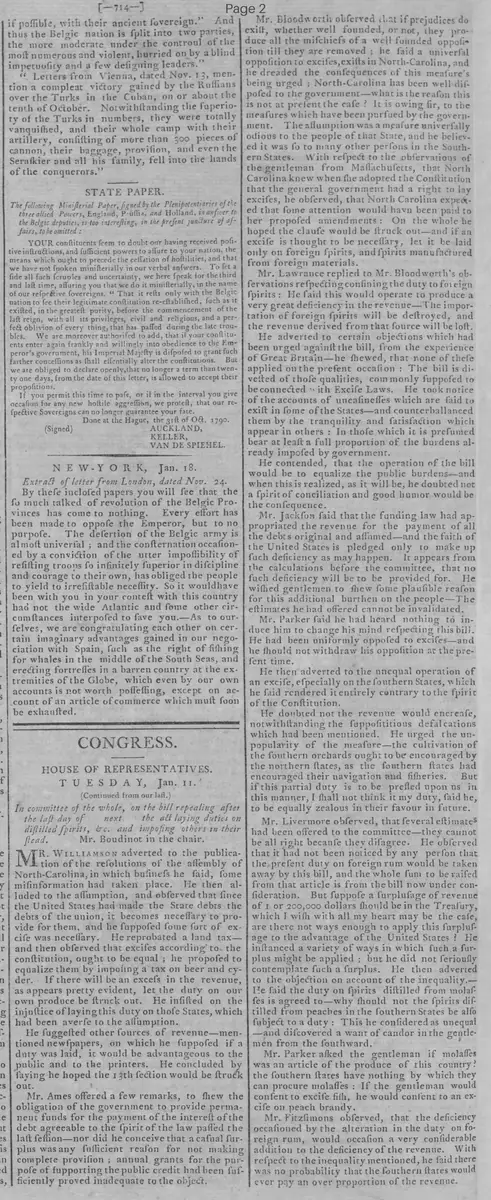
HOUSE OF REPRESENTATIVES.
TUESDAY, Jan. 11.
(Continued from our last.)
In committee of the whole, on the bill repealing, after the last day of next year, the act laying duties on distilled spirits, &c. and imposing others in their stead.
Mr. Boudinot in the chair.
Mr. Williamson adverted to the publication of the resolutions of the assembly of North-Carolina, in which business he said some misinformation had taken place. He then alluded to the assumption, and observed that since the United States had made the State debts the debts of the union, it becomes necessary to provide for them, and he supposed some sort of excise was necessary. He reprobated a land tax—and then observed that excises according to the constitution, ought to be equal; he proposed to equalize them by imposing a tax on beer and cyder. If there will be an excess in the revenue, as appears pretty evident, let the duty on our own produce be struck out. He insisted on the injustice of laying this duty on those States, which had been averse to the assumption.
He suggested other sources of revenue—mentioned newspapers, on which he supposed if a duty was laid, it would be advantageous to the public and to the printers. He concluded by saying he hoped the 13th section would be struck out.
Mr. Ames offered a few remarks, to shew the obligation of the government to provide permanent funds for the payment of the interest of the debt agreeable to the spirit of the law passed the last session—nor did he conceive that a casual surplus was any sufficient reason for not making complete provision; annual grants for the purpose of supporting the public credit had been sufficiently proved inadequate to the object.
Mr. Bloodworth observed that if prejudices do exist, whether well founded, or not, they produce all the mischiefs of a well founded opposition till they are removed; he said a universal opposition to excises, exists in North-Carolina, and he dreaded the consequences of this measure's being urged; North-Carolina has been well disposed to the government—what is the reason this is not at present the case? It is owing sir, to the measures which have been pursued by the government. The assumption was a measure universally odious to the people of that State, and he believed it was so to many other persons in the Southern States. With respect to the observations of the gentleman from Massachusetts, that North Carolina knew when she adopted the Constitution that the general government had a right to lay excises, he observed, that North Carolina expected that some attention would have been paid to her proposed amendments: On the whole he hoped the clause would be struck out—and if an excise is thought to be necessary, let it be laid only on foreign spirits, and spirits manufactured from foreign materials.
Mr. Lawrence replied to Mr. Bloodworth's observations respecting confining the duty to foreign spirits: He said this would operate to produce a very great deficiency in the revenue—The importation of foreign spirits will be destroyed, and the revenue derived from that source will be lost. He adverted to certain objections which had been urged against the bill, from the experience of Great Britain—he shewed, that none of these applied on the present occasion: The bill is divested of those qualities, commonly supposed to be connected with Excise Laws. He took notice of the accounts of uneasiness which are said to exist in some of the States—and counterbalanced them by the tranquility and satisfaction which appear in others: In those which it is presumed bear at least a full proportion of the burdens already imposed by government.
He contended, that the operation of the bill would be to equalize the public burdens—and when this is realized, as it will be, he doubted not a spirit of conciliation and good humor would be the consequence.
Mr. Jackson said that the funding law had appropriated the revenue for the payment of all the debts original and assumed—and the faith of the United States is pledged only to make up such deficiency as may happen. It appears from the calculations before the committee, that no such deficiency will be to be provided for. He wished gentlemen to shew some plausible reason for this additional burthen on the people—The estimates he had offered cannot be invalidated.
Mr. Parker said he had heard nothing to induce him to change his mind respecting this bill. He had been uniformly opposed to excises and he should not withdraw his opposition at the present time.
He then adverted to the unequal operation of an excise, especially on the southern States, which he said rendered it entirely contrary to the spirit of the Constitution.
He doubted not the revenue would increase notwithstanding the supposititious defalcations which had been mentioned. He urged the unpopularity of the measure—the cultivation of the southern orchards ought to be encouraged by the northern states, as the southern states had encouraged their navigation and fisheries. But if this partial duty is to be pressed upon us in this manner, I shall not think it my duty, said he, to be equally zealous in their favour in future.
Mr. Livermore observed, that several estimates had been offered to the committee—they cannot be all right because they disagree. He observed that it had not been noticed by any person that the present duty on foreign rum would be taken away by this bill, and the whole sum to be raised from that article is from the bill now under consideration. But suppose a surplusage of revenue of 100 or 200,000 dollars should be in the Treasury, which I wish with all my heart may be the case, are there not ways enough to apply this surplus to the advantage of the United States? He instanced a variety of ways in which such a surplus might be applied; but he did not seriously contemplate such a surplus. He then adverted to the objection on account of the inequality.—He said the duty on spirits distilled from molasses is agreed to—why should not the spirits distilled from peaches in the southern States be also subject to a duty: This he considered as unequal—and discovered a want of candor in the gentlemen from the southward.
Mr. Parker asked the gentleman if molasses was an article of the produce of this country: the southern states have nothing by which they can procure molasses: If the gentleman would consent to excise fish, he would consent to an excise on peach brandy.
Mr. Fitzsimons observed, that the deficiency occasioned by the alteration in the duty on foreign rum, would occasion a very considerable addition to the deficiency of the revenue. With respect to the inequality mentioned, he said there was no probability that the southern states would ever pay an over proportion of the revenue.
Mr. Williamson stated certain particulars to shew, that a just idea of the sum paid by North-Carolina could not be known by any statements from the public offices—their business is carried on coastwise—To judge of their consumption, recourse must be had to the exportations of that State—He said the exportations of North-Carolina amounted to a million of dollars annually.
Mr. Clymer said that a gentleman from Georgia had mentioned the aversion that the people of Pennsylvania bore to an excise law. Such a law he observed had been in force in the state for upwards of 50 or 60 years, and that the excise officers were vested with as much power as it was proposed to give them by the bill before the house; that some resistance had been offered to those officers acting in the line of their duty; but that those who opposed them in the execution of their business were severely fined.—
He was not convinced that the duty which it was proposed to lay on spirits by the bill under consideration was odious to a majority of the states;—they most of them had excise laws of their own, and he conceived the present bill was as well guarded as possible, by wholesome provisions against every objection—From the statements which had been produced, there would be no great excess in the revenue, he apprehended; but if there was, it would be well applied in lessening the public debts.
Mr. Madison remarked on the observations of Mr. Fitzsimons, respecting the southern States not paying their proportion of the Impost: He shewed that the trade of the southern states was carried on by the eastern and northern States— That the consumption of the southern States was proportioned to their numbers, and in this way they bore their full proportion of the public burdens.
Mr. Jackson replied to Mr. Clymer, and said, that if the people had been severely fined for a breach of the Excise Law in this State. he had been well informed, that the fine had been as severely remitted.
The question on striking out the 13th section, was negatived—33 to 17.
Adjourned.
WEDNESDAY, Jan. 19.
A bill, declaring the assent of Congress to a certain act of the State of Maryland, being read a second time, was referred to a committee of the whole on Monday next.
Mr. Sedgwick, from the committee appointed for that purpose, reported a bill, authorizing the President of the United States to cause the debt due to foreign officers, the interest whereon is now payable in Paris, at the rate of 6 per cent. per annum, to be paid and discharged—being read a first and second time, was referred to a committee of the whole, and made the order of the day for to-morrow.
A letter from the Directors of the Library Company of Philadelphia, making an offer of the use of the Books in said Library to the Members of both Houses of Congress, was communicated by the Speaker.
Mr. Huntington presented a memorial from the Baptist Association in the State of Connecticut, requesting the interposition of Congress to prevent incorrectness in future editions of the Bible, published in the United States read and laid on the table.
A petition from sundry surgeons and surgeon's mates, in the service of the United States, during the late war, was read and referred to the Secretary at War.
A petition from William Dewees, and a petition from William Blackledge, were referred to the Secretary of the Treasury.
Another petition from the same person, praying that certain claims against the state of North Carolina be discharged, was referred to the Secretary of War.
Mr. Fitzsimons, from the committee appointed to consider the petition of Joshua Barney, late an officer in the American navy, reported a resolution, that a committee be appointed to prepare and bring in a bill, to allow to Capt. Joshua Barney, the sum of dollars.
Agreeable to the order of the day, the House proceeded in the further consideration of the amendments proposed to the new Revenue Bill
A motion to recommit the bill was negatived: It was then moved to re-commit the fourth section, which specifies the compensations to the inspectors—this also was negatived: The debates were spun out to a considerable length—but an adjournment being called for, the further consideration of the bill was postponed.
THURSDAY, Jan. 20,
Mr. Fitzsimons presented a memorial from the merchants of Philadelphia, trading to India, and China—praying that an additional duty may be laid on all goods imported into the United States from India or China in foreign bottoms—this was read, and referred to the Secretary of the Treasury.
A petition of Robert Mead was presented by Mr. Lawrence, which was read, and referred to the Secretary of the Treasury.
A petition of C. and J. Sands, and W. Livingston in behalf of themselves and associates, praying compensation for damages sustained by a contract, for supplying the army, with provisions—read and referred to the Secretary of the Treasury.
A message was received from the Senate by Mr. Otis, their Secretary—informing, that they have passed a bill for incorporating the subscribers to the Bank of the United States.
The house resumed the consideration of the amendments proposed to the new revenue bill— and after some debate the latter part of the fourth section, referring to the compensation of the inspectors, was struck out.
A motion was again made to re-commit the bill generally to a select committee, this was lost—30 to 27.
Mr. Lee then moved that it should be re-committed for the purpose of inserting a clause devising a mode of collecting the revenue—this was negatived, 33 to 24.
Several amendments proposed by Mr. Fitzsimons were adopted—Some sections were expunged—The further consideration of the bill was postponed till to morrow.
Mr. Sedgwick laid the following motion on the table, that a committee be appointed to bring in a bill for making compensation to the inspectors of the duties on distilled spirits.
Mr. Tucker, Mr. Partridge, and Mr. Lee were appointed a committee on the part of the House, to join a committee of the Senate to consider of and report a time for the commencement of the next Congress.
Adjourned.
FRIDAY, Jan. 21.
The act to incorporate the subscribers to the bank of the United States received from the Senate yesterday, was read the first and second time. and referred to a committee of the whole house on Wednesday next.
Mr. Madison presented the petition of W. C. Webb and Conveyors Wythe, which was read and referred to the Secretary of the Treasury.
Mr. Williamson reported a bill for preventing the invalid pensioners from selling their pensions before they shall become due; read a first and second time, and made the order of the day on Thursday next.
Mr. Sedgwick's motion for a committee to bring in a bill to provide for the compensation of the inspectors of the duties on distilled spirits, was taken into consideration, and a committee consisting of Messrs. Sedgwick, Madison and Lawrence was appointed.
The house proceeded in the consideration of the amendments proposed to the bill laying duties on distilled spirits.
A motion was made by Mr. Jackson, in the following words:
And be it further Enacted. That if any inspector or other officer or person concerned in the collection of the revenue to be raised by this act. shall, by word, message or writing, or in any other manner whatsoever, persuade or endeavor to persuade, an Elector to give, or dissuade or endeavor to dissuade any from giving his vote for the choice of any person to be a member of the House of Representatives, member of the Senate, or President of the United States—such inspector or other person so offending, shall be forever disabled from holding an office under this act, and shall be subject to a penalty of dollars.
This motion occasioned a lengthy debate, The yeas and nays being required by Mr. Jackson, were, Ayes 21—Nays 37. The further consideration of the bill was postponed till to-morrow.
A message was received from the Senate by Mr. Otis their Secretary, informing that they have concurred in the vote of the house, in appointing a committee on their part to consider and report a time for the commencement of the next Congress.
Adjourned till to-morrow.
What sub-type of article is it?
What keywords are associated?
What entities or persons were involved?
Domestic News Details
Event Date
Jan. 11 To Jan. 21
Key Persons
Outcome
motion to strike out 13th section of excise bill negatived 33-17; various motions to recommit negatived; amendments adopted; inspector compensation section partly struck out; jackson's motion on elector interference negatived 21-37; multiple petitions and bills referred to committees or secretaries.
Event Details
Debates in House committee on bill repealing prior duties on distilled spirits and imposing new excise taxes, with opposition from southern representatives over inequality, assumption of state debts, and unpopularity in states like North-Carolina; suggestions for alternative revenues like taxes on beer, cider, newspapers; arguments on revenue surplus and constitutional equality. Over subsequent days, procedural actions included referring bills on Maryland act, foreign officer debts, bank incorporation, pension sales prevention; memorials from library, Baptists, merchants; petitions from surgeons, Dewees, Blackledge, Barney, Mead, Sands/Livingston, Webb/Wythe; committees appointed for inspector compensation and Congress start time.