Thank you for visiting SNEWPapers!
Sign up free
Gazette Of The United States And Daily Evening Advertiser
Philadelphia, Philadelphia County, Pennsylvania
What is this article about?
On August 14-15, 1793, the French National Convention receives the US minister plenipotentiary, who presents credentials and delivers a speech affirming the Franco-American alliance. The Convention responds with fraternal embrace and messages of mutual support for liberty.
Clipping
OCR Quality
Full Text
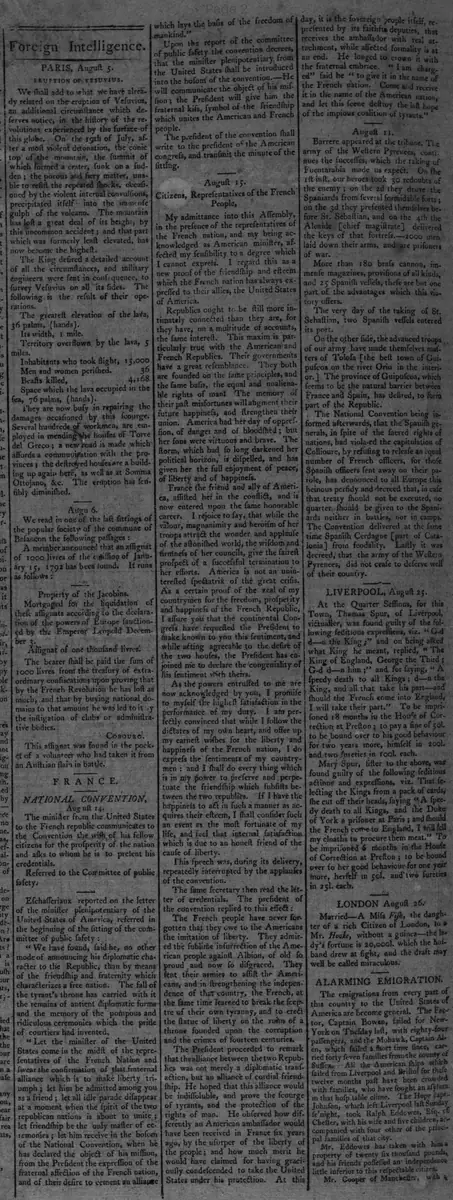
NATIONAL CONVENTION,
August 14.
The minister from the United States to the French republic communicates to the Convention the wish of his fellow citizens for the prosperity of the nation and asks to whom he is to present his credentials.
Referred to the Committee of public safety
Eschaeriaux reported on the letter of the minister plenipotentiary of the United States of America, referred in the beginning of the sitting of the committee of public safety:
"We have found, said he, no other mode of announcing his diplomatic character to the Republic, than by means of the friendship and fraternity which characterizes a free nation. The fall of the tyrant's throne has carried with it the remains of ancient diplomatic forms- and the memory of the pompous and ridiculous ceremonies which the pride of courtiers had invented.
"Let the minister of the United States come in the midst of the representatives of the French Nation and swear the confirmation of that fraternal alliance which is to make liberty triumph; let him be admitted among you as a friend; let all idle parade disappear at a moment when the spirit of the two republican nations is about to unite; let friendship be the only master of ceremonies; let him receive in the bosom of the National Convention, when he has declared the object of his mission, from the President the expression of the fraternal affection of the French nation, and of their desire to cement an alliance which lays the basis of the freedom of mankind."
Upon the report of the committee of public safety the convention decrees, that the minister plenipotentiary from the United States shall be introduced into the bosom of the convention. He will communicate the object of his mission; the President will give him the fraternal kiss, symbol of the friendship which unites the American and French people.
The president of the convention shall write to the president of the American congress, and transmit the minute of the sitting.
August 15.
Citizens, Representatives of the French People,
My admittance into this Assembly, in the presence of the representatives of the French nation, and my being acknowledged as American minister, affected my sensibility to a degree which I cannot express. I regard this as a new proof of the friendship and esteem which the French nation has always expressed to their allies; the United States of America.
Republics ought to be still more intimately connected than they are, for they have, on a multitude of accounts, the same interest. This maxim is particularly true with the American and French Republics. Their governments have a great resemblance. They both are founded on the same principles, and the same basis, the equal and unalienable rights of man! The memory of their past misfortunes will augment their future happiness, and strengthen their union. America had her day of oppression, of danger and of bloodshed; but her sons were virtuous and brave. The storm, which had so long darkened her political horizon, is dispelled, and has given her the full enjoyment of peace, of liberty and of happiness.
France the friend and ally of America, assisted her in the conflict, and is now entered upon the same honorable career. I rejoice to say, that while the valour, magnanimity and heroism of her troops attract the wonder and applause of the astonished world, the wisdom and firmness of her councils, give the fairest prospect of a successful termination to her efforts. America is not an uninterested spectator of the great crisis. As a certain proof of the zeal of my countrymen for the freedom, prosperity and happiness of the French Republic, I assure you that the continental Congress have requested the President to make known to you this sentiment, and while acting agreeable to the desire of the two houses, the President has enjoined me to declare the congeniality of his sentiment with theirs.
As the powers entrusted to me are now acknowledged by you, I promise to myself the highest satisfaction in the performance of my duty. I am perfectly convinced that while I follow the dictates of my own heart, and offer up my earnest wishes for the liberty and happiness of the French nation, I do express the sentiments of my countrymen: and I shall do every thing which is in my power to preserve and perpetuate the friendship which subsists between the two republics. If I have the happiness to act in such a manner as acquires their esteem, I shall consider such an event as the most fortunate of my life, and feel that internal satisfaction which is due to an honest friend of the cause of liberty.
This speech was, during its delivery, repeatedly interrupted by the applauses of the convention.
The same secretary then read the letter of credentials. The president of the convention replied to this effect:
The French people have never forgotten that they owe to the Americans the imitation of liberty. They admired the sublime insurrection of the American people against Albion, of old so proud and now so disgraced. They sent their armies to assist the Americans, and in strengthening the independence of that country, the French, at the same time learned to break the sceptre of their own tyranny, and to erect the statue of liberty on the ruins of a throne founded upon the corruption and the crimes of fourteen centuries.
The President proceeded to remark that the alliance between the two Republics was not merely a diplomatic transaction, but an alliance of cordial friendship. He hoped that this alliance would be indissoluble, and prove the scourge of tyrants, and the protection of the rights of man. He observed how differently an American ambassador would have been received in France six years ago, by the usurper of the liberty of the people; and how much merit he would have claimed for having graciously condescended to take the United States under his protection. At this day, it is the sovereign people itself, represented by its faithful deputies, that receives the ambassador with real attachment, while affected formality is at an end. He longed to crown it with the fraternal embrace. "I am charged" said he "to give it in the name of the French nation. Come and receive it in the name of the American nation, and let this scene destroy the last hope of the impious coalition of tyrants."
What sub-type of article is it?
What keywords are associated?
What entities or persons were involved?
Where did it happen?
Foreign News Details
Primary Location
France
Event Date
August 14 15
Key Persons
Outcome
the us minister is received into the national convention, presents credentials, delivers a speech on alliance, receives fraternal kiss from the president symbolizing friendship between republics, and the convention decrees correspondence to affirm mutual support.
Event Details
The US minister communicates wishes for French prosperity and inquires about presenting credentials, referred to Committee of Public Safety. Eschaeriaux reports favoring simple fraternal reception without pomp. Convention decrees introduction of minister, who speaks on shared republican values, past alliance, and American support for French liberty. Speech applauded. Credentials read; President replies emphasizing historical ties, indissoluble friendship against tyrants, and gives fraternal embrace.