Thank you for visiting SNEWPapers!
Sign up free
Literary
June 7, 1882
The Forest Republican
Tionesta, Forest County, Pennsylvania
What is this article about?
Newlyweds Sally and Will Gray quarrel over Sally's poor cooking on their farm near a railroad. After Will leaves angrily, distraught Sally crosses the tracks and is hit by a train, hospitalized at Seyms Station. Will searches desperately, they reconcile upon reunion, and relocate to a new farm away from the railway.
Clipping
OCR Quality
95%
Excellent
Full Text
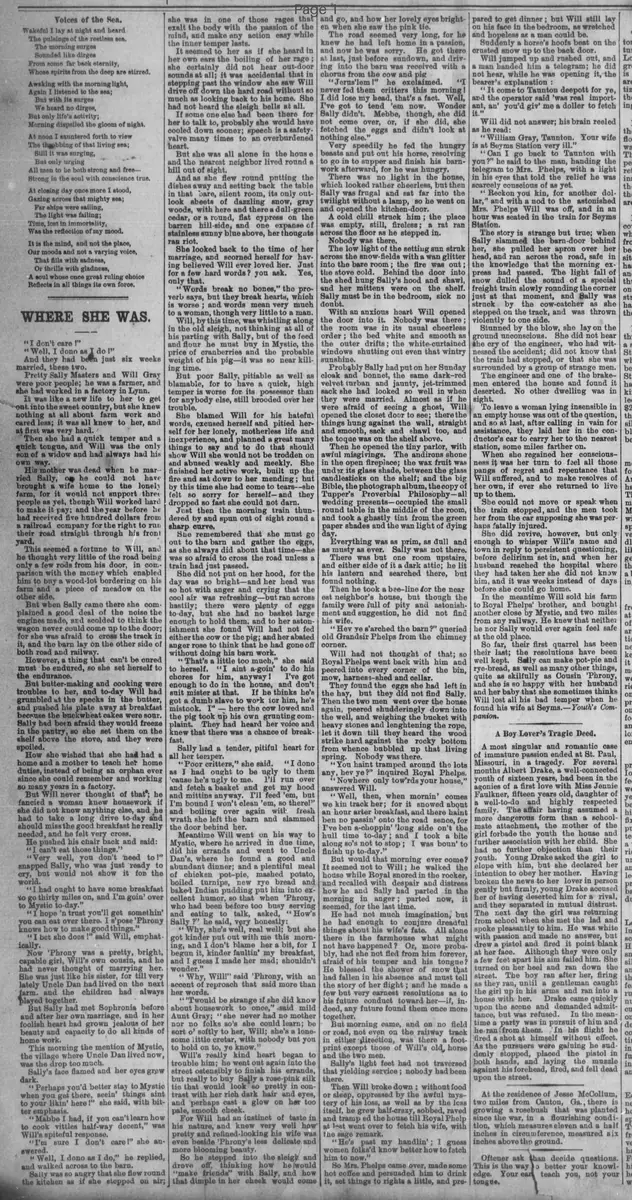
WHERE SHE WAS.
"I don't care!"
"Well, I don't as I do!"
And they had been just six weeks married, these two.
Pretty Sally Masters and Will Gray were poor people; he was a farmer, and she had worked in a factory in Lynn.
It was like a new life to her to get out into the sweet country, but she knew nothing at all about farm work and cared less; it was all new to her, and at first was very hard.
Then she had a quick temper and a quick tongue, and Will was the only son of a widow and had always had his own way.
His mother was dead when he married Sally, so he could not have brought a wife home to the lonely farm, for it would not support three people as yet, though Will worked hard to make it pay; and the year before he had received five hundred dollars from a railroad company for the right to run their road straight through his front yard.
This seemed a fortune to Will, and he thought very little of the road being only a few rods from his door, in comparison with the money which enabled him to buy a wood-lot bordering on his farm and a piece of meadow on the other side.
But when Sally came there she complained a good deal of the noise the engines made, and scolded to think the wagon never could come up to the door; for she was afraid to cross the track in it, and the barn lay on the other side of both road and railway.
However, a thing that can't be cured must be endured, so she set herself to the endurance.
But butter-making and cooking were troubles to her, and to-day Will had grumbled at the specks in the butter, and pushed his plate away at breakfast because the buckwheat cakes were sour.
Sally had been afraid they would freeze in the pantry, so she set them on the shelf above the stove, and they were spoiled.
How she wished that she had had a home and a mother to teach her home duties, instead of being an orphan ever since she could remember and working so many years in a factory.
But Will never thought of that: he fancied a woman knew housework if she did not know anything else, and he had to take a long drive to-day and should miss the good breakfast he really needed, and he felt very cross.
He pushed his chair back and said:
"I can't eat those things."
"Very well, you don't need to!" snapped Sally, who was just ready to cry, but would not show it for the world.
"I had ought to have some breakfast to go thirty miles on, and I'm goin' over to Mystic to-day."
"I hope 'n trust you'll get somethin' you can eat over there. I s'pose 'Phrony knows how to make good things."
"I bet she does!" said Will, emphatically.
Now 'Phrony was a pretty, bright, capable girl, Will's own cousin, and he had never thought of marrying her.
She was just like his sister, for till very lately Uncle Dan had lived on the next farm, and the children had always played together.
But Sally had met Sophronia before and after her own marriage, and in her foolish heart had grown jealous of her beauty and capacity to do all kinds of home work.
This morning the mention of Mystic, the village where Uncle Dan lived now, was the drop too much.
Sally's face flamed and her eyes grew dark.
"Perhaps you'd better stay to Mystic when you get there, seein' things ain't to your likin' here!" she said, with bitter emphasis.
"Mabbe I had, if you can't learn how to cook vittles half-way decent," was Will's spiteful response.
"I'm sure I don't care!" she answered.
"Well, I don't as I do," he replied, and walked across to the barn.
Sally was so angry that she flew round the kitchen as if she stepped on air; she was in one of those rages that exalt the body with the passion of the mind, and make any action easy while the inner temper lasts.
It seemed to her as if she heard in her own ears the boiling of her rage; she certainly did not hear out-door sounds at all; it was accidental that in stepping past the window she saw Will drive off down the hard road without so much as looking back to his home. She had not heard the sleigh bells at all.
If some one else had been there for her to talk to, probably she would have cooled down sooner: speech is a safety-valve many times to an overburdened heart.
But she was all alone in the house and the nearest neighbor lived round a hill out of sight.
And as she flew round putting the dishes away and setting back the table in that bare, silent room, its only outlook sheets of dazzling snow, gray woods, with here and there a dull-green cedar, or a round, flat cypress on the barren hill-side, and one expanse of stainless sunny blue above, her thoughts ran riot.
She looked back to the time of her marriage, and scorned herself for having believed Will ever loved her. Just for a few hard words? you ask. Yes, only that.
"Words break no bones," the proverb says, but they break hearts, which is worse; and words mean very much to a woman, though very little to a man. Will, by this time, was whistling along in the old sleigh, not thinking at all of his parting with Sally, but of the feed and flour he must buy in Mystic, the price of cranberries and the probable weight of his pig-it was so near killing time.
But poor Sally, pitiable as well as blamable, for to have a quick, high temper is worse for its possessor than for anybody else, still brooded over her trouble.
She blamed Will for his hateful words, excused herself and pitied herself for her lonely, motherless life and inexperience, and planned a great many things to say and to do that should show Will she would not be trodden on and abused weakly and meekly. She finished her active work, built up the fire and sat down to her mending; but by this time she had come to tears--she felt so sorry for herself--and they dropped so fast she could not darn.
Just then the morning train thundered by and spun out of sight round a sharp curve.
She remembered that she must go out to the barn and gather the eggs, as she always did about that time--she was so afraid to cross the road unless a train had just passed.
She did not put on her hood, for the day was so bright--and her head was so hot with anger and crying that the cool air was refreshing--but ran across hastily; there were plenty of eggs to-day, but she had no basket large enough to hold them, and to her astonishment she found Will had not fed either the cow or the pig; and her abated anger rose to think that he had gone off without doing his barn work.
"That's a little too much," she said to herself. "I ain't a-goin' to do his chores for him, anyway! I've got enough to do in the house, and don't suit mister at that. If he thinks he's got a dumb slave to work for him, he's mistook. I"--here the cow lowed and the pig took up his own grunting complaint. They had heard her voice and knew that there was a chance of breakfast.
Sally had a tender, pitiful heart for all her temper.
"Poor critters," she said. "I don't as I had ought to be ugly to them 'cause he's ugly to me. I'll run over and fetch a basket and get my hood and mittins anyway. I'll feed 'em, but I'm bound I won't clean 'em, so there!" and boiling over again with fresh wrath she left the barn and slammed the door behind her.
Meantime Will went on his way to Mystic, where he arrived in due time, did his errands and went to Uncle Dan's, where he found a good and abundant dinner; and a plentiful meal of chicken pot-pie, mashed potato, boiled turnips, new rye bread and baked Indian pudding put him into excellent humor, so that when 'Phrony, who had been before too busy serving and eating to talk, asked, "How's Sally?" he said, very honestly,
"Why, she's well, real well; but she got kinder put out with me this morning, and I don't blame her a bit, for I begun it, kinder faultin' my breakfast, and I guess I made her mad; shouldn't wonder."
"Why, Will!" said 'Phrony, with an accent of reproach that said more than her words.
"'Twould be strange if she did know about housework to once," said mild Aunt Gray; "she never had no mother nor no folks so's she could learn; be sort o' softly to her, Will; she's a lonesome little cretur, with nobody but you to hold on to, ye know."
Will's really kind heart began to trouble him; he went out again into the street ostensibly to finish his errands, but really to buy Sally a rose-pink silk tie that would look so pretty in contrast with her rich dark hair and eyes, and perhaps cast a glow on her too pale, smooth cheek.
For Will had an instinct of taste in his nature, and knew very well how pretty and refined-looking his wife was even beside 'Phrony's less delicate and more blooming beauty.
So he stepped into the sleigh and drove off, thinking how he would "make friends" with Sally, and how that dimple in her cheek would come and go, and how her lovely eyes brighten when she saw the pink tie.
The road seemed very long, for he knew he had left home in a passion, and now he was sorry. He got there at last, just before sundown, and driving into the barn was received with a chorus from the cow and pig.
"Jerusalem!" he exclaimed. "I never fed them critters this morning! I did lose my head, that's a fact. Well, I've got to tend 'em now. Wonder Sally didn't. Mebbe, though, she did not 'come over,' or, if she did, she fetched the eggs and didn't look at nothing else."
Very speedily he fed the hungry beasts and put out his horse, resolving to go in to supper and finish his barn-work afterward, for he was hungry.
There was no light in the house, which looked rather cheerless, but then Sally was frugal and sat far into the twilight without a lamp, so he went on and opened the kitchen-door.
A cold chill struck him; the place was empty, still, fireless; a rat ran across the floor as he stepped in.
Nobody was there.
The low light of the setting sun struck across the snow-fields with a wan glitter into the bare room; the fire was out; the stove cold. Behind the door into the shed hung Sally's hood and shawl, and her mittens were on the shelf.
Sally must be in the bedroom, sick no doubt.
With an anxious heart Will opened the door into it. Nobody was there; the room was in its usual cheerless order; the bed white and smooth as the outer drifts: the white-curtained windows shutting out even that wintry sunshine.
Probably Sally had put on her Sunday cloak and bonnet, the same dark-red velvet turban and jaunty, jet-trimmed sack she had looked so well in when they were married. Almost as if he were afraid of seeing a ghost, Will opened the closet door to see; there the things hung against the wall, straight and smooth, sack and shawl too, and the toque was on the shelf above.
Then he opened the tiny parlor, with awful misgivings. The andirons shone in the open fireplace; the wax fruit was under its glass shade, between the glass candlesticks on the shelf; and the big Bible, the photograph album, the copy of Tupper's Proverbial Philosophy--all wedding presents--occupied the small round table in the middle of the room, and took a ghastly tint from the green paper shades and the wan light of dying day.
Everything was as prim, as dull and as musty as ever. Sally was not there.
There was but one room upstairs, and either side of it a dark attic; he lit his lantern and searched there, but found nothing.
Then he took a bee-line for the nearest neighbor's house, but though the family were full of pity and astonishment and suggestion, he did not find his wife.
"Hev ye s'arched the barn?" queried old Grandsir Phelps from the chimney corner.
Will had not thought of that; so Royal Phelps went back with him and peered into every corner of the bin, mow, harness-shed and cellar.
They found the eggs she had left in the hay, but they did not find Sally.
Then the two men went over the house again, peered shudderingly down into the well, and weighing the bucket with heavy stones and lengthening the rope, let it down till they heard the wood strike hard against the rocky bottom from whence bubbled up that living spring. Nobody was there.
"You hain't tramped around the lots any, hev ye?" inquired Royal Phelps.
"Nowhere only tow'rds your house," answered Will.
"Well, then, when mornin' comes we kin track her; for it snowed about an hour arter breakfast, and there hain't ben no passin' onto the road sence, for I've ben a-choppin' 'long side on't the hull time to-day; and I took a bite along so's not to stop; I was boun'to finish up to-day."
But would that morning ever come?
It seemed not to Will; he walked the house while Royal snored in the rocker, and recalled with despair and distress how he and Sally had parted in the morning in anger; parted now, it seemed, for the last time.
He had not much imagination, but he had enough to conjure dreadful things about his wife's fate. All alone there in the farmhouse what might not have happened? Or, more probably, had she not fled from him forever, afraid of his temper and his tongue?
He blessed the shower of snow that had fallen in his absence and must tell the story of her flight; and he made a few but very earnest resolutions as to his future conduct toward her--if, indeed, any future found them once more together.
But morning came, and on no field or road, not even on the railway track in either direction, was there a foot-print except those of Will's old horse and the two men.
Sally's light feet had not traversed that yielding surface; nobody had been there.
Then Will broke down; without food or sleep, oppressed by the awful mystery of his loss, as well as by the loss itself, he grew half-crazy, sobbed, raved and tramped the house till Royal Phelps at last went over to fetch his wife, with the sage remark,
"He's past my handlin'; I guess women folks'd know better how to fetch him to now."
So Mrs. Phelps came over, made some hot coffee and persuaded him to drink it, set things to rights a little, and prepared to get dinner: but Will still lay on his face in the bedroom, as wretched and hopeless as a man could be.
Suddenly a horse's hoofs beat on the crusted snow up to the back door.
Will jumped up and rushed out, and a man handed him a telegram: he did not hear, while he was opening it, the bearer's explanation:
"It come to Taunton depot for ye, and the operator said 'twas real important, an' you'd giv' me a doller to fetch it."
Will did not answer; his brain reeled as he read:
"William Gray, Taunton. Your wife is at Seyms Station very ill."
"Can I go back to Taunton with you?" he said to the man, handing the telegram to Mrs. Phelps, with a light in his eyes that told the relief he was scarcely conscious of as yet.
"Reckon you kin, for another doller." And with a nod to the astonished Mrs. Phelps Will was off, and in an hour was seated in the train for Seyms Station.
The story is strange but true; when Sally slammed the barn-door behind her, she pulled her apron over her head, and ran across the road, safe in the knowledge that the morning express had passed. The light fall of snow dulled the sound of a special freight train slowly rounding the corner just at that moment, and Sally was struck by the cow-catcher as she stepped on the track, and was thrown violently to one side.
Stunned by the blow, she lay on the ground unconscious. She did not hear the cry of the engineer, who had witnessed the accident; did not know that the train had stopped, or that she was surrounded by a group of strange men.
The engineer and one of the brakemen entered the house and found it deserted. No other dwelling was in sight.
To leave a woman lying insensible in an empty house was out of the question, and so at last, after calling in vain for assistance, they laid her in the conductor's car to carry her to the nearest station, some miles farther on.
When she regained her consciousness it was her turn to feel all those pangs of regret and repentance that Will suffered, and to make resolves of her own, if ever she returned to live up to them.
She could not move or speak when the train stopped, and the men took her from the car supposing she was perhaps fatally injured.
She did revive, however, but only enough to whisper Will's name and town in reply to persistent questioning, before delirium set in, and when her husband reached the hospital where they had taken her she did not know him, and it was weeks instead of days before she could go home.
In the meantime Will sold his farm to Royal Phelps' brother, and bought another close by Mystic, and two miles from any railway. He knew that neither he nor Sally would ever again feel safe at the old place.
So far, their first quarrel has been their last; the resolutions have been well kept. Sally can make pot-pie and rye-bread, as well as many other things, quite as skilfully as Cousin 'Phrony, and she is so happy with her husband and her baby that she sometimes thinks Will lost all his bad temper when he found his wife at Seyms.--Youth's Companion.
"I don't care!"
"Well, I don't as I do!"
And they had been just six weeks married, these two.
Pretty Sally Masters and Will Gray were poor people; he was a farmer, and she had worked in a factory in Lynn.
It was like a new life to her to get out into the sweet country, but she knew nothing at all about farm work and cared less; it was all new to her, and at first was very hard.
Then she had a quick temper and a quick tongue, and Will was the only son of a widow and had always had his own way.
His mother was dead when he married Sally, so he could not have brought a wife home to the lonely farm, for it would not support three people as yet, though Will worked hard to make it pay; and the year before he had received five hundred dollars from a railroad company for the right to run their road straight through his front yard.
This seemed a fortune to Will, and he thought very little of the road being only a few rods from his door, in comparison with the money which enabled him to buy a wood-lot bordering on his farm and a piece of meadow on the other side.
But when Sally came there she complained a good deal of the noise the engines made, and scolded to think the wagon never could come up to the door; for she was afraid to cross the track in it, and the barn lay on the other side of both road and railway.
However, a thing that can't be cured must be endured, so she set herself to the endurance.
But butter-making and cooking were troubles to her, and to-day Will had grumbled at the specks in the butter, and pushed his plate away at breakfast because the buckwheat cakes were sour.
Sally had been afraid they would freeze in the pantry, so she set them on the shelf above the stove, and they were spoiled.
How she wished that she had had a home and a mother to teach her home duties, instead of being an orphan ever since she could remember and working so many years in a factory.
But Will never thought of that: he fancied a woman knew housework if she did not know anything else, and he had to take a long drive to-day and should miss the good breakfast he really needed, and he felt very cross.
He pushed his chair back and said:
"I can't eat those things."
"Very well, you don't need to!" snapped Sally, who was just ready to cry, but would not show it for the world.
"I had ought to have some breakfast to go thirty miles on, and I'm goin' over to Mystic to-day."
"I hope 'n trust you'll get somethin' you can eat over there. I s'pose 'Phrony knows how to make good things."
"I bet she does!" said Will, emphatically.
Now 'Phrony was a pretty, bright, capable girl, Will's own cousin, and he had never thought of marrying her.
She was just like his sister, for till very lately Uncle Dan had lived on the next farm, and the children had always played together.
But Sally had met Sophronia before and after her own marriage, and in her foolish heart had grown jealous of her beauty and capacity to do all kinds of home work.
This morning the mention of Mystic, the village where Uncle Dan lived now, was the drop too much.
Sally's face flamed and her eyes grew dark.
"Perhaps you'd better stay to Mystic when you get there, seein' things ain't to your likin' here!" she said, with bitter emphasis.
"Mabbe I had, if you can't learn how to cook vittles half-way decent," was Will's spiteful response.
"I'm sure I don't care!" she answered.
"Well, I don't as I do," he replied, and walked across to the barn.
Sally was so angry that she flew round the kitchen as if she stepped on air; she was in one of those rages that exalt the body with the passion of the mind, and make any action easy while the inner temper lasts.
It seemed to her as if she heard in her own ears the boiling of her rage; she certainly did not hear out-door sounds at all; it was accidental that in stepping past the window she saw Will drive off down the hard road without so much as looking back to his home. She had not heard the sleigh bells at all.
If some one else had been there for her to talk to, probably she would have cooled down sooner: speech is a safety-valve many times to an overburdened heart.
But she was all alone in the house and the nearest neighbor lived round a hill out of sight.
And as she flew round putting the dishes away and setting back the table in that bare, silent room, its only outlook sheets of dazzling snow, gray woods, with here and there a dull-green cedar, or a round, flat cypress on the barren hill-side, and one expanse of stainless sunny blue above, her thoughts ran riot.
She looked back to the time of her marriage, and scorned herself for having believed Will ever loved her. Just for a few hard words? you ask. Yes, only that.
"Words break no bones," the proverb says, but they break hearts, which is worse; and words mean very much to a woman, though very little to a man. Will, by this time, was whistling along in the old sleigh, not thinking at all of his parting with Sally, but of the feed and flour he must buy in Mystic, the price of cranberries and the probable weight of his pig-it was so near killing time.
But poor Sally, pitiable as well as blamable, for to have a quick, high temper is worse for its possessor than for anybody else, still brooded over her trouble.
She blamed Will for his hateful words, excused herself and pitied herself for her lonely, motherless life and inexperience, and planned a great many things to say and to do that should show Will she would not be trodden on and abused weakly and meekly. She finished her active work, built up the fire and sat down to her mending; but by this time she had come to tears--she felt so sorry for herself--and they dropped so fast she could not darn.
Just then the morning train thundered by and spun out of sight round a sharp curve.
She remembered that she must go out to the barn and gather the eggs, as she always did about that time--she was so afraid to cross the road unless a train had just passed.
She did not put on her hood, for the day was so bright--and her head was so hot with anger and crying that the cool air was refreshing--but ran across hastily; there were plenty of eggs to-day, but she had no basket large enough to hold them, and to her astonishment she found Will had not fed either the cow or the pig; and her abated anger rose to think that he had gone off without doing his barn work.
"That's a little too much," she said to herself. "I ain't a-goin' to do his chores for him, anyway! I've got enough to do in the house, and don't suit mister at that. If he thinks he's got a dumb slave to work for him, he's mistook. I"--here the cow lowed and the pig took up his own grunting complaint. They had heard her voice and knew that there was a chance of breakfast.
Sally had a tender, pitiful heart for all her temper.
"Poor critters," she said. "I don't as I had ought to be ugly to them 'cause he's ugly to me. I'll run over and fetch a basket and get my hood and mittins anyway. I'll feed 'em, but I'm bound I won't clean 'em, so there!" and boiling over again with fresh wrath she left the barn and slammed the door behind her.
Meantime Will went on his way to Mystic, where he arrived in due time, did his errands and went to Uncle Dan's, where he found a good and abundant dinner; and a plentiful meal of chicken pot-pie, mashed potato, boiled turnips, new rye bread and baked Indian pudding put him into excellent humor, so that when 'Phrony, who had been before too busy serving and eating to talk, asked, "How's Sally?" he said, very honestly,
"Why, she's well, real well; but she got kinder put out with me this morning, and I don't blame her a bit, for I begun it, kinder faultin' my breakfast, and I guess I made her mad; shouldn't wonder."
"Why, Will!" said 'Phrony, with an accent of reproach that said more than her words.
"'Twould be strange if she did know about housework to once," said mild Aunt Gray; "she never had no mother nor no folks so's she could learn; be sort o' softly to her, Will; she's a lonesome little cretur, with nobody but you to hold on to, ye know."
Will's really kind heart began to trouble him; he went out again into the street ostensibly to finish his errands, but really to buy Sally a rose-pink silk tie that would look so pretty in contrast with her rich dark hair and eyes, and perhaps cast a glow on her too pale, smooth cheek.
For Will had an instinct of taste in his nature, and knew very well how pretty and refined-looking his wife was even beside 'Phrony's less delicate and more blooming beauty.
So he stepped into the sleigh and drove off, thinking how he would "make friends" with Sally, and how that dimple in her cheek would come and go, and how her lovely eyes brighten when she saw the pink tie.
The road seemed very long, for he knew he had left home in a passion, and now he was sorry. He got there at last, just before sundown, and driving into the barn was received with a chorus from the cow and pig.
"Jerusalem!" he exclaimed. "I never fed them critters this morning! I did lose my head, that's a fact. Well, I've got to tend 'em now. Wonder Sally didn't. Mebbe, though, she did not 'come over,' or, if she did, she fetched the eggs and didn't look at nothing else."
Very speedily he fed the hungry beasts and put out his horse, resolving to go in to supper and finish his barn-work afterward, for he was hungry.
There was no light in the house, which looked rather cheerless, but then Sally was frugal and sat far into the twilight without a lamp, so he went on and opened the kitchen-door.
A cold chill struck him; the place was empty, still, fireless; a rat ran across the floor as he stepped in.
Nobody was there.
The low light of the setting sun struck across the snow-fields with a wan glitter into the bare room; the fire was out; the stove cold. Behind the door into the shed hung Sally's hood and shawl, and her mittens were on the shelf.
Sally must be in the bedroom, sick no doubt.
With an anxious heart Will opened the door into it. Nobody was there; the room was in its usual cheerless order; the bed white and smooth as the outer drifts: the white-curtained windows shutting out even that wintry sunshine.
Probably Sally had put on her Sunday cloak and bonnet, the same dark-red velvet turban and jaunty, jet-trimmed sack she had looked so well in when they were married. Almost as if he were afraid of seeing a ghost, Will opened the closet door to see; there the things hung against the wall, straight and smooth, sack and shawl too, and the toque was on the shelf above.
Then he opened the tiny parlor, with awful misgivings. The andirons shone in the open fireplace; the wax fruit was under its glass shade, between the glass candlesticks on the shelf; and the big Bible, the photograph album, the copy of Tupper's Proverbial Philosophy--all wedding presents--occupied the small round table in the middle of the room, and took a ghastly tint from the green paper shades and the wan light of dying day.
Everything was as prim, as dull and as musty as ever. Sally was not there.
There was but one room upstairs, and either side of it a dark attic; he lit his lantern and searched there, but found nothing.
Then he took a bee-line for the nearest neighbor's house, but though the family were full of pity and astonishment and suggestion, he did not find his wife.
"Hev ye s'arched the barn?" queried old Grandsir Phelps from the chimney corner.
Will had not thought of that; so Royal Phelps went back with him and peered into every corner of the bin, mow, harness-shed and cellar.
They found the eggs she had left in the hay, but they did not find Sally.
Then the two men went over the house again, peered shudderingly down into the well, and weighing the bucket with heavy stones and lengthening the rope, let it down till they heard the wood strike hard against the rocky bottom from whence bubbled up that living spring. Nobody was there.
"You hain't tramped around the lots any, hev ye?" inquired Royal Phelps.
"Nowhere only tow'rds your house," answered Will.
"Well, then, when mornin' comes we kin track her; for it snowed about an hour arter breakfast, and there hain't ben no passin' onto the road sence, for I've ben a-choppin' 'long side on't the hull time to-day; and I took a bite along so's not to stop; I was boun'to finish up to-day."
But would that morning ever come?
It seemed not to Will; he walked the house while Royal snored in the rocker, and recalled with despair and distress how he and Sally had parted in the morning in anger; parted now, it seemed, for the last time.
He had not much imagination, but he had enough to conjure dreadful things about his wife's fate. All alone there in the farmhouse what might not have happened? Or, more probably, had she not fled from him forever, afraid of his temper and his tongue?
He blessed the shower of snow that had fallen in his absence and must tell the story of her flight; and he made a few but very earnest resolutions as to his future conduct toward her--if, indeed, any future found them once more together.
But morning came, and on no field or road, not even on the railway track in either direction, was there a foot-print except those of Will's old horse and the two men.
Sally's light feet had not traversed that yielding surface; nobody had been there.
Then Will broke down; without food or sleep, oppressed by the awful mystery of his loss, as well as by the loss itself, he grew half-crazy, sobbed, raved and tramped the house till Royal Phelps at last went over to fetch his wife, with the sage remark,
"He's past my handlin'; I guess women folks'd know better how to fetch him to now."
So Mrs. Phelps came over, made some hot coffee and persuaded him to drink it, set things to rights a little, and prepared to get dinner: but Will still lay on his face in the bedroom, as wretched and hopeless as a man could be.
Suddenly a horse's hoofs beat on the crusted snow up to the back door.
Will jumped up and rushed out, and a man handed him a telegram: he did not hear, while he was opening it, the bearer's explanation:
"It come to Taunton depot for ye, and the operator said 'twas real important, an' you'd giv' me a doller to fetch it."
Will did not answer; his brain reeled as he read:
"William Gray, Taunton. Your wife is at Seyms Station very ill."
"Can I go back to Taunton with you?" he said to the man, handing the telegram to Mrs. Phelps, with a light in his eyes that told the relief he was scarcely conscious of as yet.
"Reckon you kin, for another doller." And with a nod to the astonished Mrs. Phelps Will was off, and in an hour was seated in the train for Seyms Station.
The story is strange but true; when Sally slammed the barn-door behind her, she pulled her apron over her head, and ran across the road, safe in the knowledge that the morning express had passed. The light fall of snow dulled the sound of a special freight train slowly rounding the corner just at that moment, and Sally was struck by the cow-catcher as she stepped on the track, and was thrown violently to one side.
Stunned by the blow, she lay on the ground unconscious. She did not hear the cry of the engineer, who had witnessed the accident; did not know that the train had stopped, or that she was surrounded by a group of strange men.
The engineer and one of the brakemen entered the house and found it deserted. No other dwelling was in sight.
To leave a woman lying insensible in an empty house was out of the question, and so at last, after calling in vain for assistance, they laid her in the conductor's car to carry her to the nearest station, some miles farther on.
When she regained her consciousness it was her turn to feel all those pangs of regret and repentance that Will suffered, and to make resolves of her own, if ever she returned to live up to them.
She could not move or speak when the train stopped, and the men took her from the car supposing she was perhaps fatally injured.
She did revive, however, but only enough to whisper Will's name and town in reply to persistent questioning, before delirium set in, and when her husband reached the hospital where they had taken her she did not know him, and it was weeks instead of days before she could go home.
In the meantime Will sold his farm to Royal Phelps' brother, and bought another close by Mystic, and two miles from any railway. He knew that neither he nor Sally would ever again feel safe at the old place.
So far, their first quarrel has been their last; the resolutions have been well kept. Sally can make pot-pie and rye-bread, as well as many other things, quite as skilfully as Cousin 'Phrony, and she is so happy with her husband and her baby that she sometimes thinks Will lost all his bad temper when he found his wife at Seyms.--Youth's Companion.
What sub-type of article is it?
Prose Fiction
What themes does it cover?
Moral Virtue
Temperance
What keywords are associated?
Newlyweds
Quarrel
Farm Life
Railroad Accident
Reconciliation
Literary Details
Title
Where She Was.
Key Lines
"I Don't Care!"
"Well, I Don't As I Do!"
And They Had Been Just Six Weeks Married, These Two.