Thank you for visiting SNEWPapers!
Sign up free
The National Intelligencer And Washington Advertiser
Washington, District Of Columbia
What is this article about?
Excerpts from Aaron Burr's 1807 treason trial in Richmond, Virginia, detailing William Eaton's testimony on Burr's alleged plots, witness examinations regarding overt acts on Blennerhassett's Island, arguments on evidence order, and Judge Marshall's opinion allowing intent testimony before fact proof. Includes sketches of jury impartiality arguments.
Merged-components note: These components form a single continuous story covering the trial of Col. A. Burr, spanning multiple columns and pages with sequential reading order and text that directly continues without break.
Clippings
1 of 2
OCR Quality
Full Text
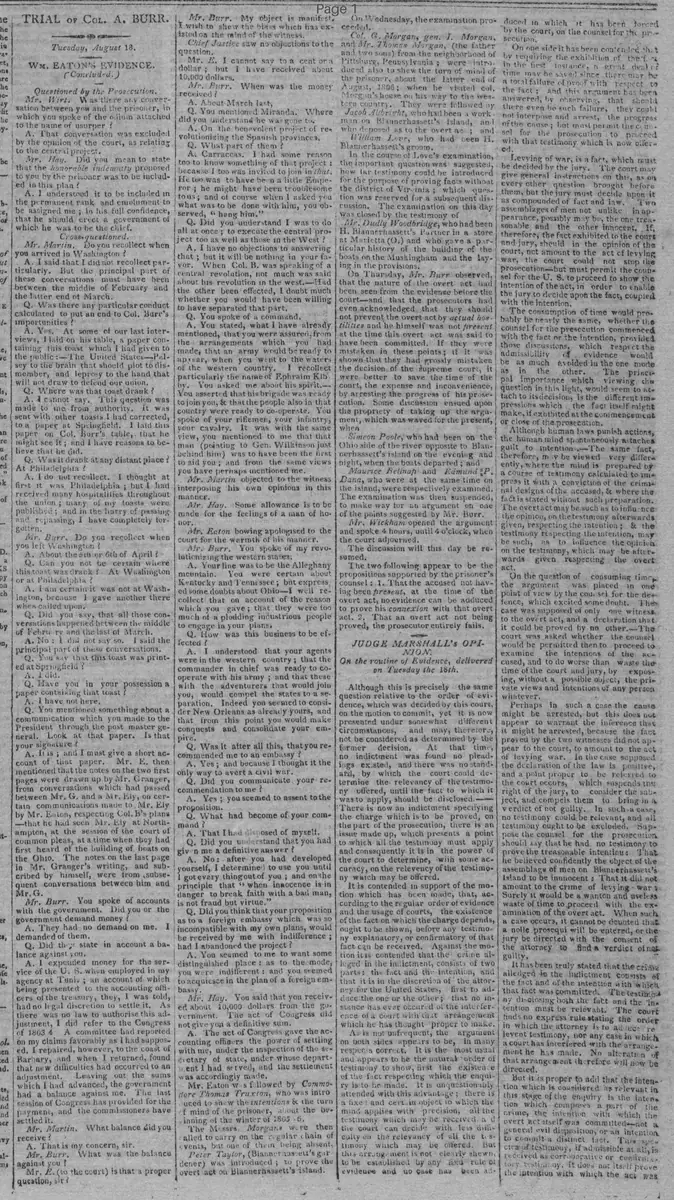
Tuesday, August 18.
WM. EATON'S EVIDENCE.
(Concluded.)
Questioned by the Prosecution.
Mr. Wirt. Was there any conversation between you and the prisoner, in which you spoke of the odium attached to the name of usurper?
A. That conversation was excluded by the opinion of the court, as relating to the central project.
Mr. Hay. Did you mean to state that the honorable indemnity proposed to you by the prisoner was to be included in this plan?
A. I understood it to be included in the permanent rank and emolument to be assigned me; in his full confidence, that he should erect a government of which he was to be the chief.
Cross-questioned.
Mr. Martin. Do you recollect when you arrived in Washington?
A. I said that I did not recollect particularly. But the principal part of these conversations must have been between the middle of February and the latter end of March.
Q. Was there any particular conduct calculated to put an end to Col. Burr's importunities?
A. Yes. At some of our last interviews, I laid on his table, a paper containing this toast which I had given to the public: - The United States - palsy to the brain that should plot to dismember, and leprosy to the hand that will not draw to defend our union.
Q. Where was that toast drank?
A. I cannot say. This question was made to me from authority. It was sent with other toasts I had corrected, to a paper at Springfield. I laid this paper on Col. Burr's table, that he might see it: and I have reasons to believe that he did.
Q. Was it drank at any distant place? At Philadelphia?
A. I do not recollect. I thought at first it was Philadelphia: but I had received many hospitalities throughout the union; many of my toasts were published; and in the hurry of passing and repassing, I have completely forgotten.
Mr. Burr. Do you recollect when you left Washington?
A. About the 5th or 6th of April?
Q. Can you not be certain where this toast was drank? At Washington or at Philadelphia?
A. I am certain it was not at Washington, because I gave another there when called upon.
Q. Did you say, that all those conversations happened between the middle of February and the last of March.
A. No: I did not say so. I said the principal part of these conversations.
Q. You say that this toast was printed at Springfield?
A. I did.
Q. Have you in your possession a paper containing that toast?
A. I have not here.
Q. You mentioned something about a communication which you made to the President through the post master general. Look at that paper. Is that your signature
A. It is; and I must give a short account of that paper. Mr. E. then mentioned that the notes on the two first pages were drawn up by Mr. Granger, from conversations which had passed between Mr. G. and a Mr. Ely, on certain communications made to Mr. Ely by Mr. Eaton, respecting Col. B's plans - that he had seen Mr. Ely at Northampton, at the session of the court of common pleas, at a time when they had first heard of the building of boats on the Ohio. The notes on the last page in Mr. Granger's writing, and subscribed by himself, were from subsequent conversations between him and Mr. G.
Mr. Burr. You spoke of accounts with the government. Did you or the government demand money?
A. They had no demand on me. I demanded of them,
Q. Did they state in account a balance against you.
A. I expended money for the service of the U. S. when employed in my agency at Tunis; an account of which being presented to the accounting officers of the treasury, they, I was told, had no legal discretion to settle it. As there was no law to authorise this adjustment, I did refer to the Congress of 1803-4. A committee had reported on my claims favorably as I had supposed. I repaired, however, to the coast of Barbary, and when I returned, found that new difficulties had occurred to an adjustment. Leaving out the sums which I had advanced, the government had a balance against me. The last session of Congress has provided for the payment, and the commissioners have settled it.
Mr. Martin. What balance did you receive?
A. That is my concern, sir.
Mr. Burr. What was the balance against you?
Mr. E. (to the court) is that a proper question, sir?
Mr. Burr. My object is manifest. I wish to shew the bias which has existed on the mind of the witness.
Chief Justice saw no objections to the question.
Mr. E. I cannot say to a cent or a dollar: but I have received about 10,000 dollars.
Mr. Burr. When was the money received?
A. About March last,
Q. You mentioned Miranda. Where did you understand he was gone to.
A. On the benevolent project of revolutionizing the Spanish provinces.
Q. What part of them?
A. Carraccas. I had some reason too to know something of that project: because I too was invited to join in that. He too was to have been a little Emperor; he might have been troublesome to us: and of course when I asked you what was to be done with him, you observed, "hang him."
Q. Did you understand I was to do all at once; to execute the central project too as well as those in the West?
A. I have no objections to answering that: but it will be nothing in your favor. When Col. B. was speaking of a central revolution, not much was said about his revolution in the west. - Had the other been effected, I doubt much whether you would have been willing to have separated that part.
Q. You spoke of a command,
A. You stated, what I have already mentioned, that you were assured, from the arrangements which you had made, that an army would be ready to appear, when you went to the waters of the western country. I recollect particularly the name of Ephraim Kibby. You asked me about his spirit, - You asserted that his brigade was ready to join you, & that the people also in that country were ready to co-operate. You spoke of your riflemen, your infantry, your cavalry. It was with the same view, you mentioned to me that that man (pointing to Gen. Wilkinson just behind him) was to have been the first to aid you; and from the same views you have perhaps mentioned me.
Mr. Martin objected to the witness interposing his own opinions in this manner.
Mr. Hay. Some allowance is to be made for the feelings of a man of honor.
Mr. Eaton bowing apologised to the court for the warmth of his manner.
Mr. Burr. You spoke of my revolution in the western states.
A. Your line was to be the Alleghany mountain. You were certain about Kentucky and Tennessee; but expressed some doubts about Ohio - I well recollect that on account of the reason which you gave; that they were too much of a plodding industrious people to engage in your plans.
Q. How was this business to be effected?
A. I understood that your agents were in the western country: that the commander in chief was ready to co-operate with his army; and that these with the adventurers that would join you, would compel the states to a separation. Indeed you seemed to consider New Orleans as already yours, and that from this point you would make conquests and consolidate your empire.
Q. Was it after all this, that you recommended me to an embassy?
A. Yes: and because I thought it the only way to avert a civil war.
Q. Did you communicate your recommendation to me?
A. Yes; you seemed to assent to the proposition.
Q. What had become of your command?
A. That I had disposed of myself.
Q. Did you understand that you had given me a definitive answer?
A. No: after you had developed yourself, I determined to use you until I got every thing out of you; and on the principle that "when innocence is in danger to break faith with a bad man, is not fraud but virtue."
Q. Did you think that your proposition as to a foreign embassy which was so incompatible with my own plans, would be received by me with indifference; had I abandoned the project?
A. You seemed to me to want some distinguished place: as to the mode, you were indifferent: and you seemed to acquiesce in the plan of a foreign embassy.
Mr. Hay. You said that you received about 10,000 dollars from the government. The act of Congress did not give you a definitive sum.
A. The act of Congress gave the accounting officers the power of settling with me, under the inspection of the secretary of state, under whose department I had served, and the settlement was accordingly made.
Mr. Eaton was followed by Commodore Thomas Truxton, who was introduced to shew the intentions & the turn of mind of the prisoner, about the beginning of the winter of 1805-6.
The Messrs. Morgans were then called to carry on the regular chain of events, but one of them being absent. Peter Taylor, (Blannerhassett's gardener) was introduced; to prove the overt act on Blannerhassett's island.
On Wednesday, the examination proceeded.
Col. G. Morgan, gen. J. Morgan. and Mr. Thomas Morgan. (the father and two sons) from the neighborhood of Pittsburgh, Pennsylvania; were introduced also to shew the turn of mind of the prisoner, about the latter end of August, 1806; when he visited col. Morgan's house on his way to the western country. They were followed by Jacob Albright, who had been a workman on Blannerhassett's island, and who deposed as to the overt act; and William Love, who had been H. Blannerhassett's groom.
In the course of Love's examination, the important question was suggested, how far testimony could be introduced for the purpose of proving facts without the district of Virginia: which question was reserved for a subsequent discussion. The examination on this day was closed by the testimony of Mr. Dudley Woodbridge, who had been H. Blannerhassett's Partner in a store at Marietta (O.) and who gave a particular history of the building of the boats on the Muskingum and the laying in the provisions.
On Thursday, Mr. Burr observed, that the nature of the overt act had been seen from the evidence before the court - and that the prosecutors had even acknowledged that they should not prevent the overt act by actual hostilities and he himself was not present at the time this overt act was said to have been committed. If they were mistaken in these points; if it was shown that they had grossly mistaken the decision of the supreme court, it were better to save the time of the court, the expense and inconvenience, by arresting the progress of his prosecution. Some discussion ensued upon the propriety of taking up the argument, which was waived for the present, when Simeon Poole, who had been on the Ohio side of the river opposite to Blannerhassett's island on the evening and night, when the boats departed; and Maurice Bellman and Edmund P. Dana, who were at the same time on the island, were respectively examined.
The examination was then suspended, to make way for an argument on one of the points suggested by Mr. Burr.
Mr. Wickham opened the argument and spoke 4 hours, until 4 o'clock, when the court adjourned.
The discussion will this day be resumed.
The two following appear to be the propositions supported by the prisoner's counsel: 1. That the accused not having been present, at the time of the overt act, no evidence can be adduced to prove his connexion with that overt act. 2. That an overt act not being proved, the prosecutor entirely fails.
JUDGE MARSHALL's OPINION.
On the routine of Evidence, delivered on Tuesday the 18th.
Although this is precisely the same question relative to the order of evidence, which was decided by this court, on the motion to commit, yet it is now presented under somewhat different circumstances, and may, therefore, not be considered as determined by the former decision. At that time. no indictment was found no pleadings existed, and there was no standard, by which the court could determine the relevancy of the testimony offered, until the fact to which it was to apply, should be disclosed. - There is now an indictment specifying the charge which is to be proved, on the part of the prosecution, there is an issue made up, which presents a point to which all the testimony must apply and consequently it is in the power of the court to determine, with some accuracy, on the relevency of the testimony which may be offered.
It is contended in support of the motion which has been made, that, according to the regular order of evidence and the usage of courts, the existence of the fact on which the charge depends, ought to be shown, before any testimony explanatory, or confirmatory of that fact can be received. Against the motion it is contended that the crime alleged in the indictment, consists of two parts: the fact and the intention, and that it is in the discretion of the attorney for the United States, first to adduce the one or the other; that no instance has ever occured of the interference of a court with that arrangement which he has thought proper to make.
As is not unfrequent, the argument on both sides appears to be, in many respects correct. It is the most usual and appears to be the natural order of testimony to show, first the existence of the fact respecting which the enquiry is to be made. It is unquestionably attended with this advantage; there is a fixed and certain object to which the mind applies with precision, all the testimony which may be received. and the court can decide with less difficulty on the relevancy of all the testimony which may be offered. But this argument is not clearly shewn, to be established by any fixed rule of evidence and no Case has been adduced in which it has been forced by the court, on the counsel for the prosecution.
On one side it has been contended that by requiring the exhibition of the fact in the first instance. a great deal of time may be saved since there may be a total failure of proof with respect to the fact; and this argument has been answered, by observing, that should there even be such failure, they could not interpose and arrest, the progress of the cause: but must permit the counsel for the prosecution to proceed with that testimony which is now offered.
Levying of war, is a fact. which must be decided by the jury. The court may give general instructions on this, as on every other question brought before themn, but the jury must decide upon it as compounded of fact and law. Two assemblages of men not unlike in appearance, possibly may be, the one treasonable and the other innocent. If. therefore, the fact exhibited to the court and jury, should in the opinion of the court, not amount to the act of levying war, the court could not stop the prosecution - but must permit the counsel for the U. S. to proceed to show the intention of the act, in order to enable the jury to decide upon the fact, coupled with the intention.
The consumption of time would probably be nearly the same, whether the counsel for the prosecution commenced with the fact or the intention, provided those discussions. which respect the admissibility of evidence would be as much avoided in the one mode as in the other. The principal importance which viewing this question in this light, would seem to attach to its decision, is the different impressions which the fact itself might make, if exhibited at the commencement or close of the prosecution.
Although human laws punish actions. the human mind spontaneously attaches guilt to intention - The same fact, therefore, may be viewed very differently, where the mind is prepared by a course of testimony calculated to impress it with a conviction of the criminal designs of the accused, & where the fact is stated without such preparation.
The overt act may be such as to influence the opinion, on the testimony afterwards given, respecting the intention; & the testimony respecting the intention, may be such, as to influence the opinion on the testimony, which may be afterwards given respecting the overt act.
On the question of consuming time the argument was placed in one point of view by the counsel for the defence. which excited some doubt. The case was supposed of only one witness to the overt act, and a declaration that. it could be proved by no other. - The court was asked whether the counsel would be permitted then to proceed to examine the intentions of the accused, and to do worse than waste the time of the court and jury, by exposing, without a possible object, the private views and intentions of any person whatever.
Perhaps in such a case the cause might be arrested, but this does not appear to warrant the inference that it might be arrested, because the fact proved by the two witnesses did not appear to the court, to amount to the act of levying war. In the case supposed the declaration of the law is positive, and a point proper to be referred to the court occurs, which suspends the right of the jury, to consider the subject, and compels them to bring in a verdict of not guilty. In such a case, no testimony could be relevant, and all testimony ought to be excluded. Suppose the counsel for the prosecution should say that he had no testimony to prove the treasonable intention: That he believed confidently the object of the assemblage of men on Blannerhassett's Island to be innocent: That it did not amount to the crime of levying war Surely it would be a wanton and useless waste of time to proceed with the examination of the overt act. When such a case occurs, it cannot be doubted that a nolle prosequi will be entered, or the jury be directed with the consent of the attorney to find a verdict of not guilty.
It has been truly stated that the crime alleged in the indictment consists of the fact and of the intention with which that fact was committed. The testimony disclosing both the fact and the intention must be relevant. The court finds no express rule stating the order in which the attorney is to adduce relevant testimony, nor any case in which a court has interfered with the arrangement he has made. No alteration of that arrangement therefore will now be directed.
But it is proper to add that the intention which is considered as relevant in this stage of the enquiry is the intention which composes a part of the crime, the intention with which the overt act itself was committed - not a general evil disposition, or an intention to commit a distinct fact. This species of testimony, if admissible at all is received as corroborative or confirmatory testimony. it does not itself prove the intention with which the act was
Performed, but it renders other testimony probably which goes to that intention. It is explanatory of or assistant to that other testimony. Now it is essentially repugnant to the usages of courts, to the declarations of the books by whose authority such testimony is received, that corroborative or confirmatory testimony should precede that which it is to corroborate or confirm. Until the introductory testimony be given, that which is merely corroborative is not relevant, and of consequence, if objected to, cannot be admitted without violating the best settled rules of evidence.
This position may be illustrated by a direct application to the testimony of Gen. Eaton. So far as his testimony relates to the fact charged in the indictment, so far as it relates to levying war on Blennerhassett's island, so far as it relates to a design to seize on New Orleans, or to separate by force the West from the Atlantic states, it is deemed relevant and is now admissible.—So far as it respects other plans to be executed in the city of Washington or elsewhere, if it indicates a treasonable design, it is a design to commit a distinct act of treason. and is therefore not relevant to the present indictment. It can only by showing a general evil intention render it more probable that the intention in the particular case was evil; it is merely additional or corroborative testimony. and therefore if admissible at any time. is only admissible according to rules and principles which the court must respect, after hearing that which it is to confirm. etc.
The counsel will perceive how many questions respecting the relevancy of testimony, the arrangement proposed on the part of the prosecution will most probably produce. He is however, at liberty to proceed according to his own judgment, and the court feel itself bound to exclude such testimony only, as at the time of its being offered, does not appear to be relevant.
Thursday, August 13.
Sketch of the arguments on the qualifications of an impartial jury (concluded.)
Mr. Wirt said, it were to be wished that in this case, a jury could be got of such pure materials as Mr. Martin desired— whose minds were as pure as the unsoiled snow on Diana's lap. But does experience justify such a hope ?— The case does not exist, and the law does not require it. Mr. Martin's authorities are elementary ; they are abstract ; and not precisely applicable to points of practice. "They are general phrases : they deal only in generals— but were these books even to be trusted —and did not their generality exclude them from familiar use ; we will find that when they specify, they express a particular reference to the person of the accused. To show that these elementary principles are not completely paramount in the English courts, he would refer to Tooke's Case, 9 D. Any enmity, and familiarity, is in Reeves a sufficient cause for rejection : but in Tooke's trial, Mr. Thompson's intimacy with Mr. T. for 34 years was said by the judge to be no good ground of exception. But let us select another case in our own country. It is important that the rules of law should not be continually shifting on the waves of uncertainty, in order that a man may know how to steer his course. Well, now what says the case of Callender in a particular point ? When Mr. John Bassett had objected to himself, because he had already made up his mind on the point of libel, he was overruled. But turn to the English laws of libel and what is the principal point there ? Is it who is the author? Is it on that point that the brightest beams of eloquence are shed? No. But it is on the question whether it is a libel or not. Then in the language of Mr. Botts, Was not Callender cut off from inure than half his defence? Let us draw an analogy between the two cases. These jurymen might have said, that the assemblage of men on Blennerhassett's island was high treason : but they know not whether Col. B. was there. Here this case and that of Callender would be strikingly parallel. In both cases, the great facts would be fixed in the mind of the juror— and the only thing that would remain, would be to trace them up to the individual accused. But the present case falls far short of that. These jurymen say, that from newspaper publications they have taken up some impression, as to Burr's treasonable intentions ; but not one of them says, that the meeting on Blennerhassett's island was an act of treason. —In another point Callender's case was a stronger one than this. It was ridiculous for J. T. Callender to have attempted to counteract the conviction, that lay against his crime. Mr. Bassett's opinion was formed upon the book itself— and there was no other evidence to produce. But in this case, jurymen have seen nothing but the evidence in the newspapers; and they say there is conflicting evidence as to the fact of treason. If then you would strip Col. B. of half his defence because a juryman has made up half of his mind how much more was J. T. Callender stript of his ! The kind of jury that Mr. Martin contends for, is impossible to be obtained from the very nature of things, Necessity has often given the law in other cases ; and perhaps it must in this — This is not the only case, where a partially impartial, jury may must have decided in favor ten some of the plainest lack he T lish kbe Jinng of 27is and 6 aa5when the qrifhe P.nee pn h heuse of ur wesn warmivited— Che m yazurs weretieg with it; itl. rannd rrkniomnimn- a. mon 3e tb- puimmn not a4 ly viay t-jongh: sor nt; aud thit i s til kmg om, that 'the very
clang and the din of the battle of Culloden rung to the other confines of the country. Is this a case in which an impartial jury could have been expected? And yet the rebels were tried by British jurors ; tried by jurors, who had been perhaps arrayed in battle against them. Perhaps those who fought for the monarch in the fields of Culloden, were the very men who decided on the trials for treason.' Mr. Martin's rule is a good rule, when it furnishes in the mind of a good man ; it is a good rule for Utopia and Arabia happy ; and look to the trials of '98 in Ireland; when men who had fought at the battle of Wexford; when men at the very focus of public illumination were to sit on the trial of Archibald Hamilton Rowan, Could such men have gone into the jury box as if they had never seen the books on which these charges had been predicated: as if they had been men dropt from another planet? From the plains of Culloden and Wexford, from London and Dublin let us come back to our own thresholds. He who could peruse the public prints of North America, for the last 12 months with adamantine indifference ; he who could read the depositions of Eaton and Wilkinson without some interest ;— Cannot be a man. No man could do it that has a soul, that can grace the bosom of a man. I appeal to the bench, whether there is that base frigidity of character in the inhabitants of North America. Look at this very panel; have they taken no impressions ?—Mr. Wirt embraced a variety of other points, which our limits do not permit us to detail ; and in a strain of eloquence, which it is impossible for us to transfuse.
Mr. Wickham observed, that the remarks of the gentleman last up, reminded him, of a Roman Epigram on a lady, who was so completely covered by the decorations which enveloped her, that she was the least part of herself. it was precisely so with the gentleman's arguments It was so perfectly enveloped in figures and graces, that the argument constituted the least part of itself ; and it was only by lifting a flounce here and a furbelow there, that you could catch a glimpse of it. The gentleman has hurried us to England. and to the battle of Culloden, with as much ease as if he had waved the wand of a magician He has compared. the judicial decisions in that country at the period of the rebellion with the case now agitated before this court ; without having attended to the natural points of distinction between them." Every man in England could reason upon the cause of the Pretender. The basis of this decision was a chain of historical facts, recorded in books. which reason could appreciate and prejudice could not distort. Such a case would have been precisely similar to the one now before the court, had this too been founded on the annals of history or on matters of fact. Had it been established that gun boats had descended the Ohio; that Col. B. had had several engagements with Gen. Wilkinson ; and had then been brought before this court for trial; the jury would have decided upon these facts, and not upon their own prepossessions. But where are the established facts in this case ! The President has declared that of his guilt there can be no doubt. Yet the President is but a man and liable to deception. General Wilkinson too is a witness; but his credibility may be hereafter impeached; and the supreme court has already decided that his testimony is not relative to the charge of treason. This whole tale then resolves itself into Gen.-Eaton's deposition; of which though we may not be disposed to say it is untrue, we may at least assert that it is marvellous. Is this accusation then founded on historical facts is there a single document to support it? No-not one. How then can the gentleman pretend to institute a parallel between this Case, and the case of the rebellions of England? If it be no disqualification for one juryman to have entertained an opinion of Col. B's treasonable intentions, it Can be no disqualification for 12 of them. What then would be the situation of his counsel ? The jury are impannelled : their minds made up as to the treasonable designs of Col. B. With what attitude could his counsel stand before such men to vindicate his innocence— Would they pretend to operate upon marble ?—They might as well at once abandon the cause of their client - These impressions too, respecting Col. B's intentions would directly contribute to influence their judgments as to the overt acts said to have been committed. These impressions do directly bear upon the overt act : because the intention is the first step towards the act itself, and renders it more probable that that act will be committed. What is most probable is soonest believed to be most likely to happen; and the man whose judgment is therefore made up as to the intentions of Col. B. cannot be said to be impartial on any one point in the cause. Let the case be supposed of six jury men whose mind is decided as to the intentions ; and six others as to the overt act. How could the counsel pretend to address them on either of those points? If they wished to argue on one of them, they must abandon it ; be- Cause six of the jury are adamant : If they turned to the other, they would have with equal prejudice and equal resistance.-it was like the case of the A Gia and the Nun, recorded in Tristram Shandy : where It would be a sin for either of them to pronounce a certain word entire ; but by splitting it in two pieces, they completely Pe moved all the sin of the transaction. One of wer. could then articulate the Bou, orn Jee oher the ger. ntn Callender'sCase, had Mr. Bass- sect coer luded that Callender was the
author of the libel? Had he decided upon his intentions ? Or upon the guilt of publishing it? No.-Did the counsel who appeared for him pretend to deny that it was a libel ; or did they not rather voluntarily step forward for the sake of disputing the constitutionality of the law and the authority of the court under which he was arraigned? Did Mr. Randolph himself, in the House of Representatives, deny that it was a libel? And let it be recollected, that this very decision of Judge Chase was overruled in the Senate of the U. S. by a majority of 18 to 16? And yet Mr. Hay has now quoted it as law.
Mr. W. then expatiated upon Mr. Hay's definition of an impartial jury-man. If the sense of the majority of any country was to be considered as the criterion of impartiality and truth. What a vast saving of trouble would result from this new principle. Instead of a student's poring over the black letter in his own closet, in search of principles and tests ; he need only go about to this barbecue and that horse-race, to take the common sense of mankind. A lawyer would perhaps consult his M Nally, or his Reeves: but Mr. Hay would go about collecting the sense of the nation. Is there then to be an article nominal, as there has been in France, when the French people were asked " are you for Napoleon being king of the French?" Put this argument proves too much. Were. a man to declare colonel Burr guilty not only of a treasonable intent, but of a treasonable act, could he be considered as an impartial jury man, be- Cause he happened to coincide with the public opinion ?. It is in fact impossible to know what that opinion is. (Opinions are continually fluctuating : What is law under the administration of John Adams, is not so under the administration of Mr. Jefferson.
Mr. Wirt has found fault with elementary writings, and asserts that they are not always the tests of truth. It is true that they are not always so: but they are most generally so considered Some elementary books, such as Lord Coke's, are of inestimable value.As to the variation which Mr. Wirt has pointed out between one of these elementary principles of Reeves and the court's decision in the Case of Horne Tooke, a reference to the report of that trial would clearly shew that this case had not been accurately represented to this court. Thompson, the juryman, was not in court; he had exercised the discretion of absenting himself, and it was said by way of excuse, that he had been long and intimately acquainted with the defendant. it was to this point that the judge spoke, when he said that it was no excuse. No excuse for what? Not from serving on the jury, but for not attending the court,
Mr. Wirt here interrupted Mr. W. and submitted it to every Candid mind which had most candidly stated the passage. Mr. Wirt then read it and commented at some length. A long and desultory conversation occurred on this point ; after which Mr. Wickham observed, that he had but one more remark to offer : that he had come here to try the defendant on the law and on the fact, and not on public rumor-but that this trial would be nothing but mockery. if it were to be submitted to the decision of a prejudiced jury. Why did the framers of our constitution attempt to secure the privilege of an impartial jury ? Was it not known to them, that the period would at length arrive, when some individual would be marked out as the victim of popular and political jealousy? And was it not from such a case, that the constitution had originally forbid the legislature to change the law of treason— and that a subsequent amendment was introduced, still further to fortify and to secure the privileges of the accused?
Mr. E. Randolph (at the request of the court) read Judge Chase's answer to the article of the indictment, which arraigns his decision in the case of Mr. Bassett: Mr R. then observed that: he had not intended to have interfered in this discussion: because he expected that the objections which would be offered to have been made to particular individuals only ; but he had since seen, that a more serious blow was meditated at the whole system of jury trial Whether Heaven or accident had given us this illustrious boon ; it was certainly our most solemn duty to preserve it pure and perfect. Vain would be all this parade, if a judge would calmly sit upon the bench,and connive at its violation If the courts do not defend this right, could it be truly said that any man was safe in his own habitation !Mr. R. said that some analogies had been stated between the present and other cases. Other gentlemen had introduced Burglary and Murder; and to this catalogue he would add the crime of uttering false money. knowing it to be false. If a juror should assert that he knew not whether the accused passed the money ; but that he was certain he must have known it to be false; there could be no doubt of his being a biased and incompetent juryman Mr. R. expatiated at some length upon the case of Tooke, and upon the authorities quoted from Hawkins; and attempted to shew that Hawkins had contradicted and confuted himself; that instead of advocating the pure and more liberal doctrines of his own day on the subject of juries, he had appealed to the reign of the Tudors. where not a spark of liberty existed He concluded by solemnly conjuring the court to lervr the Divtleges ot the jury t, ial free from violation, he would apt :! tht clune of human natore; he cculd alnol appeal to Mr. Hay's
What sub-type of article is it?
What themes does it cover?
What keywords are associated?
What entities or persons were involved?
Where did it happen?
Story Details
Key Persons
Location
Richmond, Virginia; Blennerhassett's Island; Pittsburgh, Pennsylvania; Marietta, Ohio; Washington
Event Date
Tuesday, August 18; Thursday, August 13; Winter Of 1805 6; Latter End Of August, 1806
Story Details
Proceedings of Aaron Burr's treason trial include William Eaton's cross-examination on Burr's alleged plots to separate western states and seize New Orleans, witness testimonies on overt acts like boat-building on Blennerhassett's Island, arguments on evidence order and jury impartiality, and Chief Justice Marshall's opinion permitting intent testimony before proving the overt act.