Thank you for visiting SNEWPapers!
Sign up free
Vermont Phœnix
Brattleboro, Bellows Falls, Ludlow, Windham County, Windsor County, Vermont
What is this article about?
South Carolina declared itself independent from the Union on December 20, 1860, via secession ordinance, but the article dismisses its impact, citing historical precedents like the 1832 nullification crisis and asserting the Union's indivisibility.
Clipping
OCR Quality
Full Text
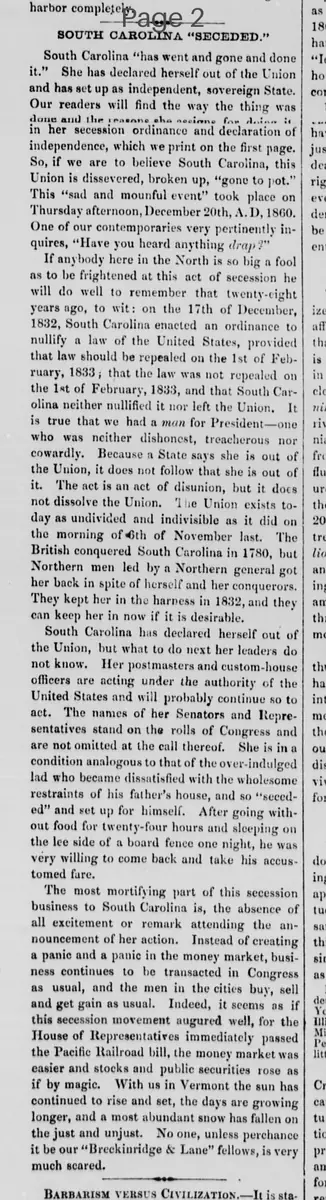
South Carolina "has went and gone and done it." She has declared herself out of the Union and has set up as independent, sovereign State.
Our readers will find the way the thing was done and the reasons she assigns for doing it in her secession ordinance and declaration of independence, which we print on the first page.
So, if we are to believe South Carolina, this Union is dissevered, broken up, "gone to pot."
This "sad and mournful event" took place on Thursday afternoon, December 20th, A.D, 1860.
One of our contemporaries very pertinently inquires, "Have you heard anything drop?"
If anybody here in the North is so big a fool as to be frightened at this act of secession he will do well to remember that twenty-eight years ago, to wit: on the 17th of December 1832, South Carolina enacted an ordinance to nullify a law of the United States, provided that law should be repealed on the 1st of February, 1833; that the law was not repealed on the 1st of February, 1833, and that South Carolina neither nullified it nor left the Union. It is true that we had a man for President—one who was neither dishonest, treacherous nor cowardly. Because a State says she is out of the Union, it does not follow that she is out of it. The act is an act of disunion, but it does not dissolve the Union. The Union exists today as undivided and indivisible as it did on the morning of 6th of November last. The British conquered South Carolina in 1780, but Northern men led by a Northern general got her back in spite of herself and her conquerors. They kept her in the harness in 1832, and they can keep her in now if it is desirable.
South Carolina has declared herself out of the Union, but what to do next her leaders do not know. Her postmasters and custom-house officers are acting under the authority of the United States and will probably continue so to act. The names of her Senators and Representatives stand on the rolls of Congress and are not omitted at the call thereof. She is in a condition analogous to that of the over-indulged lad who became dissatisfied with the wholesome restraints of his father's house, and so "seceded" and set up for himself. After going without food for twenty-four hours and sleeping on the lee side of a board fence one night, he was very willing to come back and take his accustomed fare.
The most mortifying part of this secession business to South Carolina is, the absence of all excitement or remark attending the announcement of her action. Instead of creating a panic and a panic in the money market, business continues to be transacted in Congress as usual, and the men in the cities buy, sell and get gain as usual. Indeed, it seems as if this secession movement augured well, for the House of Representatives immediately passed the Pacific Railroad bill, the money market was easier and stocks and public securities rose as if by magic. With us in Vermont the sun has continued to rise and set, the days are growing longer, and a most abundant snow has fallen on the just and unjust. No one, unless perchance it be our "Breckinridge & Lane" fellows, is very much scared.
What sub-type of article is it?
What keywords are associated?
Where did it happen?
Domestic News Details
Primary Location
South Carolina
Event Date
Thursday Afternoon, December 20th, A.D, 1860
Outcome
south carolina declared independence but federal operations continue unchanged; no immediate panic or disruption reported; union asserted to remain intact.
Event Details
South Carolina passed a secession ordinance and declaration of independence, setting up as an independent sovereign state; the article prints the document on the first page and downplays the event's significance, referencing the 1832 nullification crisis and historical precedents.