Thank you for visiting SNEWPapers!
Sign up free
Literary
March 7, 1799
Gazette Of The United States, & Philadelphia Daily Advertiser
Philadelphia, Philadelphia County, Pennsylvania
What is this article about?
A letter signed 'A.B.' to Mr. Fenno critiques the style and merit of a sermon by the President of the College of New-Jersey on 'The Dangers of Pleasure.' It quotes the sermon's conclusion advocating moderation in pleasures, reflections on life, death, and duty, followed by commentary explaining biblical imagery from Ecclesiastes 12.
Clipping
OCR Quality
98%
Excellent
Full Text
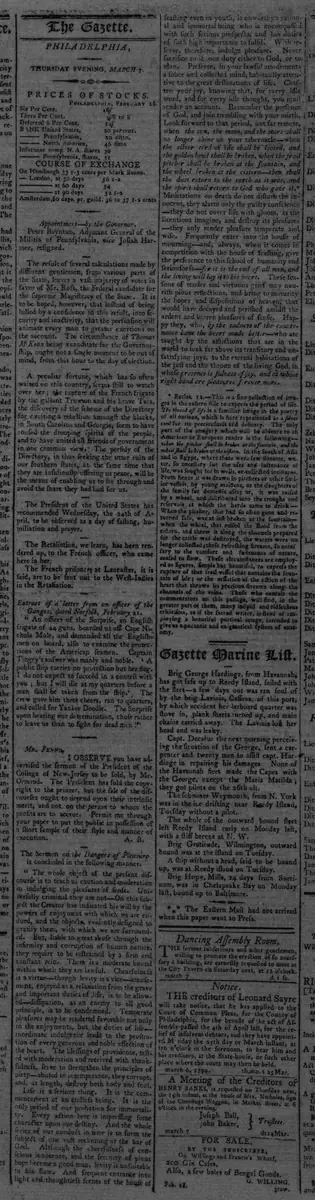
MR. FENNO,
I OBSERVE you have advertised the sermon of the President of the College of New-Jersey to be sold, by Mr. Ormrod. The President has sold the copyright to the printer, but the sale of the discourses ought to depend upon their intrinsic merit, and not on the person to whom the profits are to accrue. Permit me through your paper to put the public in possession of a short sample of their style and manner of execution.
A. B.
The Sermon on the Dangers of Pleasure is concluded in the following manner.
'The whole object of the present discourse is to teach us caution and moderation in indulging the pleasures of sense. Universally criminal they are not—On this subject the Creator has indicated his will by the powers of enjoyment with which we are endowed, and the objects, evidently designed to gratify them, with which we are surrounded. But, liable to great abuse through the infirmity and corruption of human nature, they require to be restrained by a firm and constant rein. There is a moderate bound within which they are lawful. Cheerfulness is a virtue—though levity is a vice—amusement, enjoyed as a relaxation from the grave and important duties of life, is to be allowed—dissipation, as an enemy to all good principle, is to be condemned. Temperate pleasures may be rendered favorable not only to the enjoyments, but the duties of life—inordinate indulgence leads to the prostration of every generous and noble affection of the heart. The blessings of providence, tasted with moderation and received with thankfulness, serve to strengthen the principles of piety—abused to intemperance, they corrupt, and, at length, destroy both body and soul.
Life is a serious thing. It is the commencement of an endless being. It is the only period of our probation for immortality. Every action here is impressing some character upon our destiny. And the whole series of our conduct in time is to form the subject of one vast reckoning at the bar of God. Although the cheerfulness of conscious innocence, and the serenity of pious hope become a good man, levity is unsuitable to his state. And frequent entrance into light and thoughtless scenes of the house of feasting even in youth, is unworthy a rational and immortal being who is encompassed with such serious prospects and has duties of such high importance to fulfil. With reserve, therefore, indulge pleasure. Never sacrifice to it one duty either to God, or to man. Preserve, in your lawful amusements a sober and collected mind, habitually attentive to the great destinies of life. Chastise your joy, knowing that, for every idle word, and for every idle thought, you must render an account. Remember the presence of God, and join trembling with your mirth. Look forward to that period, not far remote, when the sun, the moon, and the stars shall no longer shine on your tabernacle—when the silver cord of life shall be loosed, and the golden bowl shall be broken, when the frail pitcher shall be broken at the fountain, and the wheel broken at the cistern—then shall the dust return to the earth as it was, and the spirit shall return to God who gave it.*
Meditations on death do not disturb the innocent, they alarm only the guilty conscience—they do not cover life with gloom, as the licentious imagine, and destroy its pleasures—they only render pleasure temperate and wise. Frequently enter into the house of mourning and, always, when it comes in competition with the house of feasting, give the preference to this school of humanity and seriousness—for it is the end of all men, and the living will lay it to his heart. These seasons of tender and virtuous grief may nourish pious reflections, and bring to maturity the hopes and dispositions of heaven, that would have decayed and perished amidst the ardent and barren pleasures of sense. Happy they, who, by the sadness of the countenance have the heart made better—who are taught by the afflictions that are in the world to look far above its transitory and unsatisfactory joys, to the eternal habitations of the just and the throne of the living God, in whose presence is fulness of joy, and at whose right hand are pleasures for ever more.
Eccles. 12. This is a fine collection of images in the eastern style to express the period of life. The thread of life is a familiar image in the poetry of all nations, which is here represented as a silver cord for its preciousness and delicacy. The only part of the imagery which will be obscure to an American or European reader is the following—when the pitcher shall be broken at the fountain, and the wheel broken at the cistern. In the south of Asia and in Egypt, where there were few streams, water, so necessary for the use and sustenance of life, was sought for in wells, or—collected in cisterns. From hence it was drawn in pitchers or other similar vessels, by young maidens, or the daughters of the family for domestic uses; or, it was raised by a wheel, and distributed into the troughs and reservoirs at which the herds came to drink—When the pitcher, that had so often gone and returned safe, was at last broken at the fountain—when the wheel, that raised the flood from the cistern, and threw it along the channels prepared for the cattle was destroyed, the waters were no longer collected; these refreshing streams, so necessary to the comfort and sustenance of nature, ceased to flow. These circumstances are employed as figures, simple but beautiful, to express the rupture of that frail vessel that contains the fountain of life or the cessation of the action of the heart that throws its precious streams along the channels of the veins. Those who consult the commentators on this passage, will find, in the greater part of them, many insipid and ridiculous criticisms, as if the sacred writer, instead of employing a beautiful poetical image, intended to give us a pedantic and enigmatical system of anatomy.'
I OBSERVE you have advertised the sermon of the President of the College of New-Jersey to be sold, by Mr. Ormrod. The President has sold the copyright to the printer, but the sale of the discourses ought to depend upon their intrinsic merit, and not on the person to whom the profits are to accrue. Permit me through your paper to put the public in possession of a short sample of their style and manner of execution.
A. B.
The Sermon on the Dangers of Pleasure is concluded in the following manner.
'The whole object of the present discourse is to teach us caution and moderation in indulging the pleasures of sense. Universally criminal they are not—On this subject the Creator has indicated his will by the powers of enjoyment with which we are endowed, and the objects, evidently designed to gratify them, with which we are surrounded. But, liable to great abuse through the infirmity and corruption of human nature, they require to be restrained by a firm and constant rein. There is a moderate bound within which they are lawful. Cheerfulness is a virtue—though levity is a vice—amusement, enjoyed as a relaxation from the grave and important duties of life, is to be allowed—dissipation, as an enemy to all good principle, is to be condemned. Temperate pleasures may be rendered favorable not only to the enjoyments, but the duties of life—inordinate indulgence leads to the prostration of every generous and noble affection of the heart. The blessings of providence, tasted with moderation and received with thankfulness, serve to strengthen the principles of piety—abused to intemperance, they corrupt, and, at length, destroy both body and soul.
Life is a serious thing. It is the commencement of an endless being. It is the only period of our probation for immortality. Every action here is impressing some character upon our destiny. And the whole series of our conduct in time is to form the subject of one vast reckoning at the bar of God. Although the cheerfulness of conscious innocence, and the serenity of pious hope become a good man, levity is unsuitable to his state. And frequent entrance into light and thoughtless scenes of the house of feasting even in youth, is unworthy a rational and immortal being who is encompassed with such serious prospects and has duties of such high importance to fulfil. With reserve, therefore, indulge pleasure. Never sacrifice to it one duty either to God, or to man. Preserve, in your lawful amusements a sober and collected mind, habitually attentive to the great destinies of life. Chastise your joy, knowing that, for every idle word, and for every idle thought, you must render an account. Remember the presence of God, and join trembling with your mirth. Look forward to that period, not far remote, when the sun, the moon, and the stars shall no longer shine on your tabernacle—when the silver cord of life shall be loosed, and the golden bowl shall be broken, when the frail pitcher shall be broken at the fountain, and the wheel broken at the cistern—then shall the dust return to the earth as it was, and the spirit shall return to God who gave it.*
Meditations on death do not disturb the innocent, they alarm only the guilty conscience—they do not cover life with gloom, as the licentious imagine, and destroy its pleasures—they only render pleasure temperate and wise. Frequently enter into the house of mourning and, always, when it comes in competition with the house of feasting, give the preference to this school of humanity and seriousness—for it is the end of all men, and the living will lay it to his heart. These seasons of tender and virtuous grief may nourish pious reflections, and bring to maturity the hopes and dispositions of heaven, that would have decayed and perished amidst the ardent and barren pleasures of sense. Happy they, who, by the sadness of the countenance have the heart made better—who are taught by the afflictions that are in the world to look far above its transitory and unsatisfactory joys, to the eternal habitations of the just and the throne of the living God, in whose presence is fulness of joy, and at whose right hand are pleasures for ever more.
Eccles. 12. This is a fine collection of images in the eastern style to express the period of life. The thread of life is a familiar image in the poetry of all nations, which is here represented as a silver cord for its preciousness and delicacy. The only part of the imagery which will be obscure to an American or European reader is the following—when the pitcher shall be broken at the fountain, and the wheel broken at the cistern. In the south of Asia and in Egypt, where there were few streams, water, so necessary for the use and sustenance of life, was sought for in wells, or—collected in cisterns. From hence it was drawn in pitchers or other similar vessels, by young maidens, or the daughters of the family for domestic uses; or, it was raised by a wheel, and distributed into the troughs and reservoirs at which the herds came to drink—When the pitcher, that had so often gone and returned safe, was at last broken at the fountain—when the wheel, that raised the flood from the cistern, and threw it along the channels prepared for the cattle was destroyed, the waters were no longer collected; these refreshing streams, so necessary to the comfort and sustenance of nature, ceased to flow. These circumstances are employed as figures, simple but beautiful, to express the rupture of that frail vessel that contains the fountain of life or the cessation of the action of the heart that throws its precious streams along the channels of the veins. Those who consult the commentators on this passage, will find, in the greater part of them, many insipid and ridiculous criticisms, as if the sacred writer, instead of employing a beautiful poetical image, intended to give us a pedantic and enigmatical system of anatomy.'
What sub-type of article is it?
Epistolary
Essay
What themes does it cover?
Religious
Moral Virtue
Death Mortality
What keywords are associated?
Sermon
Pleasures
Moderation
Death
Ecclesiastes
Biblical Imagery
Piety
Immortality
What entities or persons were involved?
A. B.; President Of The College Of New Jersey
Literary Details
Title
The Sermon On The Dangers Of Pleasure
Author
A. B.; President Of The College Of New Jersey
Subject
Critique Of Sermon Style With Excerpt On Moderation In Pleasures And Biblical Commentary
Key Lines
The Whole Object Of The Present Discourse Is To Teach Us Caution And Moderation In Indulging The Pleasures Of Sense.
Life Is A Serious Thing. It Is The Commencement Of An Endless Being.
Meditations On Death Do Not Disturb The Innocent, They Alarm Only The Guilty Conscience.
Eccles. 12. This Is A Fine Collection Of Images In The Eastern Style To Express The Period Of Life.