Thank you for visiting SNEWPapers!
Sign up free
Editorial
November 26, 1880
The Daily Cairo Bulletin
Cairo, Alexander County County, Illinois
What is this article about?
Editorial advocates for Judge Lowell's proposed national bankrupt law bill in Congress, emphasizing its necessity for uniform, efficient handling of bankrupt estates to protect creditors, and improvements over the repealed act by minimizing fees and delays.
Clipping
OCR Quality
98%
Excellent
Full Text
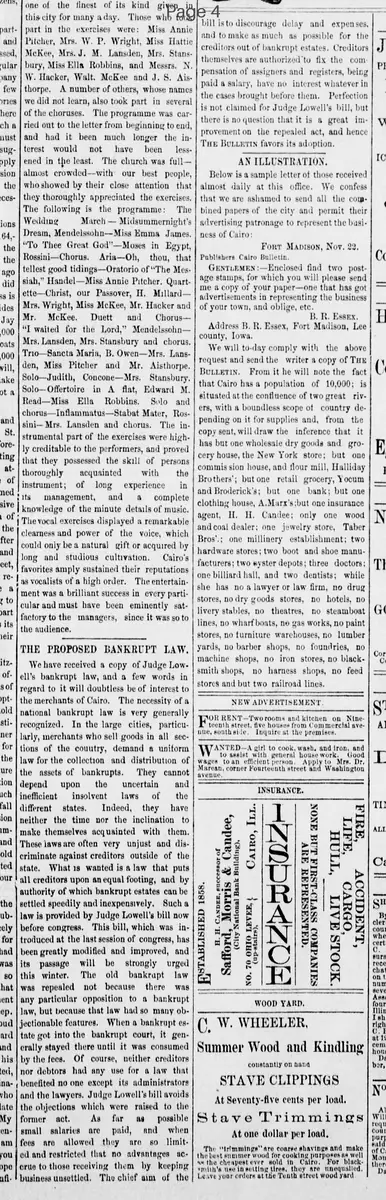
THE PROPOSED BANKRUPT LAW.
We have received a copy of Judge Lowell's bankrupt law, and a few words in regard to it will doubtless be of interest to the merchants of Cairo. The necessity of a national bankrupt law is very generally recognized. In the large cities, particularly, merchants who sell goods in all sections of the country, demand a uniform law for the collection and distribution of the assets of bankrupts. They cannot depend upon the uncertain and inefficient insolvent laws of the different states. Indeed, they have neither the time nor the inclination to make themselves acquainted with them. These laws are often very unjust and discriminate against creditors outside of the state. What is wanted is a law that puts all creditors upon an equal footing, and by authority of which bankrupt estates can be settled speedily and inexpensively. Such a law is provided by Judge Lowell's bill now before congress. This bill, which was introduced at the last session of congress, has been greatly modified and improved, and its passage will be strongly urged this winter. The old bankrupt law was repealed not because there was any particular opposition to a bankrupt law, but because that law had so many objectionable features. When a bankrupt estate got into the bankrupt court, it generally stayed there until it was consumed by the fees. Of course, neither creditors nor debtors had any use for a law that benefited no one except its administrators and the lawyers. Judge Lowell's bill avoids the objections which were raised to the former act. As far as possible small salaries are paid, and when fees are allowed they are so limited and restricted that no advantages accrue to those receiving them by keeping business unsettled. The chief aim of the bill is to discourage delay and expenses, and to make as much as possible for the creditors out of bankrupt estates. Creditors themselves are authorized to fix the compensation of assignees and registers, being paid a salary, have no interest whatever in the cases brought before them. Perfection is not claimed for Judge Lowell's bill, but there is no question that it is a great improvement on the repealed act, and hence The Bulletin favors its adoption.
We have received a copy of Judge Lowell's bankrupt law, and a few words in regard to it will doubtless be of interest to the merchants of Cairo. The necessity of a national bankrupt law is very generally recognized. In the large cities, particularly, merchants who sell goods in all sections of the country, demand a uniform law for the collection and distribution of the assets of bankrupts. They cannot depend upon the uncertain and inefficient insolvent laws of the different states. Indeed, they have neither the time nor the inclination to make themselves acquainted with them. These laws are often very unjust and discriminate against creditors outside of the state. What is wanted is a law that puts all creditors upon an equal footing, and by authority of which bankrupt estates can be settled speedily and inexpensively. Such a law is provided by Judge Lowell's bill now before congress. This bill, which was introduced at the last session of congress, has been greatly modified and improved, and its passage will be strongly urged this winter. The old bankrupt law was repealed not because there was any particular opposition to a bankrupt law, but because that law had so many objectionable features. When a bankrupt estate got into the bankrupt court, it generally stayed there until it was consumed by the fees. Of course, neither creditors nor debtors had any use for a law that benefited no one except its administrators and the lawyers. Judge Lowell's bill avoids the objections which were raised to the former act. As far as possible small salaries are paid, and when fees are allowed they are so limited and restricted that no advantages accrue to those receiving them by keeping business unsettled. The chief aim of the bill is to discourage delay and expenses, and to make as much as possible for the creditors out of bankrupt estates. Creditors themselves are authorized to fix the compensation of assignees and registers, being paid a salary, have no interest whatever in the cases brought before them. Perfection is not claimed for Judge Lowell's bill, but there is no question that it is a great improvement on the repealed act, and hence The Bulletin favors its adoption.
What sub-type of article is it?
Legal Reform
Economic Policy
What keywords are associated?
Bankrupt Law
National Legislation
Creditors Rights
Uniform Law
Legal Reform
Economic Policy
Judge Lowell
What entities or persons were involved?
Judge Lowell
Congress
The Bulletin
Editorial Details
Primary Topic
Support For Judge Lowell's National Bankrupt Law Bill
Stance / Tone
Favorable And Urging Adoption
Key Figures
Judge Lowell
Congress
The Bulletin
Key Arguments
Necessity Of A Uniform National Bankrupt Law For Merchants And Creditors
State Insolvent Laws Are Uncertain, Inefficient, And Discriminatory
Bill Provides Equal Footing For All Creditors And Speedy, Inexpensive Settlements
Improves On Repealed Act By Limiting Fees And Discouraging Delays
Creditors Can Fix Compensation Of Assignees And Registers
Aims To Maximize Benefits For Creditors From Bankrupt Estates