Thank you for visiting SNEWPapers!
Sign up free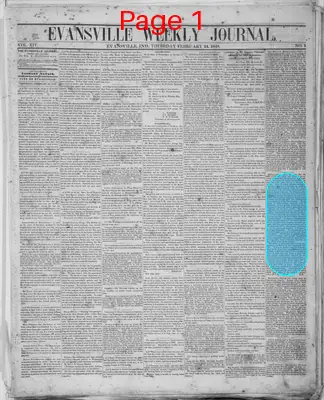
Evansville Weekly Journal
Evansville, Vanderburgh County, Indiana
What is this article about?
On December 25, 1846, a loud noise resembling cannon fire, kettledrums, and trumpets was heard over an 18-league area near Mindethal, Germany. A black ball descended in Schoenenberg, revealing a warm aerolite stone weighing 8 kg with metallic crystals. Similar to a 1811 French event termed 'music of the spheres' by Arago.
Clipping
OCR Quality
Full Text
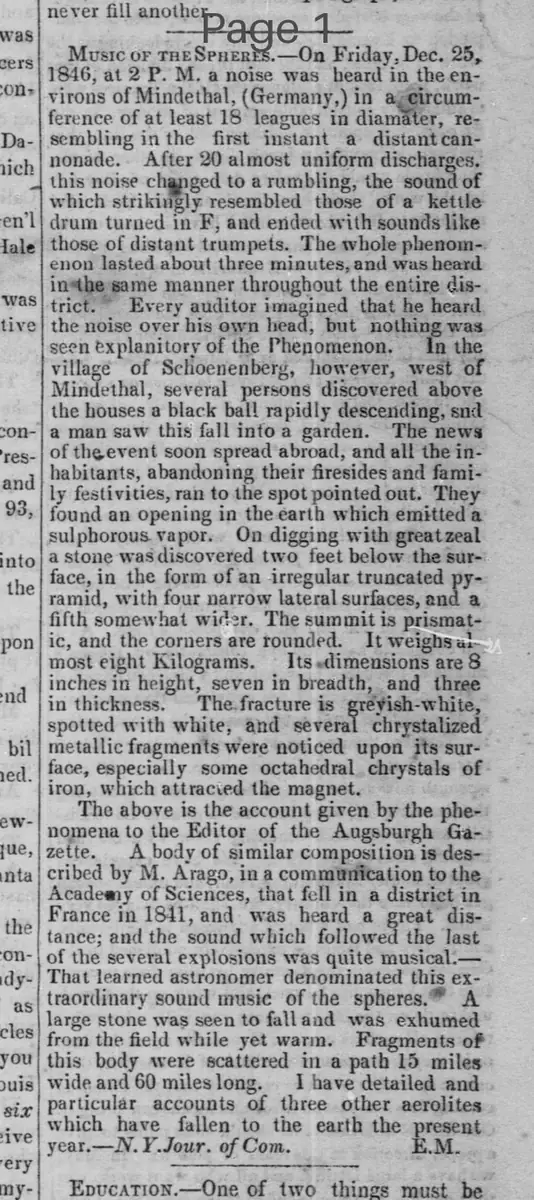
On Friday, Dec. 25, 1846, at 2 P. M. a noise was heard in the environs of Mindethal, (Germany,) in a circumference of at least 18 leagues in diameter, resembling in the first instant a distant cannonade. After 20 almost uniform discharges, this noise changed to a rumbling, the sound of which strikingly resembled those of a kettledrum tuned in F, and ended with sounds like those of distant trumpets. The whole phenomenon lasted about three minutes, and was heard in the same manner throughout the entire district. Every auditor imagined that he heard the noise over his own head, but nothing was seen explanatory of the Phenomenon. In the village of Schoenenberg, however, west of Mindethal, several persons discovered above the houses a black ball rapidly descending, and a man saw this fall into a garden. The news of the event soon spread abroad, and all the inhabitants, abandoning their firesides and family festivities, ran to the spot pointed out. They found an opening in the earth which emitted a sulphurous vapor. On digging with great zeal a stone was discovered two feet below the surface, in the form of an irregular truncated pyramid, with four narrow lateral surfaces, and a fifth somewhat wider. The summit is prismatic, and the corners are rounded. It weighs almost eight Kilograms. Its dimensions are 8 inches in height, seven in breadth, and three in thickness. The fracture is greyish-white, spotted with white, and several crystallized metallic fragments were noticed upon its surface, especially some octahedral crystals of iron, which attracted the magnet.
The above is the account given by the phenomena to the Editor of the Augsburgh Gazette. A body of similar composition is described by M. Arago, in a communication to the Academy of Sciences, that fell in a district in France in 1811, and was heard a great distance; and the sound which followed the last of the several explosions was quite musical. That learned astronomer denominated this extraordinary sound music of the spheres. A large stone was seen to fall and was exhumed from the field while yet warm. Fragments of this body were scattered in a path 15 miles wide and 60 miles long. I have detailed and particular accounts of three other aerolites which have fallen to the earth the present year.—N.Y. Jour. of Com.
E.M.
What sub-type of article is it?
What themes does it cover?
What keywords are associated?
What entities or persons were involved?
Where did it happen?
Story Details
Key Persons
Location
Environs Of Mindethal, Germany; Schoenenberg
Event Date
Friday, Dec. 25, 1846, At 2 P. M.
Story Details
A sonic phenomenon like cannonade, kettledrum in F, and trumpets lasted three minutes over 18 leagues near Mindethal. A black ball fell in Schoenenberg garden, revealing an 8 kg aerolite with iron crystals. Compared to 1811 French meteorite called 'music of the spheres' by Arago.