Thank you for visiting SNEWPapers!
Sign up free
Editorial
February 7, 1794
Gazette Of The United States & Evening Advertiser
Philadelphia, Philadelphia County, Pennsylvania
What is this article about?
An editorial argues that sovereign states, as moral persons, often evade justice due to divided responsibility among members, necessitating compulsory legal mechanisms to enforce rights against them, reciprocal to how states compel individuals. It invokes common law principles of right and remedy.
Clipping
OCR Quality
95%
Excellent
Full Text
NEW-YORK, Feb. 4.
STABILITY OF STATES.
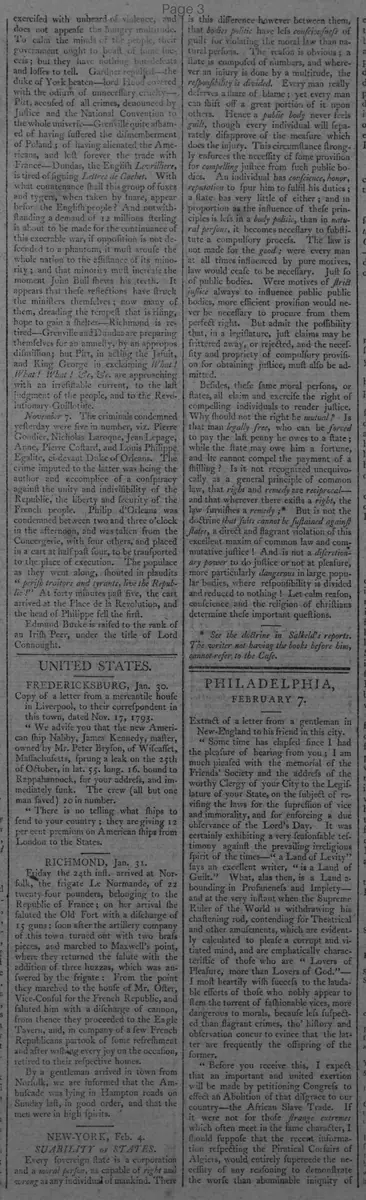
Every sovereign state is a corporation and a moral person, as capable of right and wrong as any individual of mankind. There is this difference however between them, that bodies politic have less consciences of guilt for violating the moral law than natural persons. The reason is obvious; a state is composed of numbers, and wherever an injury is done by a multitude, the responsibility is divided. Every man really deserves a share of blame; yet every man can shift off a great portion of it upon others. Hence a public body never feels guilt, though every individual will separately disapprove of the measure which does the injury. This circumstance strongly enforces the necessity of some provision for compelling justice from such public bodies. An individual has conscience, honor, reputation to spur him to fulfil his duties; a state has very little of either; and in proportion as the influence of these principles is less in a body politic, than in natural persons, it becomes necessary to substitute a compulsory process. The law is not made for the good; were every man at all times influenced by pure motives, law would cease to be necessary. Just so of public bodies. Were motives of right justice always to influence public bodies, more efficient provision would never be necessary to procure from them perfect right. But admit the possibility that, in a legislature, just claims may be frittered away, or rejected, and the necessity and propriety of compulsory provision for obtaining justice, must also be admitted.
Besides, these same moral persons, or states, all claim and exercise the right of compelling individuals to render justice. Why should not the right be mutual? Is that man legally free, who can be forced to pay the last penny he owes to a state; while the state may owe him a fortune, and he cannot compel the payment of a shilling? Is it not recognized unequivocally as a general principle of common law, that right and remedy are reciprocal--and that wherever there exists a right, the law furnishes a remedy;* But is not the doctrine that suits cannot be sustained against states, a direct and flagrant violation of this excellent maxim of common law and commutative justice! And is not a discretionary power to do justice or not at pleasure, more particularly dangerous in large popular bodies, where responsibility is divided and reduced to nothing! Let calm reason, conscience and the religion of Christians determine these important questions.
* See the doctrine in Salkeld's reports. The writer not having the books before him, cannot refer to the case.
STABILITY OF STATES.
Every sovereign state is a corporation and a moral person, as capable of right and wrong as any individual of mankind. There is this difference however between them, that bodies politic have less consciences of guilt for violating the moral law than natural persons. The reason is obvious; a state is composed of numbers, and wherever an injury is done by a multitude, the responsibility is divided. Every man really deserves a share of blame; yet every man can shift off a great portion of it upon others. Hence a public body never feels guilt, though every individual will separately disapprove of the measure which does the injury. This circumstance strongly enforces the necessity of some provision for compelling justice from such public bodies. An individual has conscience, honor, reputation to spur him to fulfil his duties; a state has very little of either; and in proportion as the influence of these principles is less in a body politic, than in natural persons, it becomes necessary to substitute a compulsory process. The law is not made for the good; were every man at all times influenced by pure motives, law would cease to be necessary. Just so of public bodies. Were motives of right justice always to influence public bodies, more efficient provision would never be necessary to procure from them perfect right. But admit the possibility that, in a legislature, just claims may be frittered away, or rejected, and the necessity and propriety of compulsory provision for obtaining justice, must also be admitted.
Besides, these same moral persons, or states, all claim and exercise the right of compelling individuals to render justice. Why should not the right be mutual? Is that man legally free, who can be forced to pay the last penny he owes to a state; while the state may owe him a fortune, and he cannot compel the payment of a shilling? Is it not recognized unequivocally as a general principle of common law, that right and remedy are reciprocal--and that wherever there exists a right, the law furnishes a remedy;* But is not the doctrine that suits cannot be sustained against states, a direct and flagrant violation of this excellent maxim of common law and commutative justice! And is not a discretionary power to do justice or not at pleasure, more particularly dangerous in large popular bodies, where responsibility is divided and reduced to nothing! Let calm reason, conscience and the religion of Christians determine these important questions.
* See the doctrine in Salkeld's reports. The writer not having the books before him, cannot refer to the case.
What sub-type of article is it?
Legal Reform
Constitutional
What keywords are associated?
Sovereign States
Moral Responsibility
Compulsory Justice
Common Law
Legal Remedies
State Immunity
Reciprocity
What entities or persons were involved?
Sovereign States
Public Bodies
Legislatures
Editorial Details
Primary Topic
Compelling Justice From Sovereign States
Stance / Tone
Argumentative Advocacy For Legal Remedies Against States
Key Figures
Sovereign States
Public Bodies
Legislatures
Key Arguments
States As Moral Persons Lack Individual Conscience Due To Divided Responsibility
Necessity Of Compulsory Processes To Enforce Justice On States
Reciprocity: States Compel Individuals, So Individuals Should Compel States
Common Law Principle That Right Implies Remedy Is Violated By Immunity Of States
Discretionary Justice In Popular Bodies Is Dangerous Due To Diffused Responsibility