Thank you for visiting SNEWPapers!
Sign up free
Vermont Watchman And State Journal
Montpelier, Washington County, Vermont
What is this article about?
The Whig National Convention in Harrisburg, Pennsylvania, from December 4-7, 1839, nominates William Henry Harrison of Ohio for President and John Tyler of Virginia for Vice President, unifying the party against the incumbent administration's policies.
Clipping
OCR Quality
Full Text
FOR PRESIDENT,
WM. HENRY HARRISON.
OF OHIO.
FOR VICE PRESIDENT
JOHN TYLER.
OF VIRGINIA.
THE CANDIDATE.
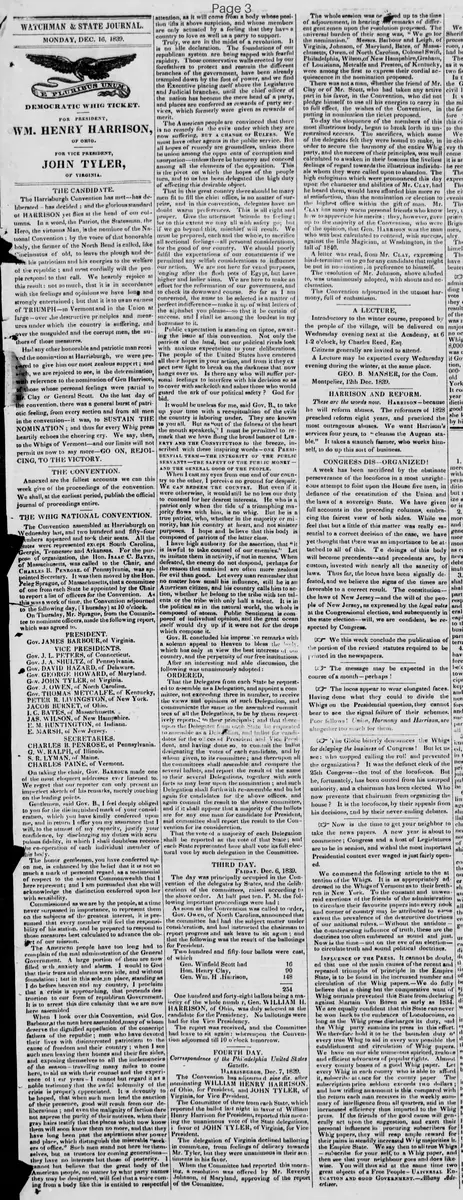
The Harrisburg Convention has met—has deliberated—has decided; and the glorious standard of HARRISON yet flies at the head of our columns. In a word, the Patriot, the Statesman, the Hero, the virtuous Man, is the nominee of the National Convention; by the voice of that honorable body, the farmer of the North Bend is called, like Cincinnatus of old, to leave the plough and devote his patriotism and his energies to the welfare of the republic; and most cordially will the people respond to that call. We heartily rejoice at this result: not so much, that it is in accordance with the feelings and opinions we have long and strongly entertained; but that it is to us an earnest of TRIUMPH—in Vermont and in the Union at large—over the destructive principles and measures under which the country is suffering, and over the misguided and the corrupt men, the authors of those measures.
Had any other honorable and patriotic man received the nomination at Harrisburg, we were prepared to give him our most zealous support; and such, we are rejoiced to see, is the determination with reference to the nomination of Gen. Harrison, of those whose personal feelings were partial to Mr. Clay or General Scott. On the last day of the convention, there was a general burst of patriotic feeling, from every section and from all men in the convention—it was, to SUSTAIN THE NOMINATION; and thus far every Whig press heartily echoes the cheering cry. We say, then, to the Whigs of Vermont—and our limits will not permit us now to say more—GO ON, REJOICING, TO THE VICTORY.
THE CONVENTION.
Annexed are the fullest accounts we can this week give of the proceedings of the convention. We shall, at the earliest period, publish the official journal of proceedings entire.
THE WHIG NATIONAL CONVENTION.
The Convention assembled at Harrisburg on Wednesday last, and two hundred and fifty-four members appeared and took their seats. All the states were represented except South Carolina, Georgia, Tennessee and Arkansas. For the purpose of organization, the Hon. Isaac C. Bates, of Massachusetts, was called to the Chair, and Charles B. Penrose, of Pennsylvania, was appointed Secretary. It was then moved by the Hon. Peleg Sprague, of Massachusetts, that a committee of one from each state be appointed by the Chair to report a list of officers for the Convention. As this was a work of time, the Convention adjourned to the following day, (Thursday) at 10 o'clock.
On Thursday, Mr. Sprague, from the Committee to nominate officers, made the following report, which was agreed to.
PRESIDENT.
Gov. JAMES BARBOUR, of Virginia.
VICE PRESIDENTS.
Gov. J. L. PETERS, of Connecticut.
Gov. J. A. SHULTZ, of Pennsylvania.
Gov. DAVID HAZARD, of Delaware.
Gov. GEORGE HOWARD, of Maryland.
Gov. JOHN TYLER, of Virginia.
Gov. J. OWEN, of North Carolina.
Gov. THOMAS METCALFE, of Kentucky,
PETER R. LIVINGSTON, of New York.
JACOB BURNET, of Ohio.
I. C. BATES, of Massachusetts.
JAS. WILSON, of New Hampshire.
E. M. HUNTINGTON, of Indiana.
E. MARSH, of New Jersey.
SECRETARIES.
CHARLES B. PENROSE, of Pennsylvania.
G. W. RALPH, of Illinois.
S. R. LYMAN, of Maine.
CHARLES PAINE, of Vermont.
On taking the chair, Gov. Barbour made one of the most eloquent addresses ever listened to. We regret that our reporter can only present an imperfect sketch of his remarks, merely touching on the leading points.
Gentlemen, said Gov. B., I feel deeply obliged to you for the distinguished mark of your consideration, which you have kindly conferred upon me, and in return I offer you my assurance that I will, to the utmost of my capacity, justify your confidence, by discharging my duties with scrupulous fidelity, in which I shall doubtless receive the co-operation of each individual member of this body.
The honor gentlemen, you have conferred upon me, is enhanced by the belief that it is not so much a mark of personal regard, as a testimonial of respect to the ancient Commonwealth that I here represent; and I am persuaded that she will acknowledge the distinction conferred upon her with sensibility.
Commissioned as we are by the people, at a time never surpassed in importance, to represent them on the subjects of the greatest interest, it is presumed that every member will feel the responsibility of his station, and be prepared to respond to those measures best calculated to advance the object of our mission.
The American people have too long had to complain of the mal-administration of the General Government. A large portion of them are now filled with anxiety and alarm. I would to God that their fears and alarms were idle, and without foundation; but in this solemn place, standing as I do before heaven and my country, I proclaim that a crisis is approaching, that portends destruction to our form of republican Government. It is to arrest this dire calamity that we are now here assembled.
When I look over this Convention, said Gov. Barbour, at the men here assembled, many of whom deserve the dignified appellation of the conscript fathers of the republic; men who have devoted their lives with disinterested patriotism to the cause of freedom and their country; when I see such men leaving their homes and their fire sides, and exposing themselves to all the inclemencies of the season—travelling many miles to come here, to aid us with their counsel and the experience of their years—I cannot but regard it as a noble testimony that the awful solemnity of the crisis is properly appreciated. It is devoutly to be hoped, that when such men lend the sanction of their presence, good will result from our deliberations; and even the malignity of faction dare not asperse the purity of their motives, when their gray hairs testify that the places which now know them will soon know them no more, and that they have long been past the aspirations after power and place, which distinguish the miserable "seekers of office." Such men stand not here for themselves, but as trustees for coming generations—they have no interests but those of posterity. I cannot but believe that the great body of the American people, no matter by what party names they are distinguished, will pay due attention, as it will come from a body whose position lifts it above suspicion, and whose members are only actuated by a feeling that they have a country to love as well as a party to support.
Truly, we are in the midst of a revolution. It is no idle declaration. The foundations of our republican system are being sapped with fearful rapidity. Those conservative walls erected by our forefathers to protect and restrain the different branches of the government, have been already trampled down by the foot of power, and we find the Executive placing itself above the Legislative and Judicial branches, until the chief officer of the nation has become the mere head of a party, and places are conferred as rewards of party services, which formerly were given as rewards of merit.
The American people are convinced that there is no remedy for the evils under which they are now suffering, BUT A CHANGE OF RULERS. We must have other agents in the public service. But all hopes of remedy are groundless, unless there be union among the opponents of corruption and usurpation—unless there be harmony and concord among all the elements of the opposition. This is the pivot on which the hopes of the people turn, and to us has been delegated the high duty of effecting this desirable object.
That in this great country there should be many men fit to fill the chief office, is no matter of surprise, and in this convention, delegates have no doubt warm preferences. This is all right and proper. Give the uttermost latitude to feeling; for to this extent we may all with safety go; but if we go beyond this, mischief will result. We must be prepared, each and the whole, to sacrifice all sectional feelings—all personal considerations, for the good of our country. We should poorly fulfil the expectations of our constituents if we permitted any selfish considerations to influence our action. We are not here for venal purposes, longing after the flesh pots of Egypt, but have higher and holier aims. We are here to make an effort for the reformation of our government, and to check its downward course. So far as I am concerned, the name to be selected is a matter of perfect indifference—make it up of what letters of the alphabet you please—so that it be certain of success, and I shall be among the loudest in my huzzas to it.
Public expectation is standing on tiptoe, awaiting the issue of this convention. Not only the patriots of the land, but our political rivals look with anxious expectation to your deliberations. The people of the United States have centered all their hopes in your action, and from it they expect new light to break on the darkness that now hangs over us. Is there any who will suffer personal feelings to interfere with his decision so as to cover with sackcloth and ashes those who should guard the ark of our political safety? God forbid.
It would be useless for me, said Gov. B., to take up your time with a recapitulation of the evils the country is laboring under. They are known to you all. But as "out of the fulness of the heart the mouth speaketh," I must be permitted to remark that we have flung the broad banner of LIBERTY AND THE CONSTITUTION to the breeze, inscribed with these inspiring words—one PRESIDENTIAL TERM—THE INTEGRITY OF THE PUBLIC SERVANTS—THE SAFETY OF THE PUBLIC MONEY—AND THE GENERAL GOOD OF THE PEOPLE.
When I cast my eyes from one end of our country to the other, I perceive no ground for despair. We CAN REDEEM THE COUNTRY. But EVEN if it were otherwise, it would still be no less our duty to contend for her dearest interests. He who is a patriot only when the tide of a triumphing majority flows with him, is no whig. But he is a true patriot, who, whether in the majority or minority, has his country at heart, and not sinister purposes. I hope and believe that this body is composed of patriots of the latter class.
I have high authority for the assertion, that "it is lawful to take counsel of our enemies." Let us imitate them in activity, if not in means. When defeated, the enemy do not despond, perhaps for the reason that mankind are often more zealous for evil than good. Let every man remember that no matter how small his influence, still he is an American citizen, and his country calls him to action, whether he belong to the tribe with ten talents or the tribe with only half a talent. It is in the political as in the natural world, the whole is composed of atoms. Public Sentiment is composed of individual opinion, and the great ocean itself would dry up if it were not for the drops which compose it.
Gov. B. concluded his impressive remarks with a solemn appeal to Heaven to bless the unity which has only in view the best interests of our country, and the perpetuity of our free institutions.
After an interesting and able discussion, the following was unanimously adopted:
ORDERED,
That the Delegates from each State be requested to assemble as a Delegation, and appoint a committee, not exceeding three in number, to receive the views and opinions of such Delegation, and communicate the same to the assembled committees of all the Delegations, to be by them respectively reported to their principals; and that thereupon the Delegates from each State be requested to assemble as a Delegation, and ballot for candidates for the offices of President and Vice President, and having done so, to commit the ballot designating the votes of each candidate, and by whom given, to its committee; and thereupon all the committees shall assemble and compare the several ballots, and report the result of the same to their several Delegations, together with such facts as may bear upon the nomination; and such Delegation shall forthwith re-assemble and ballot again for candidates for the above offices, and again commit the result to the above committee, and if it shall appear that a majority of the ballots are for any one man for candidate for President, said committee shall report the result to the Convention for its consideration.
That the vote of a majority of each Delegation shall be reported as the vote of that State; and each State represented here shall vote its full electoral vote by such delegation in the Committee.
THIRD DAY.
FRIDAY, Dec. 6, 1839.
The day was principally occupied in the Convention of the delegates by States, and the deliberations of the committees, raised according to the above order. At half past ten, P. M. the following important proceedings were had:
As soon as the Convention was called to order, Gov. Owen, of North Carolina, announced that the committee had had the subject matter under consideration, and had instructed the chairman to report progress and ask leave to sit again: and that the following was the result of the ballotings for President.
Two hundred and fifty-four ballots were cast, of which
Gen. Winfield Scott had 16
Hon. Henry Clay, 90
Gen. Wm. H. Harrison, 148
254
One hundred and forty-eight ballots being a majority of the whole number, Gen. WILLIAM H. HARRISON, of Ohio, was duly selected as the candidate for the Presidency. No ballotings were had for the Vice Presidency.
The report was received, and the Committee had leave to sit again: whereupon the Convention adjourned till 10 o'clock tomorrow.
FOURTH DAY.
Correspondence of the Philadelphia United States Gazette.
HARRISBURGH, Dec. 7, 1839.
The Convention has adjourned sine die, after nominating WILLIAM HENRY HARRISON, of Ohio, for President, and JOHN TYLER, of Virginia, for Vice President.
The Committee of three from each State, which reported the ballot last night in favor of William Henry Harrison for President, reported this morning the unanimous vote of the State delegations, in favor of JOHN TYLER, of Virginia, for Vice President.
The delegation of Virginia declined balloting in committee, from feelings of delicacy towards Mr. Tyler, but they were unanimous in their sentiments in his favor.
When the Committee had reported this morning, a resolution was offered by Mr. Reverdy Johnson, of Maryland, approving of the report of the Committee.
The whole session was occupied up to the time of adjournment, in hearing remarks of different gentlemen upon the resolution proposed. The universal burden of their song was, "We go for the nomination." Messrs. Barbour and Leigh, of Virginia, Johnson, of Maryland, Bates, of Massachusetts, Owen, of North Carolina, Colonel Swift, of Philadelphia, Wilson, of New Hampshire, Graham of Louisiana, Metcalfe and Preston, of Kentucky, were among the first to express their cordial acquiescence in the nomination proposed.
There was not a man, whether the friend of Mr. Clay or of Mr. Scott, who had taken any active part in his favor, in the Convention, who did not pledge himself to use all his energies to carry into full effect, the wishes of the Convention, in putting in nomination the ticket proposed.
To-day the eloquence of the members of this most illustrious body, began to break forth in unrestrained accents. The sacrifices, which some of the delegates felt they were bound to make, in order to secure the harmony of the entire Whig party, and the success of their principles, was well calculated to awaken in their bosoms the liveliest feelings of regard towards the illustrious individuals whom they were called upon to abandon. The high eulogiums which were pronounced this day upon the character and abilities of Mr. CLAY, had he heard them, would have afforded him more real satisfaction, than the nomination or election to the highest office within the gift of man. Mr. Clay has many warm personal friends who know how to appreciate his merits: they, however, gave up to the majority of the Convention, who were of the opinion, that Gen. Harrison was the man who was best calculated to contend, with success, against the little Magician, at Washington, in the fall of 1840.
A letter was read, from Mr. CLAY, expressing his determination to go for any candidate that might be put in nomination, in preference to himself.
The resolution of Mr. Johnson, above alluded to, was unanimously adopted, with shouts and acclamation.
The Convention adjourned in the utmost harmony, full of enthusiasm.
What sub-type of article is it?
What themes does it cover?
What keywords are associated?
What entities or persons were involved?
Where did it happen?
Story Details
Key Persons
Location
Harrisburg
Event Date
December 4 7, 1839
Story Details
The Whig National Convention assembles in Harrisburg, organizes with James Barbour as president, and after deliberations and balloting, nominates William Henry Harrison for President with 148 votes over Henry Clay (90) and Winfield Scott (16), and John Tyler for Vice President unanimously, amid speeches emphasizing unity and opposition to the current administration.