Thank you for visiting SNEWPapers!
Sign up free
The National Intelligencer And Washington Advertiser
Washington, District Of Columbia
What is this article about?
In the US House of Representatives on February 10, 1801, debate on a bill to extend the Non-Intercourse Act with France until March 1802. Opponents argued it was unnecessary after the recent convention, harming trade especially tobacco planters; supporters urged caution to maintain national dignity. The bill was rejected 55-37.
Merged-components note: This is a continuation of the congressional debate on the Non-Intercourse Act with France across pages 1 and 2, with sequential reading order and direct text flow.
Clippings
1 of 2
OCR Quality
Full Text
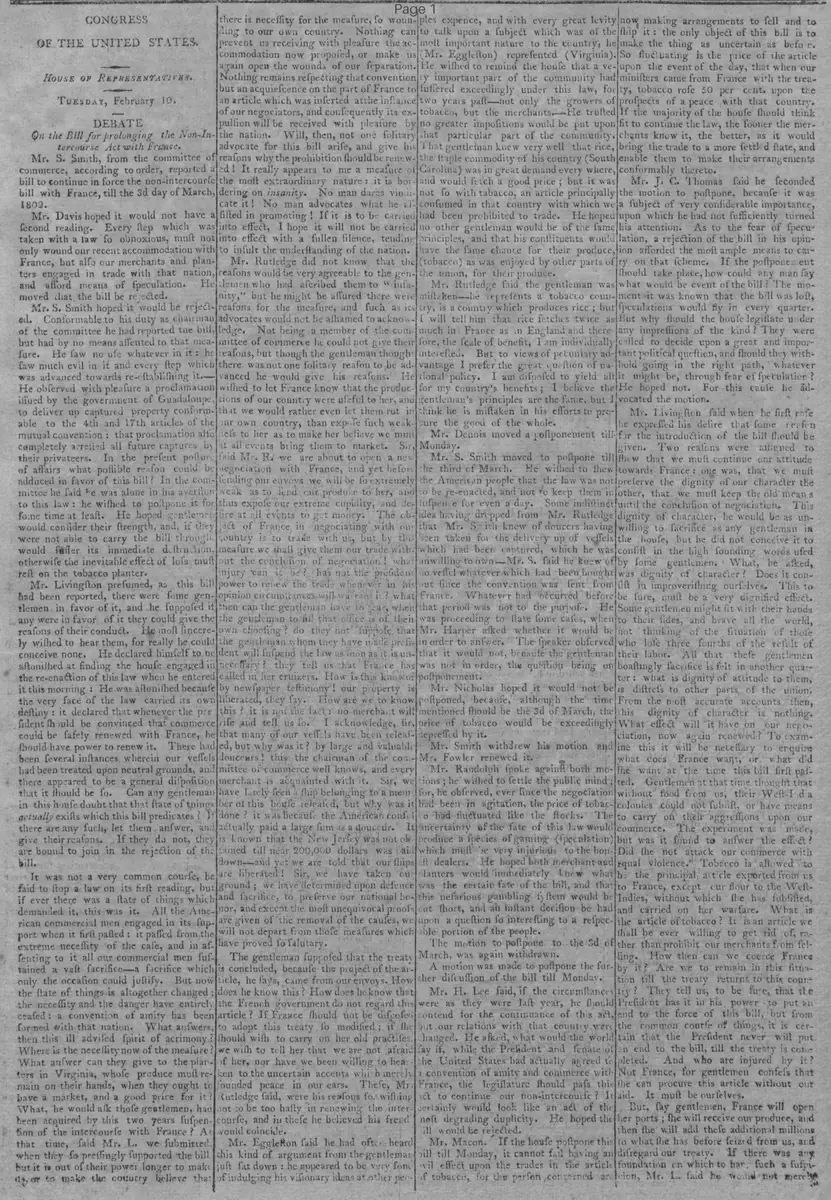
OF THE UNITED STATES
HOUSE OF REPRESENTATIVES
TUESDAY, February 10.
DEBATE
On the Bill for prolonging the Non-Intercourse Act with France.
Mr. S. Smith, from the committee of commerce, according to order, reported a bill to continue in force the non-intercourse bill with France, till the 3d day of March, 1802.
Mr. Davis hoped it would not have a second reading. Every step which was taken with a law so obnoxious, must not only wound our recent accommodation with France, but also our merchants and planters engaged in trade with that nation, and afford means of peculation. He moved that the bill be rejected.
Mr. S. Smith hoped it would be rejected. Conformable to his duty as chairman of the committee he had reported the bill, but had by no means assented to that measure. He saw no use whatever in it: he saw much evil in it and every step which was advanced towards re-establishing it. He observed with pleasure a proclamation issued by the government of Guadaloupe, to deliver up captured property conformable to the 4th and 17th articles of the mutual convention: that proclamation also completely arrested all future captures by their privateers. In the present posture of affairs what possible reason could be adduced in favor of this bill? In the committee he said he was alone in his aversion to this law: he wished to postpone it for some time at least. He hoped gentlemen would consider their strength, and, if they were not able to carry the bill through, would suffer its immediate destruction. Otherwise the inevitable effect of loss must rest on the tobacco planter.
Mr. Livingston presumed, as this bill had been reported, there were some gentlemen in favor of it, and he supposed if any were in favor of it they could give the reasons of their conduct. He most sincerely wished to hear them, for really he could conceive none. He declared himself to be astonished at finding the house engaged in the re-enaction of this law when he entered it this morning: He was astonished because the very face of the law carried its own destiny: it declared that whenever the President should be convinced that commerce could be safely renewed with France, he should have power to renew it. There had been several instances wherein our vessels had been treated upon neutral grounds, and there appeared to be a general disposition that it should be so. Can any gentleman in this house doubt that that state of things actually exists which this bill predicates? If there are any such, let them answer, and give their reasons. If they do not, they are bound to join in the rejection of the bill.
It was not a very common course, he said to stop a law on its first reading, but if ever there was a state of things which demanded it, this was it. All the American commercial men engaged in its support when it first passed: it passed from the extreme necessity of the case, and in assenting to it all our commercial men sustained a vast sacrifice—a sacrifice which only the occasion could justify. But now the state of things is altogether changed: the necessity and the danger have entirely ceased: a convention of amity has been formed with that nation. What answers, then this ill advised spirit of acrimony? Where is the necessity now of the measure? What answer can they give to the planters in Virginia, whose produce must remain on their hands, when they ought to have a market, and a good price for it? What, he would ask those gentlemen, had been acquired by this two years suspension of the intercourse with France? At that time, said Mr. L. we submitted. when they so pressingly supported the bill but it is out of their power longer to make us, or to make the country believe that there is necessity for the measure, so wounding to our own country. Nothing can prevent us receiving with pleasure the accommodation now proposed, or make us again open the wounds of our separation. Nothing remains respecting that convention but an acquiescence on the part of France to an article which was inserted at the instance of our negociators, and consequently its expunging will be received with pleasure by the nation. Will, then, not one solitary advocate for this bill arise, and give his reasons why the prohibition should be renewed! It really appears to me a measure of the most extraordinary nature: it is bordering on insanity. No man dares vindicate it! No man advocates what he assisted in promoting! If it is to be carried into effect, I hope it will not be carried into effect with a sullen silence, tending to insult the understanding of the nation.
Mr. Rutledge did not know that the reasons would be very agreeable to the gentlemen who had ascribed them to "insanity," but he might be assured there were reasons for the measure, and such as its advocates would not be ashamed to acknowledge. Not being a member of the committee of commerce he could not give their reasons, but though the gentleman thought there was not one solitary reason to be advanced he would give his reasons. He wished to let France know that the productions of our country were useful to her, and that we would rather even let them rot in our own country, than expose such weakness to her as to make her believe we must at all events bring them to market. Sir, said Mr. R. we are about to open a new negociation with France, and yet before sending our envoys we will be so extremely weak as to send our produce to her, and thus expose our extreme cupidity, and desire at all events to get money. The object of France in negociating with our country is to trade with us, but by this measure we shall give them our trade without the conclusion of negociation! what injury can it be? has not the President power to resume the trade whenever in his opinion circumstances will warrant? what then can the gentleman have to fear, when the gentleman to fill that office is of their own choosing? do they not suppose that the gentleman whom they have made President will suspend the law as soon as it is unnecessary? they tell us that France has called in her cruizers. How is this known! by newspaper testimony! our property is liberated, they say. How are we to know this? it is not the fact: no merchant will rise and tell us so. I acknowledge, sir. that many of our vessels have been released, but why was it? by large and valuable douceurs! this the chairman of the committee of commerce well knows, and every merchant is acquainted with it. Sir, we have lately seen a ship belonging to a member of this house released, but why was it done? it was because the American consul actually paid a large sum as a douceur. It is known that the New Jersey was not obtained till near 200,000 dollars was paid down—and yet we are told that our ships are liberated! Sir. we have taken our ground; we have determined upon defence and sacrifice, to preserve our national honor, and except the most unequivocal proofs are given of the removal of the causes, we will not depart from those measures which have proved so salutary.
The gentleman supposed that the treaty is concluded, because the project of the article, he says, came from our envoys. How does he know this? How does he know that the French government do not regard this article? If France should not be disposed to adopt this treaty so modified; if she should wish to carry on her old practices. we wish to tell her that we are not afraid of her, nor have we been willing to hearken to the uncertain accents which merely sounded peace in our ears. These, Mr. Rutledge said, were his reasons for wishing not to be too hasty in renewing the intercourse, and in these he believed his friends would coincide.
Mr. Eggleston said he had often heard this kind of argument from the gentleman just sat down: he appeared to be very fond of indulging his visionary ideas at other people's expense, and with every great levity to talk upon a subject which was of the most important nature to the country, he (Mr. Eggleston) represented (Virginia). He wished to remind the house that a very important part of the community had suffered exceedingly under this law, for two years past—not only the growers of tobacco, but the merchants.—He trusted no greater impositions would be put upon that particular part of the community. That gentleman knew very well that rice, the staple commodity of his country (South Carolina) was in great demand every where, and would fetch a good price; but it was not so with tobacco, an article principally consumed in that country with which we had been prohibited to trade. He hoped no other gentleman would be of the same principles, and that his constituents would have the same chance for their produce, (tobacco) as was enjoyed by other parts of the union, for their produce.
Mr. Rutledge said the gentleman was mistaken—he represents a tobacco country, is a country which produces rice; but I will tell him that rice fetches twice as much in France as in England and therefore, the case of benefit, I am individually interested. But to views of pecuniary advantage I prefer the great question of national policy. I am disposed to yield all for my country's benefits; I believe the gentleman's principles are the same, but I think he is mistaken in his efforts to procure the good of the whole.
Mr. Dennis moved a postponement till Monday.
Mr. S. Smith moved to postpone till the third of March. He wished to show the American people that the law was not to be re-enacted, and not to keep them in suspense for even a day. Some indistinct idea having dropped from Mr. Rutledge that Mr. Smith knew of doucers having been taken for the delivery up of vessels which had been captured, which he was unwilling to own—Mr. S. said he knew of no vessel whatever which had been bought out since the convention was sent from France. Whatever had occurred before that period was not to the purpose. He was proceeding to state some cases, when Mr. Harper asked whether it would be in order to answer. The Speaker observed that it would not, because the gentleman was not in order, the question being on postponement.
Mr. Nicholas hoped it would not be postponed, because, although the time mentioned should be the 3d of March, the price of tobacco would be exceedingly depressed by it.
Mr. Smith withdrew his motion and Mr. Fowler renewed it.
Mr. Randolph spoke against both motions: he wished to settle the public mind: for, he observed, ever since the negociation had been in agitation, the price of tobacco had fluctuated like the stocks. The uncertainty of the fate of this law would produce a species of gaming (speculation) which must be very injurious to the honest dealers. He hoped both merchant and planters would immediately know what was the certain fate of the bill, and that this nefarious gambling system would be cut short, and an instant decision be had upon a question so interesting to a respectable portion of the people.
The motion to postpone to the 3d of March, was again withdrawn.
A motion was made to postpone the further discussion of the bill till Monday.
Mr. H. Lee said, if the circumstances were as they were last year, he should contend for the continuance of this act, but our relations with that country were changed. He asked, what would the world say if, while the President and Senate of the United States had actually agreed to a convention of amity and commerce with France, the legislature should pass this act to continue our non-intercourse? It certainly would look like an act of the most degrading duplicity. He hoped the bill would be rejected.
Mr. Macon. If the house postpone this bill till Monday, it cannot fail having an ill effect upon the traders in the article of tobacco, for the persons concerned are now making arrangements to sell and to ship it: the only object of this bill is to make the thing as uncertain as before. So fluctuating is the price of the article upon the event of the day, that when our ministers came from France with the treaty, tobacco rose 50 per cent. upon the prospects of a peace with that country. If the majority of the house should think fit to continue the law, the sooner the merchants know it, the better, as it would bring the trade to a more settled state, and enable them to make their arrangements conformably thereto.
Mr. J. C. Thomas said he seconded the motion to postpone, because it was a subject of very considerable importance, upon which he had not sufficiently turned his attention. As to the fear of peculation, a rejection of the bill in his opinion afforded the most ample means to carry on that scheme. If the postponement should take place, how could any man say what would be event of the bill? The moment it was known that the bill was lost, peculations would fly in every quarter. But why should the house legislate under any impressions of the kind? They were called to decide upon a great and important political question, and should they withhold going in the right path, whatever it might be, through fear of peculation? He hoped not. For this cause he advocated the motion
Mr. Livingston said when he first rose he expressed his desire that some reason for the introduction of the bill should be given. Two reasons were assigned to show that we must continue our attitude towards France: one was, that we must preserve the dignity of our character the other, that we must keep the old means until the conclusion of negociation. This dignity of character, he would be as unwilling to sacrifice as any gentleman in the house, but he did not conceive it to consist in the high sounding words used by some gentlemen. : What, he asked, was dignity of character? Does it consist in impoverishing ourselves. This to be sure, must be a very dignified effect. Some gentlemen might sit with their hands to their sides, and brave all the world, not thinking of the situation of those who lose three fourths of the result of their labor. All that these gentlemen boastingly sacrifice is felt in another quarter : what is dignity of attitude to them, is distress to other parts of the union. From the most accurate accounts then, this dignity of character is nothing. What effect will it have on our negociation, now again renewed? To examine this it will be necessary to enquire what does France want, or. what did she want at the time this bill first passed. Gentlemen at that time thought that without food from us, their West-India colonies could not subsist, or have means to carry on their aggressions upon our commerce. The experiment was made, but was it found to answer the effect? Did she not attack our commerce with equal violence." Tobacco is allowed to be the principal article exported from us to France, except our flour to the West-Indies, without which she has subsisted, and carried on her warfare. What is the article of tobacco? It is an article we shall be ever willing to get rid of, rather than prohibit our merchants from selling. How then can we coerce France by it? Are we to remain in this situation till the treaty returns to this country? They tell us, to be sure, that the President has it in his power to put an end to the force of this bill, but from the common course of things, it is certain that the President never will put an end to the bill, till the treaty is completed. And who are injured by it? Not France, for gentlemen confess that she can procure this article without our aid. It must be ourselves. But, say gentlemen, France will open her ports ; she will receive our produce, and then she' will add these additional millions to what she has before seized from us, and disregard our treaty. If there was any foundation on which to harbor such a suspicion, Mr. L. said he would not merit
vote for the opinion for one year, but forever. But where was the foundation for such distrust? He could see none, and believed there was none. The gentleman from Massachusetts presented this dilemma—either the house must believe the treaty would not go into operation, or it was a very uncertain event. Now, between these two, Mr. L. thought there might be a mean supposed, that is, that it was a probable event that it would be carried into execution: this was the middle way he chose to take as a foundation. He thought the possibility bordering upon certainty: He thought the probability so great as to justify any measures being founded thereupon. But, gentlemen say, we must take nothing upon probability, because as soon as it is certain, the president can act conformable to circumstances, which he must be most acquainted with. Upon this point, Mr. L. was perfectly at issue: he did believe France to be sincere, and he farther believed that condition which we had ratified the treaty, would be no hindrance to its final passage: he was well satisfied that the second article, which was erased, was inserted at the instance and even desire of our commissioners. Believing this he could not conceive they would make excuses to evade its ratification. This brought him to another reason for objection which was urged. Could any gentleman believe France would act so perfidiously as to desire and promote this treaty, on purpose to induce us to send our produce to that country, which she would seize? Did he suppose that nation so base, he never would agree to open the communication at all, without other assurances. If gentlemen thought this, they ought not to sit here; their duty requires them to put a perpetual end to commercial intercourse with a nation whose faith was so bad. But it was no such thing—he believed there was good faith in that nation, and that we had received as good assurances of it as could be expected. He hoped a majority of the house believed so, and that no delay would take place in promoting an accommodation in which ourselves would be gainers. He believed the interests of the country called upon the house for immediate action, and therefore hoped that an end would be put to any doubt on the subject.
Mr. WALN thought gentlemen were mistaken in supposing that the non-intercourse with that nation was only felt by the southern States: he believed it was as severely felt by every commercial town in the union, whether southward of the Delaware or eastward. Every gentleman knew that the spirit of adventure in the eastern states, would excite them to carry their commerce as extensively as possible, and that, though not the growers of that species of produce, they were the carriers of it, and were interested in its increasing exportation. But for his part he wished not to be so confined in his ideas to the interest of this or of that state, but to the United States. He did believe that the result of the measures now taking to produce accommodation, was yet uncertain. As a ground of argument, the article of tobacco had been mentioned, and its rise and fall called forth to prove the fluctuating state of political appearances. But for his part he believed that changableness arose from the amounts of the crops. He would appeal to gentlemen who were, from their local knowledge, acquainted with the price of that article, whether in times of plentiful crops, it was not as low as at the present moment. And, upon this, whether the last crop of tobacco was not very great? He believed it was so, and if why should this be considered as proper data for a national concern of such moment? he believed that this, as well as many others prohibited articles found its way to France, and that this small increase in the price but very little lessened its consumption. He would appeal to the understandings of gentlemen, whether there could be a more auspicious moment to open the communication than at present? It was this desire of the committee to wait a few days to know the result of the treaty before the Senate: if that had been signed unconditionally, the law would not have been reported, but as it was not, the possibility of evil alone was a sufficient warrant for the continuance of the law for such time as circumstances might continue the same. He could not believe the policy of the country would warrant the immediate opening of intercourse, and therefore should vote for the bill.
Mr. Gallatin said as he last session voted for this bill, it was proper for him to state this reasons why he now voted against it. The measure was originally adopted as a defensive measure: circumstances being little different last session, and a treaty being on the tapis, he thought it would be wrong policy, then to change it: but now the state of things was altogether changed.
As he conceived a safe intercourse with every foreign nation could not fail to produce general advantages, he should now, upon the idea of safety, vote that the suspension be taken off. The house were told that the same negotiation was pending, and therefore the measures ought to be the same. He thought very differently: last session there was only the appearance of a treaty; it was a question of uncertainty whether it would be concluded. But at present we know the precise state of things and no gentleman in the house can doubt as to the acquiescence of France in the modification we have made. It is true that France may make this an excuse to refuse the treaty, and that they may possibly seize our produce sent there under the impressions of their good faith. But if such was her disposition, was it not to be supposed that she would have treated with us before now, on purpose to draw our commerce into her clutches for seizure? He thought the prospect was as favorable and the moment as safe as ever it would be, and to leave it to the president was at least to suspend it till the final ratification. It was properly a legislative question, and as it originated in congress, in the same branch it should expire, and not be confided to executive pleasure. Any thing confided to the executive, is upon the supposition of a change of circumstances during the recess of the legislature. Why should the house leave to the president to do what it was not only alone competent to, but what every consideration of safety declared ought to be done without fail? It is impossible to say what circumstances may take place after the third of March, or how our relations with any nation may stand, but we must go upon present circumstances; we must only view the present state of things.
Mr. S. Smith replied to Mr. Waln, in his declaration that every commercial part of the union, felt as much as Virginia the want of this trade. It was not so; the tonnage of the United States was now fully employed; if they could not go to France direct, they could and they would go to England, and she received the benefits which the planters lost. He appealed to the gentleman's commercial knowledge whether there ever was such an immensity of tonnage, employed as at present and whether ever freight was so high. There never was a time in which our shipping was more used. He farther answered the gentleman in his assertion that the great crops made the difference of price. How from the appearances of accommodation with France.
An argument advanced by... if he would not think we were honest course would they take? Why most probably seize them out again and force from us what our diffidence in their friendship prevented us selling them.
Mr. C. Goodrich was not willing to trust our trade in the present uncertain situation. He believed from the best information, that every step taken towards negotiation by our envoys was taken with difficulty, and that every possible care was taken by France not to lose an article. He wished as much as any gentleman to see the trade opened with safety, but till it could be done with safety, he was not willing to take a step towards it. He would leave it with the President, whose information must at any time, be adequate to take the proper steps.
The question was taken on the motion to reject the bill and carried.
Yeas 55.
Nays 37.
What sub-type of article is it?
What themes does it cover?
What keywords are associated?
What entities or persons were involved?
Where did it happen?
Story Details
Key Persons
Location
House Of Representatives, United States
Event Date
February 10, 1801
Story Details
Debate in the House on extending the Non-Intercourse Act with France until March 1802. Mr. S. Smith reports the bill but opposes it. Speakers debate necessity post-convention, economic impacts on tobacco trade, national dignity, and trust in France. Motions to postpone fail; bill rejected 55-37.