Thank you for visiting SNEWPapers!
Sign up free
Republican Herald
Providence, Providence County, Rhode Island
What is this article about?
Senator Thomas Hart Benton's continued speech in the U.S. Senate on February 2, 1834, replying to Henry Clay on the removal of federal deposits from the Bank of the United States. Benton criticizes the bank's insolvency, role in currency issues, and violations of its charter, praising the people's role in restoring specie payments after wars.
Merged-components note: Continuation of Mr. Benton's speech on the removal of deposits across pages 1 and 2; relabeled from domestic_news to story as it is a full narrative article.
Clippings
1 of 2
OCR Quality
Full Text
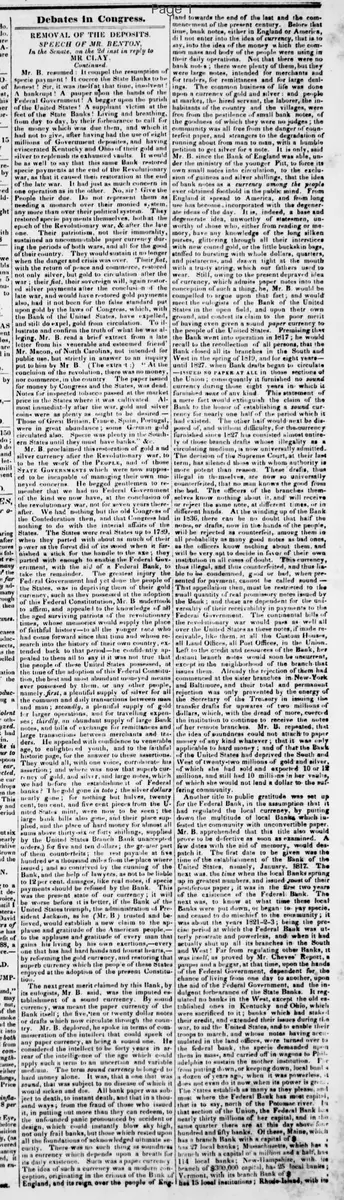
REMOVAL OF THE DEPOSITS.
SPEECH OF MR. BENTON
In the Senate, on the 2d inst. in reply to
MR. CLAY.
Continued.
Mr. B. resumed: It compels the resumption of
Specie payment! It coerce the State Banks to be
honest! Sir, it was itself at that time, insolvent!
A bankrupt! A pauper upon the hands of the
Federal Government! A beggar upon the parish
of the United States! A suppliant victim at the
feet of the State Banks! Living and breathing,
from day to day, by their forbearance to call for
the money which was due them, and which it
had not to give, after having had the use of eight
millions of Government deposits, and having
eviscerated Kentucky and Ohio of their gold and
silver to replenish its exhausted vaults. It would
be as well to say that this same Bank restored
specie payments at the end of the Revolutionary
war, as that it caused their restoration at the end
of the late war. It had just as much concern in
one operation as in the other. No, sir! Give the
People their due. Do not represent them as
needing a monarch over their monied system.
any more than over their political system. They
restored specie payments themselves, both at the
epoch of the Revolutionary war, & after the late
one.
Their patriotism, not their immorality,
sustained an uncommutable paper currency dur-
ing the periods of both wars, and all for the good
of their country. They would sustain it no longer
when the danger and crisis was over. Their fiat,
with the return of peace and commerce, restored
not only silver, but gold to circulation after the
war; their fiat, their sovereign will, again restor-
ed silver payments after the conclusion of the
late war, and would have restored gold payments
also, had it not been for the false standard put
upon gold by the laws of Congress, which, with
the Bank of the United States, have expelled,
and still do expel, gold from circulation. To il-
lustrate and confirm the truth of what he was al-
leging, Mr. B. read a brief extract from a late
letter from his venerable and esteemed friend'
Mr. Macon, of North Carolina, not intended for
public use, but strictly in answer to an inquiry
put to him by Mr. B. (The extract:) "At the
conclusion of the revolution, there was no money,
nor commerce, in the country. The paper issued
for money by Congress and the States, was dead.
Notes for inspected tobacco passed at the market
price in the States where it was cultivated. Al-
most immediately after the war, gold and silver
coins were as plenty as ought to be desired—
Those of Great Britain, France, Spain, Portugal,
were in great abundance; some German gold
circulated also. Specie was plenty in the South-
Mr. B. proclaimed this restoration of gold and
silver currency after the Revolutionary war, to
be the work of the PEOPLE, and of those
State Governments which were now supposed to
be incapable of managing their own monied con-
cerns. He begged gentlemen to re-
member that we had no Federal Government
of the kind we now have, at the conclusion of
the revolutionary war, not for seven years there-
after. We had nothing but the old Congress of
the Confederation then, and that Congress had
nothing to do with the internal affairs of the
States. The States were real States up to 1789,
when they parted with about as much of their
power as the forest did of its wood when it fur-
nished a stick for the handle to the axe; they
parted with enough to enable the Federal Gov.
ernment, with the aid of a Federal Bank, to
take the remainder. The greatest injury the
Federal Government had yet done the people of
the States, was in depriving them of their gold
currency, such as they possessed at the adoption
of this Federal Constitution. Mr. B. undertook
to affirm, and appealed to the knowledge of all
the aged surviving patriots of the revolutionary
times, whose memories would supply the place
of faithful history—to all the younger race who
had come forward since that time and whose re-
search into the history of their own country, ex-
tended back to that period—he confidently ap-
pealed to them all to say if it was not true that
the people of these United States possessed, at
the time of the adoption of this Federal Constitu-
tion, the best and most abundant monied means
ever possessed by them, or any other people,
namely, first, a plentiful supply of silver for all
the common and daily transactions between man
and man; secondly, a plentiful supply of gold
for larger operations, and for travelling expen-
ses; thirdly, an abundant supply of large Bank
notes, and bills of exchange for remittances and
large transactions between merchants and tra-
ders. He appealed with confidence to venerable
age, to enlightened youth, and to the faithful
historic page, for the answer to these assertions.
They would all, with one voice, corroborate his
assertion; and where was now that superb cur-
rency of gold, and silver, and large notes, which
we had before the establishment of Federal
banks? The gold gone in toto; the silver dollars
nearly gone; for nothing but halves, twenty
cent, ten cent, and five cent pieces from the U.
ited States mint, were now to be seen; the
large bank bills also gone, and their place sup-
plied, and the place of hard money for almost all
sums above thirty-six or forty shillings, supplied
by the United States Branch Bank unaccepted
orders,) for five and ten dollars; the greater part
of them counterfeits; the rest payable at five
hundred or a thousand miles from the place where
issued; and so contrived by the cunning of the
Bank, and the help of lawyers, as not to be liable
to 12 per cent. damages, like real notes, if specie
payments should be refused by the Bank. This
was the present state of our currency; it will
be worse before it is better, if the Bank of the
United States triumph, the administration of Pre-
sident Jackson, as he (Mr. B.) trusted and be-
lieved, would establish a new claim to the ap-
plause and gratitude of the American people,
to the applause and gratitude of every man that
gains his living by his own exertions,—every
one that has had hard hands and honest hearts,—
by reforming the gold currency, and restoring that
superb currency which the people of these States
enjoyed at the adoption of the present Constitu-
tion.
The next great merit claimed by this Bank, by
its eulogists, Mr. B. said, was the imputed es-
tablishment of a sound currency. By sound
currency, was meant the paper currency of the
Bank itself; the five, ten or twenty dollar notes
or drafts which now circulate through the coun-
try. Mr. B. deplored, he spoke in terms of com-
misseration of the intellect that could speak of
any paper currency, as being a sound one. He
considered the intellect to be forty years in ar-
rear of the intelligence of the age which could
apply such a term to an uncertain and variable
medium. The term sound currency belonged to
hard money alone. It was, that one that was
sound, that was subject to no disease of which it
would sicken and die. All bank paper was sub-
ject to death, to instant death, and that in a thou-
sand ways; from the fraud of those who issued
it, in putting out more than they can redeem, to
the unfounded panic pronounced by accident or
design, which could instantly blow sky high,
not only frail banks, but those which rested upon
all the foundations of acknowledged ultimate se-
curity. There was no such thing as soundness
in a currency which depends upon a breath for
its daily existence. Such was a paper currency.
The idea of such a currency was a modern con-
ception, originating in the crimes of the Bank of
England, and its reign over the people of Eng-
land towards the end of the last and the com-
mencement of the present century. Before that
time, bank notes, either in England or America,
did not enter into the idea of currency, that is to
say, into the idea of the money which the com-
mon mass and body of the people were using in
their daily operations. Not that there were no
bank notes; there were plenty of them, but they
were large notes, intended for merchants and
for traders, for remittances and for large deal-
ings. The common business of life was done
upon a currency of gold and silver: and people
at market, the hired servant, the laborer, the in-
habitants of the country and the villages, were
free from the pestilence of small bank notes, of
the goodness of which they were no judges; the
Community was all free from the danger of coun-
terfeit paper, and strangers to the degradation of
running about from man to man, with a humble
petition to get silver for a note. It is only, said
Mr. B. since the Bank of England was able, un-
der the ministry of the younger Pitt, to force its
own small notes into circulation, to the exclu-
sion of guineas and silver shillings, that the idea
of bank notes as a currency among the people
ever obtained foothold in the public mind. From
England it spread to America, and from long
use has become incorporated with the degener-
ate ideas of the day. It is, indeed, a base and
degenerate idea, unworthy of statesmen, un-
worthy of those who, either from reading or me-
mory, have any knowledge of the long silken
purses, glittering through all their interstices
with new coined gold, or the little buckskin bags,
stuffed to bursting with whole dollars, quarters,
and pistareens, and drawn tight at the mouth
with a trusty string, which our fathers used to
wear. Still, owing to the present depraved idea
of currency, which admits paper notes into the
conception of such a thing, he, Mr. B. would be
compelled to argue upon that fact; and would
meet the eulogists of the Bank of the United
States in the open field, and upon their own
ground, and contest its claim to the poor merit
of having even given a sound paper currency to
the people of the United States. "Premising that
the Bank went into operation in 1817; he would
recall to the recollection of all persons, that the
Bank closed all its branches in the South and
West in the spring of 1819, and for eight years—
until 1827, when Bank drafts began to circulate
—ISSUED NO PAPER AT ALL in those sections of
the Union; consequently it furnished no sound
currency during those eight years in which it
furnished none of any kind. This statement of
a mere fact would extinguish the claim of the
Bank to the honor of establishing a sound cur-
rency for nearly one half of the period which it
had existed. The other half would next be dis-
posed of, and without difficulty, for the currency
furnished since 1827 has consisted almost entire-
ly of those branch drafts whose illegality as a
circulating medium, is now universally admitted.
The decision of the Supreme Court, at their last
term, has silenced those with whom authority is
more potent than reason. These drafts, thus
illegal in themselves, are now so universally
counterfeited, that no man knows the good from
the bad. The officers of the branches them-
selves know nothing about it, and will receive
or reject the same note, at different times, or in
different hands. At the winding up of the Bank
in 1836, there can be no doubt that half the
notes, or drafts, now in the hands of the people,
will be rejected as counterfeit, among them in
all probability as many good notes as bad ones,
as the officers know nothing about them, and
will be very apt to decide in favor of their own
institution in all cases of doubt. This currency,
thus illegal, and thus counterfeited, and thus lia-
ble to be condemned, good or bad, when pre-
sented for payment, cannot be called sound—
That appellation then, must be restricted to the
small quantity of real promissory notes issued by
the Bank: and these are dependent for the uni-
versality of their receivability in payments to the
Federal Government. The continental bills of
the revolutionary war would pass as well all
over the United States as these notes, if made re-
ceivable, like them, at all the Custom Houses,
all Land Offices, all Post Offices, in the Union.
Left to the credit and resources of the Bank, her
distant branch notes would soon be uncurrent,
except in the neighborhood of the branch—that
issues them. Already the rejection of them had
commenced at the sister branches in New-York
and Baltimore, and their total and permanent
rejection was only prevented by the energy of
the Secretary of the Treasury in issuing trans-
fer drafts for upwards of two millions of
dollars, which, with the dread of more, coerced
the institution to continue to receive the notes
of her remote branches. Mr. B. repeated, that
the idea of soundness could not attach to paper
money of any kind whatever; that it was only
applicable to hard money; and of that the Bank
of the United States had deprived the South and
West of twenty-two millions of gold and silver
of which she had sold and exported 10 or 12
millions, and still had 10 millions in her vaults,
of which she would not lend a dollar to the suf-
fering community.
Another title to public gratitude was set up
for the Federal Bank, in the assumption that it
had regulated the local currency, by putting
down the multitude of local Banks which in-
fested the community with unconvertible paper.
Mr. B. apprehended that this title also would
prove to be defective as soon as examined. A
few dates with the aid of memory, would des-
patch it. The first date to be given was the
time of the establishment of the Bank of the
United States, namely, January, 1817. The
next was, the time when the local Banks sprung
up in greatest numbers, and issued most of their
pestiferous paper; it was in the first two years
of the existence of the Federal Bank. The
next was, to know at what time these local
Banks were put down, or began to pay specie,
and ceased to do mischief to the community; it
was about the years 1821-2-3; being the pre-
cise period at which the Federal Bank was ut-
terly prostrate and powerless, and when it had
actually shut up all its branches in the South
and West! Far from putting down, or keeping down, local banks a dozen of years ago, when it was powerless, it
does not even do it now when its power is great.
The States establish as many as they please, and
most where the Federal Bank has most capital,
that is to say, north of the Potomac river. In
that section of the Union, the Federal Bank has
nearly thirty millions of her capital, and in the
same quarter there are at this day above four
hundred and fifty banks. Of these, Maine, which
has a branch Bank with a capital of
has 27 local banks; Massachusetts, which has a
branch with a capital of a million and a half, has
114 local banks; New-Hampshire, with its
branch of 300,000 capital, has 25 local banks;
Vermont, with its branch Bank of
had 15 local institutions; Rhode-Island, with it
tolerated for a moment,
Mr. B. having shown the fallacy of the pretensions set up for the Bank of the United States to the honor of restoring specie payments, furnishing a sound currency, or keeping local banks in order, went on to the next side of the picture which had been exhibited, the splendid and elaborate eulogiums upon the conduct of the Bank of the United States. It was his duty, he said, made so by the course which the discussion had taken, to spoil the gorgeous coloring of that fine picture; and if, in doing so, the current of facts should lead to the destruction not only of the coloring but of the very canvass on which the picture was painted, the fault must lie at the door of those who forced him to do it. The Bank had been exhibited as an innocent, beneficent institution, sustaining the Government and the country by its funds, infusing life and vigor into every industry: and carefully guarding the chastity of its own conduct by keeping within the limited sphere of its appropriate duties, and never transcending the chartered boundaries of its own power. To all this, he, Mr. B. had a very different picture to exhibit, that of a lawless institution trampling upon its charter, and oppressing the people from the first year of its birth: and constantly escaping, with triumph and impunity, from all attempts to make it amenable to the violated majesty of the laws. In filling up this picture he would barely refer to—not dwell upon—the events of the two first years of the Bank's existence, when a Committee of Congress solemnly reported a number of breaches of its charter, supported by them by a volume of evidence, and proposed the issue of a writ of scire facias to try the truth of its allegations. The scire facias was resisted, and successfully resisted, by the friends of the Bank; not more than about thirty members of the House of Representatives voted for it: and thus the Bank, though young and weak, proved itself too strong for the government; and escaped, without a trial, from the consequence of its lawless and oppressive conduct. It triumphed over Congress in the first trial of strength between them; and developed the system of tactics on which it has ever since conducted its defences, that of avoiding trials upon evidence, and depending upon clamor and declamation to drown these accusations against it. Mr. B. would come down to later times, and take a glance at the present exhibition which the Bank made of itself, that of a great monied institution—an institution styled national, and bearing the name of this grand confederacy of States—utterly unable, or wholly unwilling, to help the country in a brief period of local and temporary distress. He left out the consideration that itself produced this distress; he took the institution under its own exhibition of itself, as either unable or unwilling, (he did not care which; it was only the difference between weakness and wickedness: and either would show it to be useless) to aid the merchants of Philadelphia and New-York in the present moment of pressure. Taking the question upon the assumption that the bank is unable to aid them, what an idea does it give of the worthlessness of that institution, and the folly of all its pretensions to aid the Government in time of war or difficulty. The Bank is now old; it has a prosperous run of business; it has been making eleven per cent. upon its capital: if it could ever give help, it surely could now: yet because the government has refused to continue those deposits—two years longer, which it has enjoyed for eighteen years, the institution is paralyzed; has curtailed its debts in all directions, refuses to lend a dollar: utters the most doleful cries; and avows a total inability to do any thing for the merchants until it gets back again the future keeping of the public moneys! What is this but to acknowledge itself a useless and inadequate institution, a burthen, rather than aid, to the Federal Government: Taken on the other foot, that the Bank is able, but not willing, to help the community, a position that is sustained by the present possession of more than ten millions of specie; and that her average public deposits for the whole year 1833, and the average for each month of that year was about 8 millions and a half, of which $5,162,260 and 63 cents were on hand on the 1st day of December last: and it will result that she is not unable, but unwilling to aid the community: and therefore, a wicked instead of a weak institution. Mr. B. did not push this inquiry further to show that the Bank actually created the pressure which it affects not to be able to relieve. He took her upon her own showing—upon the exhibition which she made of herself—and averred it to be sufficient to explode, and blow into the skies, every pretension which it could make to the character of public utility. To show still more strongly the worthlessness of the institution, in being now either unable or unwilling to relieve the community, and its ingratitude for past benefits, Mr. B. would present the statement which had been obtained from the Treasury Department, showing the monthly deposits, and the annual average deposits of the public moneys in this Bank, from its establishment in January, 1817, down to the month of December 1833. The statement would show that the institution had been gorged with the people's money for eighteen years; and if after having the constant use, without interest, of such enormous sums, for so great a length of time, it was unable, or unwilling to aid the people in a little distress, or even to pay back the remnant of these deposits, it was time to cast her off, as a useless and pernicious incumbrance on the body politic. Mr. B. here exhibited a table, showing the amount of public moneys of the United States, which had been deposited in the bank since 1818, the average amount of which in each month during that period, was $6,717,225 67. The amount in 1832 averaging 11,337,722 21. From the worthlessness of the Bank, Mr. B. proceeded to its offences; and undertook to show that, confiding in its own power to do as it pleased, and its ability to escape justice, it had repeatedly violated its charter, trampled Congress under foot, oppressed the community, and triumphed in the impunity of its misconduct. The first instance that he would bring before the Senate was the case of the famous currency of branch bank drafts, which had been so often mentioned in the course of the debate. But it was not to argue their validity that he now spoke of them. That point was settled by law and reason, two years ago, in the minds of those who yield to reason; it was settled by authority, at the last term of the Supreme Court, in the minds of those with whom authority is more potent than law and reason. It was not to argue their legality that he now referred to them, but to give their history—an instructive detail it should be to all legislators who should hereafter undertake to create a national bank, and to bind it by a charter! For this history, Mr. B. would have recourse to the evidence obtained by the Investigating Committee two years ago, and should use the very words of the President of the Bank in giving that history to the committee. This is his account of it: The inability of the Bank to furnish the amount of circulating medium which it was created to supply, became apparent at an early period. In a year after its organization, the directors presented a memoir to Congress dated the 9th of January, 1818, requesting that an alteration might be made in the charter, so as to authorize the president and cashiers of the several branches to sign the notes used by those branches. The subject was renewed by another memorial, dated November 24th, 1819, requesting authority to appoint signers to the notes. The application was again renewed, and a select committee of the House of Representatives reported in favor of allowing the appointment of signers on the 27th of February, 1820, but there was no action of the House upon it. On the 1st of December, 1826, the President was instructed to endeavor to procure necessary change. He reported, on the 27th of February, 1827, that no action on the subject, would take place in that session of Congress; accordingly, the matter was referred to the Committee on the Offices. So far, Mr. B. said he had read the words of the President as contained in the volume of evidence brought in by the investigating committee. It presented a lively picture of the easy promptness with which a matter, which Congress for nine years had refused to act upon, and by refusing, had acted upon, could be referred, as a thing of course, and, "accordingly," to a subordinate committee of the Bank of the United States, appointed and presided by the President of the Bank itself.
What sub-type of article is it?
What themes does it cover?
What keywords are associated?
What entities or persons were involved?
Where did it happen?
Story Details
Key Persons
Location
U.S. Senate
Event Date
On The 2d Inst.
Story Details
Senator Benton defends the removal of federal deposits from the Bank of the United States, arguing the bank was insolvent, failed to restore specie payments, provided unsound currency, violated its charter, and oppressed the people, while crediting the public and states for economic recoveries after wars.